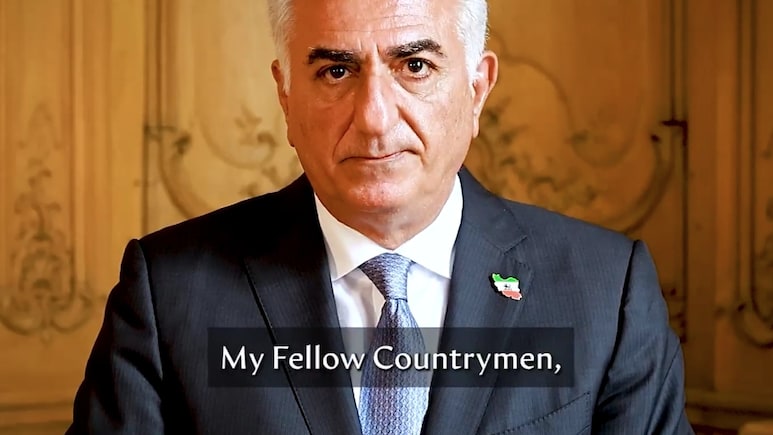
Iran's exiled crown prince, Reza Pahlavi, who is aiming for a potential return to his erstwhile kingdom amid anti-government unrest, said a "democratic Iranian state" under him would seek close and cooperative relations with India, citing long-standing cultural, civilisational, and historical ties between the two countries.
Speaking at a crowded news conference in Washington, Pahlavi recalled that relations between India and Iran "go a long time" and said the connection extended well beyond modern diplomacy. "Culturally, it was many, many years," he said, adding that Iran and India had enjoyed good relations in modern history as well.
He said a democratic Iran would be committed to building partnerships based on shared values. "It's natural, as I said, that a democratic Iran is committed to having the best possible relationship in the context of sovereignty and liberty to have the best possible relationship with any country that adheres to the same values and can work with us and can partner with us in many different domains," he said.
He argued that global challenges required deeper international collaboration and said India would be an important partner in addressing them. "We have so many challenges to face on our planet. We have issues of energy, and we have issues of population. We have issues of energy shortages. We have a water crisis," he said.
Pahlavi also highlighted India's technological strengths and said, "India is one of the leading countries when it comes to technology, when it comes to expertise. I think these are the kind of things that will help us in every area that we need to focus on."
He said cooperation could extend to new and renewable energy and other emerging sectors, adding that he looked forward to closer engagement between experts, entrepreneurs and business communities in both countries. "I'm looking forward to having our experts, our entrepreneurs, our business sector, and anybody else working very closely with our Indian counterpart," he said.
What Pahlavi's Potential Return To Iran Means For India
Pahlavi's potential return to Iran presents mixed implications for India, bringing both opportunities for closer technological and economic ties along with risks from a US-aligned, Pakistan-leaning Iran, potentially affecting India's access to Chabahar Port.
Pro-Pak Iran: Historically, Iran's royal family under Reza Pahlavi's father, Shah Mohammad Reza Pahlavi, the last king of Iran from 1941 to 1979, maintained strong military, economic, and diplomatic ties with Pakistan, viewing it as a vital buffer state for Iranian security and regional influence.
The Shah openly backed Pakistan in both the 1965 and 1971 Indo-Pakistani wars against India. Under the Shah, Iran strongly supported Pakistan's position on Kashmir, openly accusing India of being the aggressor on international platforms. This contrasted sharply with the post-1979 Islamic Republic's generally neutral stance on the issue.
Though Pahlavi promises democratic reforms and cooperation, his return could take Iran back to pro-Pakistan stances on Kashmir.
US-Aligned Iran: A restored Pahlavi regime would also likely align closely with the US, potentially bringing Iran back into American security and energy policies, which could impact India's strategic interests like Chabahar Port. For India, Chabahar is far more than a commercial venture. The port is central to New Delhi's connectivity strategy, offering access to the Indian Ocean and providing a crucial route to Afghanistan and Central Asia while bypassing Pakistan. It has also been a key hub for India's humanitarian assistance to the people of Afghanistan.
Unstable Iran: Moreover, a Pahlavi restoration will most probably happen with a Western-backed coup, which could trigger instability or a new axis (US-Iran-Pakistan) that challenges India's regional standing.
Tech/Economic Ties With Iran: Pahlavi, however, positions himself as a leader for a democratic transition, promising a new, more open relationship with India. He has expressed admiration for India's tech sector (IT, renewable energy) and envisions new chapters in cooperation, benefiting both nations.
Track Latest News Live on NDTV.com and get news updates from India and around the world


