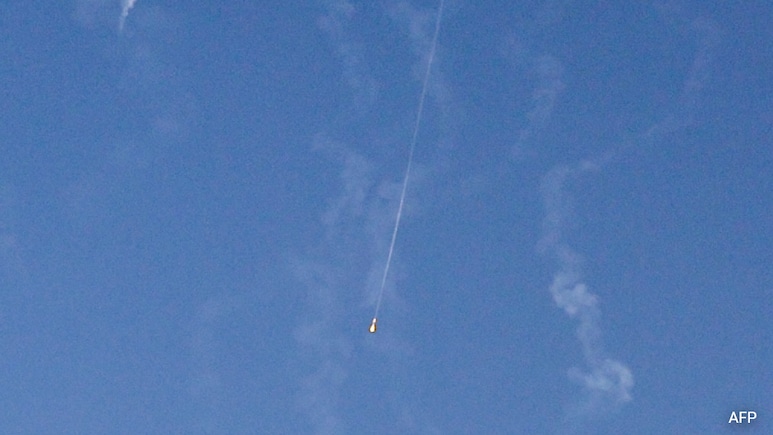
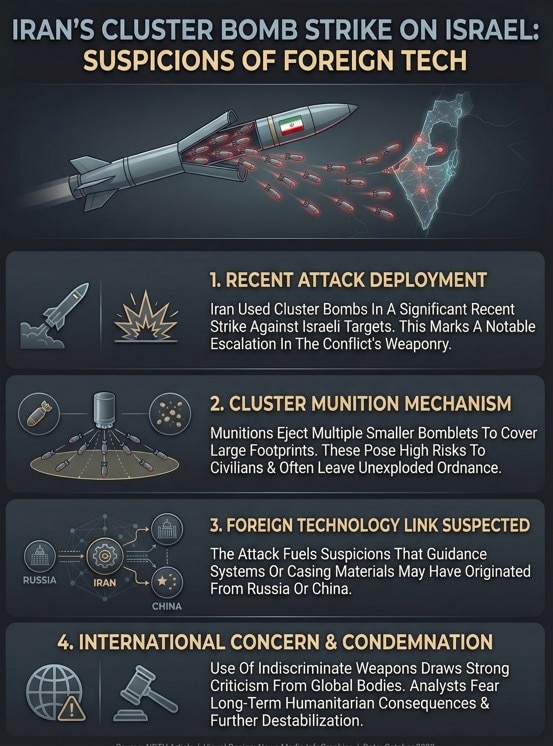
- Iran fired ballistic missiles with cluster munitions toward Israel, first use in current war
- Cluster warheads disperse multiple bomblets, increasing civilian risk and unexploded ordnance
- Missiles struck near Tel Aviv, injuring 12 and damaging homes without fatalities
Israeli military officials have claimed that Iran has fired ballistic missiles carrying cluster munitions toward Israeli territory, marking the first reported use of such weapons in the current war.
Cluster weapons are among the most controversial forms of modern bombs. Their defining characteristic is the ability to disperse dozens of smaller explosives over a wide area. Israeli defence officials say some Iranian cluster missile warheads can release up to 80 submunitions mid-air, spreading destructive fragments across several kilometres.
Military analysts warn that the introduction of these weapons changes the dynamics of the conflict. Instead of a single explosion at one point, a cluster warhead can scatter many smaller bombs across a large zone, increasing the risk to civilians and leaving behind unexploded ordnance that can remain lethal long after fighting ends.
At the centre of the debate now is not only the immediate military threat but also the question of how Iran developed this capability, especially in a country where scientists linked to advanced weapons programmes have frequently been targeted in assassinations. Israeli experts have suggested that external assistance may have played a role, raising speculation about possible transfers of military know-how from Russia or China.
Strike Near Tel Aviv
Israeli military officials claimed that at least one Iranian ballistic missile carrying cluster munitions struck central Israel during the latest round of attacks.
According to Israeli reports, the missile's warhead split open at an altitude of about four miles, or roughly seven kilometres, above the ground. It then released around 20 submunitions, dispersing them across a radius of about five miles, roughly eight kilometres, over central Israel.
One of the bomblets struck a home in the town of Azor, located south of Tel Aviv. The impact caused structural damage but did not result in casualties, as per reports.
The wider barrage caused injuries elsewhere. An Iranian ballistic missile carrying cluster munitions landed near Tel Aviv, injuring at least 12 people.
Since February 28, Iranian ballistic missile strikes have killed at least 11 people in Israel and injured more than 1,000 others to varying degrees, according to reporting cited by NBC News.
The Israeli military released a graphic warning the public about the dangers posed by unexploded submunitions.
Brigadier General Effie Defrin, a spokesperson for the Israeli military, told reporters that Iran had deployed weapons designed to maximise civilian harm.
"The terror regime seeks to harm civilians and even used weapons with wide dispersal in order to maximise the scope of the damage," he said.
A Shift In Pattern
Iran's missile campaign has continued throughout the week, although the intensity of launches has fluctuated. On March 3, Iran fired at least six missile barrages toward Israel. The same number of barrages were launched the day before.
That represents a significant drop from February 28, when Israeli officials recorded at least 20 missile barrages fired in a single day.
Despite the lower frequency, Israeli defence officials say the use of cluster warheads introduces a new operational challenge. These weapons disperse multiple explosives across urban areas, making interception more complicated and increasing the risk of secondary hazards on the ground.
Defence officials believe Iran has fired at least five cluster missiles at Israel since Saturday, all directed toward densely populated civilian areas.
Two such missiles were launched in a barrage toward central Israel on Tuesday. The attacks caused damage and injuries across several locations.
How Cluster Missile Warheads Work
A conventional ballistic missile typically carries a single large warhead weighing between 500 and 1,000 kilograms.
Cluster warheads function differently.
Instead of detonating in a single explosion, the missile opens mid-air and releases smaller bomblets. Each submunition usually carries an explosive charge of up to seven kilograms, roughly comparable to the power of the short-range rockets used by militant groups such as Hamas and Hezbollah.
While each individual explosion is smaller, the overall destructive footprint can be much larger because the bomblets scatter over a wide area.
Israeli defence officials say the warhead of the missile used in the recent attack split at approximately seven kilometres altitude and dispersed its submunitions across an eight-kilometre radius.
Military experts note that cluster weapons are particularly dangerous when intercepted mid-flight.
If a missile completes its trajectory, its bomblets typically detonate on impact with the ground. But if interception occurs mid-air, the submunitions may fall unpredictably, sometimes exploding upon impact and sometimes remaining unexploded.
These unexploded bomblets can later detonate if disturbed, posing long-term risks to civilians and rescue teams.
The most serious long-term danger associated with cluster weapons lies in unexploded submunitions.
A significant percentage of bomblets fail to detonate when they hit the ground. These unexploded explosives can remain active for years, functioning effectively as improvised landmines.
Previous Use Conflict
Israeli defence officials say Iran first deployed cluster missiles during the 12-day war between the two countries last June.
During that conflict, three cluster missiles were believed to have been launched at Israel, striking seven different cities. The current war therefore represents the second time such weapons have appeared in the confrontation.
Israeli military analysts believe Iran has developed at least three types of missiles capable of carrying cluster warheads.
These include the short-range Zolfaghar missile, the longer-range Qadr series, and the larger Khorramshahr ballistic missile.
The Khorramshahr is considered the most powerful of the three systems. Iran claims it has a range of roughly 2,000 kilometres and can carry up to 80 cluster bomblets.
Iran's Cluster Weapons Capability
Iran does not publicly discuss its production of cluster munitions. However, evidence suggests that the country manufactures such weapons for use with both ballistic missiles and rockets.
Iranian state-owned media has reported that the domestically produced Qadr S ballistic missile carries a cluster munition warhead and has a range of around 2,000 kilometres.
The number and weight of the submunitions carried by this missile have not been publicly disclosed.
Western media reports have suggested that Iran's Zolfaghar ballistic missile may also be capable of delivering cluster munitions.
In 2015, Iranian authorities displayed a variant of the Fateh missile carrying 30 submunitions, each weighing about 20 pounds.
Other Iranian missiles may also have been adapted for such payloads.
According to analysis cited by The New York Times, a Qiam series missile -- itself based on the Soviet-era Scud design -- or a larger Khorramshahr missile could have delivered the cluster munitions allegedly used in a June 19, 2025 attack on Israel.
Iran also produces several types of unguided rockets, including 122mm, 240mm and 333mm systems. It remains unclear whether these rockets can carry submunition payloads.
Imported Weapons And Stockpiles
Open-source intelligence from Jane's Information Group has listed Iran as possessing several foreign cluster systems, including KMGU dispensers designed to release submunitions, PROSAB-250 cluster bombs and BL755 cluster bombs manufactured in the United Kingdom.
Iran has never publicly disclosed the quantity or types of cluster munitions in its stockpile.
Cluster weapons have been subject to intense international debate.
In 2008, more than 100 countries signed the Convention on Cluster Munitions, an international treaty banning the use, production, transfer and stockpiling of such weapons.
A total of 111 countries and 12 additional entities have joined the treaty.
Neither Israel nor Iran signed the treaty.
The United States also declined to join the convention.
The issue returned to international attention in 2023, when Washington supplied cluster munitions to Ukraine for use against Russian forces.
Ukraine has said Russian troops also used cluster weapons during the war.
Track Latest News Live on NDTV.com and get news updates from India and around the world


