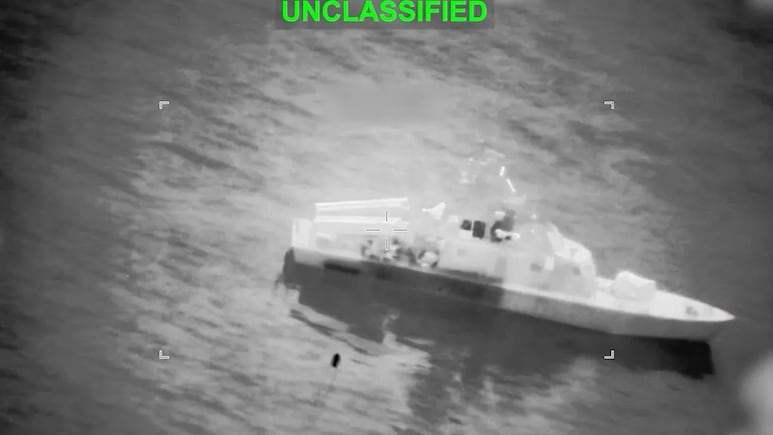
American forces sank 16 mine-layers Wednesday in an operation framed as a pre-emptive strike against Iran's plans to mine the Strait of Hormuz – the waterway over which Tehran exerts geographical control and which is at the centre of global concern over energy trade volatility and is being monitored by India over fuel and fertiliser supply disruptions.
Israeli military, meanwhile said that nearly half the 300 missiles Iran fired at it since the war began, including those launched today, carried cluster munition warheads, which scatters sub-munitions, or smaller bombs, over a wide area after impact.
Its use is banned by the Convention on Cluster Munitions but, conveniently, Israel, Iran and the US are not signatories.
On Tuesday US broadcaster CNN cited two unnamed intelligence sources as saying Iran had begun mining the Hormuz – a critical energy chokepoint because it carries a fifth of the world's crude oil and natural gas trade – with a view to underlining its control over the passage.
Another broadcaster, CBS, said Iran may use smaller ships – which can carry three mines each - to lay the underwater explosives in an effort to avoid detection by American/Israeli forces.
US CENTCOM posted an FPV, or first-person view, video on X this morning, likely from surveillance drones, highlighting the destruction of "multiple Iranian naval vessels".
U.S. forces eliminated multiple Iranian naval vessels, March 10, including 16 minelayers near the Strait of Hormuz. pic.twitter.com/371unKYiJs
— U.S. Central Command (@CENTCOM) March 10, 2026
In a separate post President Donald Trump said 10 "inactive mine-laying boats and/or ships" had been hit and vowed more would follow. Trump had warned Iran "not to put any mines".
Iran's elite Revolutionary Guard Corps had earlier declared the strait closed and said any vessels trying to pass through it would be "set ablaze", a warning that caused Brent crude prices to cross US$100 a barrel for the first time in nearly four years and trigger fuel scarcity concerns.
In addition to the US' claim of attacks on Iranian vessels, three ships were hit by projectiles of unknown origin. One of the strikes led to a fire – on Thailand-flagged bulk carrier Mayuree Naree, Reuters said – and forced most of the crew to evacuate. The fire has since been put out and no environmental damage has been reported.

No deaths were reported after a Thailand-flagged cargo ship was attacked near Iran
Simultaneously, US-Israel forces launched its 'most intense' air strikes yet; US Defence Secretary Pete Hegseth said operational goals, which include destroying Iran's missile stockpiles, launchers, and defence-related industries, as well as the navy, remain in focus.
"We will not relent until the enemy is totally and decisively defeated," he said, underlining this will be executed "on our timeline" and echoing Trump's declaration the time had passed for talks over Iran's nuclear programme and only "unconditional surrender" would end the war.
Data from the Washington-based Institute for the Study of War showed American-Israel forces struck at nine IRGC/Iran Navy bases along the Persian Gulf. Israel Defence Forces said its fighter jets had dropped over 170 bombs targeting IRGC facilities Tehran, Isfahan, and Shiraz City over the past 24 hours, including a missile production facility and several air defence systems.
Israel also struck locations, including a four-storey building with shops on the ground floor, in southern Lebanon causing large fires. Tel Aviv has insisted its strikes here target infrastructure operated by the Hezbollah, the militant group armed by Iran as part of the 'Axis of Resistance'.
The state-run National News Agency cited Health Ministry sources as saying seven died.
Iran responded with a volley of missiles of its own, its 35th such wave, indicating that despite a steady degradation of its offensive capabilities Tehran remains a significant military threat. ISW intel suggested strikes on over a dozen vessels in the Persian Gulf and the Gulf of Oman.
Qatar said it intercepted a missile attack from Iran after loud explosions were heard across capital Doha. Similar explosions were heard in UAE capital Dubai, Reuters reported.
The airport in Dubai – one of the busiest in the world – has been repeatedly affected by Iranian missile and drone strikes, causing severe flight delays and leaving thousand stranded.
Oman's state news agency said it had shot down two Iranian drones.
Meanwhile, Iran also threatened attacks on American and Israeli banks in the region; British broadcaster BBC cited an Iranian military command spokesperson as declaring "people in the region (no specific location was given) should not be within a one-km radius of banks".
This followed reports from Iran's state news agency, IRNA, that the central Tehran offices of the government-controlled Sepah Bank had been targeted.
Continuing conflict – with neither Washington, Tel Aviv nor Tehran setting any timeline – still spooks oil prices, though these have settled since the surge past US$100 per barrel last week.
Track Latest News Live on NDTV.com and get news updates from India and around the world


