After Oil, Gas, Iran's Hormuz Chokehold Raises Fertiliser Red Flag For India
The data suggests India faces a 20-25 per cent exposure to fertiliser supply chain disruptions due to the war and informal blockade on the Hormuz.
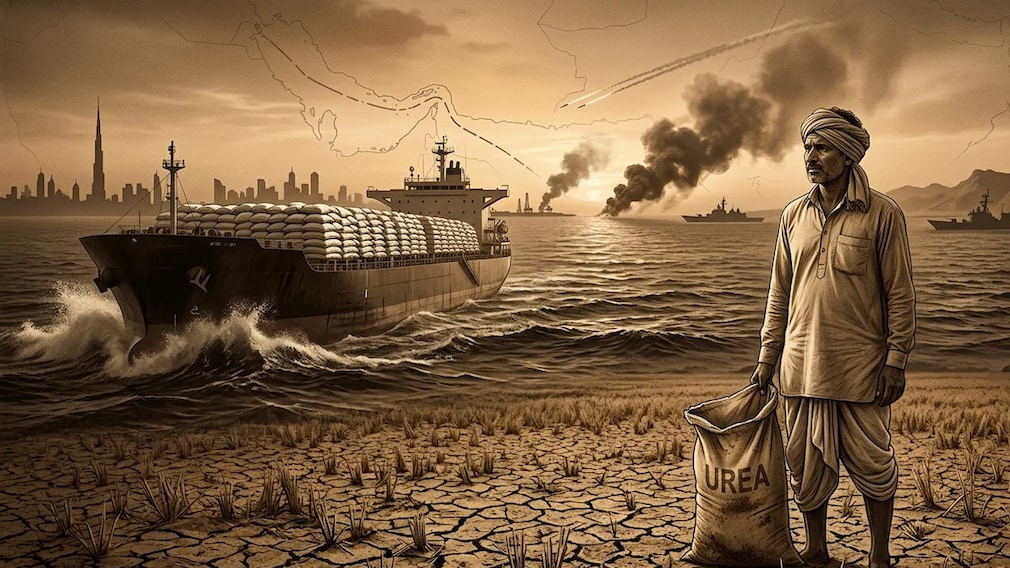
The 12-day (and counting) US-Israel war on Iran reframed battlefield tactics – courtesy a drone-led asymmetric assault by Tehran that has challenged traditional intercept equations.
But short- and long-term impacts on fertiliser supply chains are increasingly critical – and which has flown under the radar so far – particularly since Middle East and Ukraine conflict zones reveal similar vulnerabilities to India's ability to feed an est. 147 crore population. It also impacts jobs and livelihoods in an economy heavily reliant on agriculture.
The energy supply question – crude oil supply unpredictability due to US-Israeli and Iranian strikes on refineries and depots in the Middle East, and shipping constraints as a result of Tehran's unofficial blockade on the Strait of Hormuz – has been well documented so far.
So too has supply volatility impact on India, leading from fears of rationing of petrol and diesel to shortage of LPG cylinders used by over 33 crore households and lakhs of eateries.
Potential dips in crude oil supply via Hormuz are expected to be offset by increased purchases from Russia, and the government has insisted sufficient strategic reserves exist in the interim. The Petroleum Ministry has also directed increased production of LPG cylinders.
But oil and gas are only part of India's exposure in this war.
The fertiliser focus
The data suggests India faces a 20 – 25 per cent exposure to fertiliser supply chain disruptions due to the war and informal blockade on the Hormuz.
This is because, like oil, shipments from the Gulf – from the UAE, Qatar, Saudi Arabia, and Oman – are shipped via the strait.
Given the agriculture sector's importance, this is a not insignificant chink in the armour.
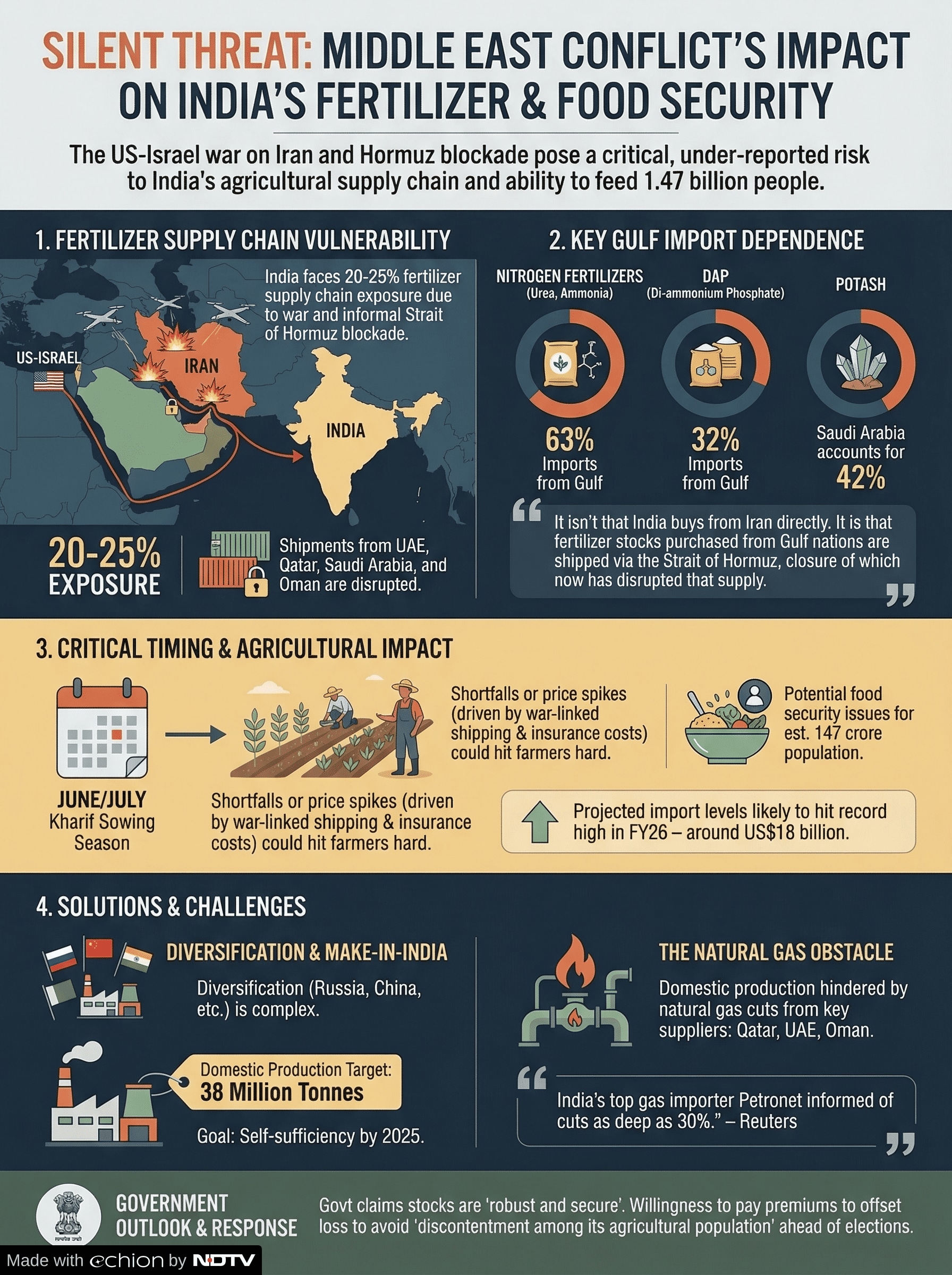
India's potential fertiliser supply chain issues due to the war in Iran.
An estimated 63 per cent of India's nitrogen fertiliser imports, which includes urea and ammonia, and 32 per cent of DAP, or di-ammonium phosphate, comes from these nations.
And Saudia Arabia accounts for an estimated 42 per cent of India's potash imports.
Iran's direct share in this is low; in 2024, for example, India bought urea worth US$231 million from the UAE, Saudi Arabia, and Qatar. Iran supplies were worth only US$2.59 million.
It isn't that India buys from Iran directly. It is that fertiliser stocks purchased from Gulf nations are shipped via the Strait of Hormuz, closure of which now has disrupted that supply.
And though these figures show some volatility – a 21 per cent overall urea import drop in 2023 – the general trend is upward, underlining a potentially significant impact of the war.
Projected import levels are likely to hit a record high in FY26 – around US$18 billion – with urea leading that charge at around 61 per cent because the price is government-controlled.
This is partly due to the two-crop calendar, i.e., the Kharif and Rabi seasons, and with sowing of crops due in June/July for the first, shortfalls or price spikes – driven by war-linked shipping costs, including insurance – could hit farmers hard and lead to food security issues.
The solution?
Diversification is critical but the options are, perhaps, limited.
A pivot back to Ukraine is possible but urea imports were negligible even pre-war.
More practical options are Russia and China, though Delhi's move towards the Gulf nations for urea was to reduce dependence on Beijing. Both will bypass the Hormuz conundrum.
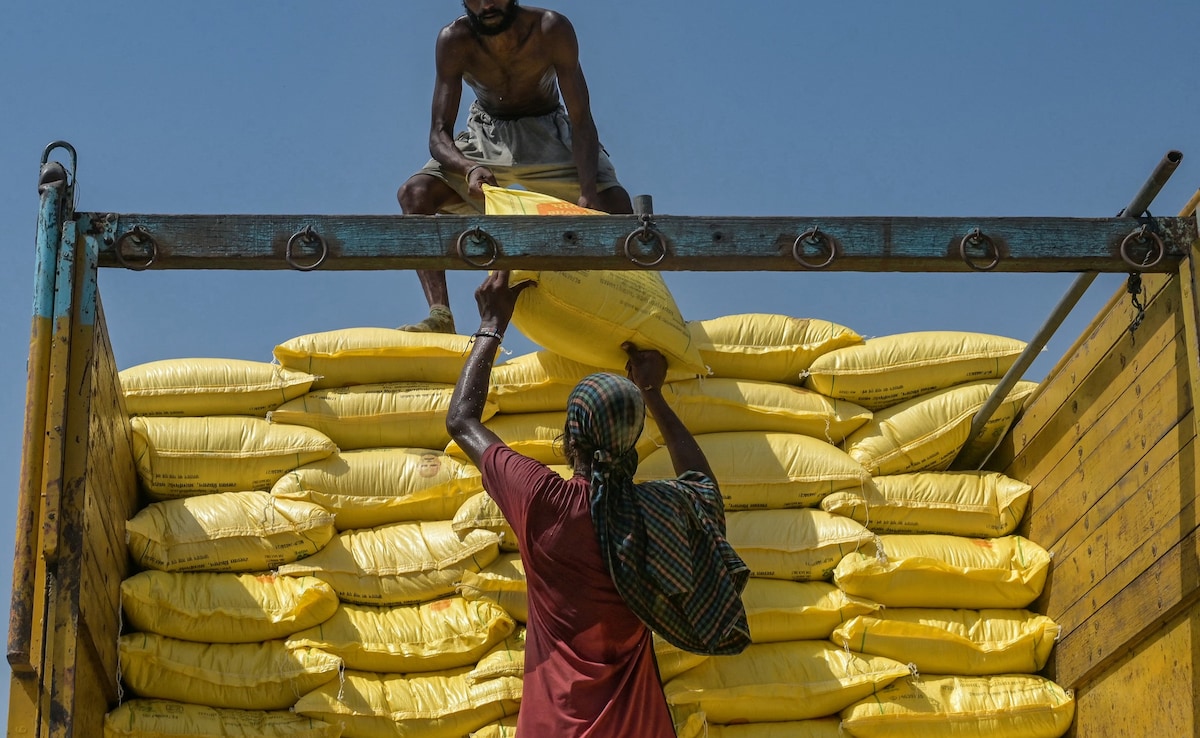
Urea producers trim output as Iran war disrupts LNG flows. Photo: Bloomberg.
India also imports from Nigeria, Uzbekistan, and Indonesia, but these are negligible sellers, each holding a less than five per cent share of the country's urea purchases.
Make-in-India?
Increasing domestic production is a viable alternative, particularly for the long term and as guaranteed risk reduction in times of conflict abroad, a scenario that now seems more plausible than ever. India had set itself a self-sufficiency target of an est. 38 million tonnes.
In fact, urea imports were to have been rolled back by 2025.
However, this presents a different challenge – natural gas – a key ingredient in the manufacture of urea and, unfortunately, India's core suppliers are Qatar, the UAE, and Oman, and all three have reduced supplies in the wake of the war in Iran.
Last week Reuters cited unnamed industry sources as saying India's top gas importer Petronet had informed state-owned marketing companies about cuts as deep as 30 per cent.
The outlook…
… is not all doom and gloom.
The government has said fertiliser stocks are "robust and secure".
On March 6 the Department of Fertilisers said availability of urea and other fertilisers and natural gas would not be affected by the loss of imports from the Middle East. Analysts cited by S&P Global suggested the government would be willing to pay a premium to offset that loss rather than "risk discontentment among its agricultural population" before elections in April/May.
-
Opinion | Bankipur, And Why The Most Dangerous Voter Is The One Who Thinks Again

Bankipur is like the NOIDA of Uttar Pradesh. Its voter list isn't like the rest of Bihar. Which is why one must be careful in declaring Kishor's win a phenomenon - yet. But then, there's the power of the voter...
-
Russia's 'Human Safaris' Are Bringing Terror To Ukraine's Frontline Cities
Kherson is among the first places where Russian forces began using short-range FPV drones against civilians. Equipped with live-streaming cameras, the aircraft allow operators to observe targets in real time and make decisions moments before impact.
-
Opinion | Prashant Kishor May Just Be Playing Two Games At Once In Bihar
The Jan Suraaj is neither a 'BJP-lite' option for disaffected upper-caste voters, nor is it an RJD alternative for Muslims. It is, in fact, both things at once, in the same seat, in the same election.
-
Opinion | Inside The Cabinet Drama That Has Shaken The Congress In Karnataka
Siddaramaiah's decision to 'boycott' the swearing-in ceremony because of a perceived 'insult' is a story in itself.
-
Opinion | The Panic In Rawalpindi: Why Pakistani Generals Suddenly Sound So Afraid
Lectures on governance and usual accusations against India aside, the truth is that Pakistani generals are fast losing their grip on the country.
-
Opinion | Bankipur Is Prashant Kishor's Stinging Comeback. But It Is Also The End Of His 'Excuse'
Kishor's ideological flexibility helped make him a successful strategist, but it remains a political vulnerability.
-
As AI Takes Jobs, Could It Also Create A New Generation Of Entrepreneurs?
The job market has already begun feeling the impact of AI as companies automate more tasks and rethink hiring. However, India Inc and global industry captains believe the AI disruption could mean spawning a new wave of entrepreneurs.
-
Ahmedabad 2030 Isn't Just About Commonwealth Games, It's India's Olympic Audition
Ahmedabad will host the 2030 Commonwealth Games, exactly a century after the event first began in Hamilton, Canada. India hosted once before, in Delhi in 2010
-
Opinion | Kangana Ranaut Is Fast Running Out Of Enemies To Pick On
Kangana spent years cultivating the image of the 'lupa', the lone she-wolf who survived without a pack. But rebellion, once rewarded, can quickly become an addiction.
-
Opinion | 17 Dead, 166 Trapped: How Indian Seafarers Became 'Collateral' In Others' Wars
India is now the second-largest supplier of seafarers in the world, contributing 311,936 personnel. But that also means that they are among the easiest targets during war.