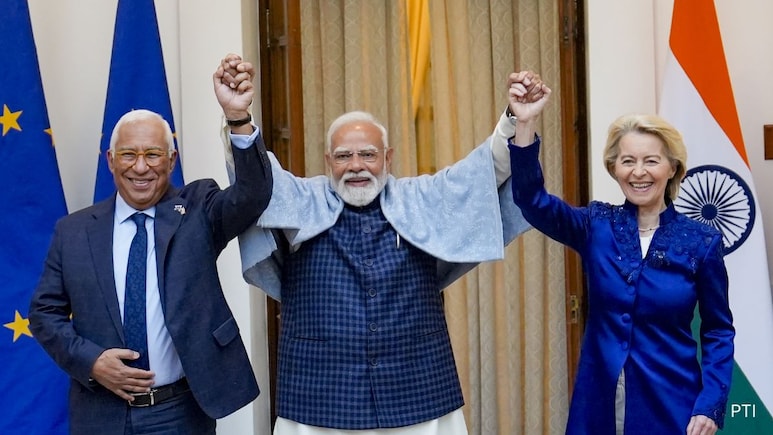
In a moment heavy with symbolism and strategic consequence, India and the European Union sealed a long-awaited Free Trade Agreement (FTA) as the EU Commission President and the President of the European Council joined Prime Minister Narendra Modi at the India-EU Summit, fresh from their role as Chief Guests at India's Republic Day celebrations. The confluence of diplomacy, pageantry and commerce has turned New Delhi into the stage for what is pegged to become one of the most consequential trade deals of this decade.
The agreement caps more than two decades of painstaking negotiations and partnership-building between two of the world's largest democratic markets. India and the EU have been strategic partners since 2004, a relationship rooted in shared democratic values, multilateralism and a commitment to a rules-based international order. Their ties, however, stretch back even further-to 1962-when India became one of the first countries to establish diplomatic relations with the European Economic Community, the EU's precursor.
The timing of the deal could hardly be more dramatic. The global economy is navigating renewed turbulence: US President Donald Trump's return to aggressive tariff postures has unsettled markets, supply chains remain fragile, and the Russia-Ukraine war shows no sign of resolution. Against this backdrop, an India-EU FTA sends a strong signal in favour of open, predictable and diversified trade at a moment when economic nationalism is again on the rise.
A Partnership Ready To Take Off
Economically, the two sides are already deeply intertwined. The EU is India's largest trading partner in goods, with bilateral trade touching about USD 136 billion in 2024-25, and a steadily growing services trade as well. Over the past decade, European companies have expanded their footprint in India's manufacturing, clean energy and digital sectors, while Indian firms-- from IT services to pharmaceuticals-- have deepened their presence across Europe.
Yet, despite this scale, both sides have long argued that trade remains "below potential." Negotiations for a comprehensive FTA, an investment protection agreement and a pact on geographical indications were formally resumed in 2021, with leaders setting an ambitious goal to conclude them by the end of 2025. Continuous ministerial engagements through 2025 and early 2026 bridged remaining gaps, and the pact was crystallised.
Diplomats describe the deal as "balanced and forward-looking", one that would lower tariffs, ease regulatory barriers, open services markets and strengthen supply chain resilience. For India, it promises greater access to a 450-million-strong consumer market. For Europe, it offers a deeper anchor in one of the world's fastest-growing major economies.
More Than Just Trade
The FTA is also the economic pillar of a much broader strategic convergence. Over the past few years, India and the EU have woven together cooperation across defence and maritime security, clean energy and climate action, digital technologies, space, and connectivity. The establishment of the India-EU Trade and Technology Council in 2022, only the EU's second such council after the one with the US, was a recognition that trade, technology and security are now inseparable.
Security cooperation has accelerated too, with joint naval exercises in the Indian Ocean and growing dialogue on defence industrial collaboration. On climate and energy, Europe has become a key partner in India's transition to renewables, green hydrogen and sustainable urban mobility.
Connectivity is another strategic thread. The India-EU Connectivity Partnership and the ambitious India-Middle East-Europe Economic Corridor (IMEC) reflect a shared interest in building transparent, sustainable infrastructure networks across continents. An FTA would give these strategic initiatives a powerful economic backbone.
The Symbolism Of Republic Day
That the EU's top leadership chose to attend India's Republic Day as chief guests has not gone unnoticed in diplomatic circles. Recently, the entire EU College of Commissioners visited India as a group for the first time, underlining the bloc's growing focus on New Delhi as a strategic partner beyond the confines of trade. The Republic Day invitation, officials say, was meant to signal that Europe sees India not merely as a market but as a central pillar in its Indo-Pacific and global strategy.
At the summit table, leaders framed the FTA as a "future-oriented" agreement – one that supports resilient supply chains, trusted technologies and sustainable growth. The deal is also positioned as a counterweight to the uncertainties unleashed by tariff wars and geopolitical fragmentation.
Challenges Remain, But Momentum Is Real
Negotiations have not been easy. Differences over market access in sensitive sectors, environmental and labour standards, data flows and public procurement have, in the past, slowed progress. But officials on both sides say the geopolitical and economic context has changed the calculus. The need to de-risk supply chains away from over-dependence on any single geography and to uphold a rules-based trading system has injected fresh urgency into the talks.
The FTA announced today marked not just the conclusion of a long negotiation but the opening of a new chapter in India-EU relations, one that ties together economics, strategy and shared values more tightly than ever before.
In a world increasingly defined by uncertainty, the handshake in New Delhi is expected to resonate far beyond Raisina Hill: as a statement that two major democratic powers are choosing cooperation over confrontation and integration over isolation.
Track Latest News Live on NDTV.com and get news updates from India and around the world


