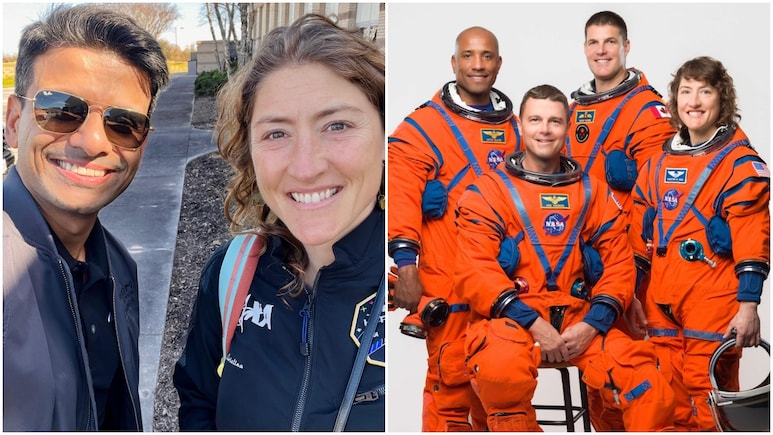
As NASA prepares for the Artemis 2 mission, which will take humans back toward the Moon after a gap of more than five decades, one Indian voice carries a rare and unique perspective. Group Captain Shubhanshu Shukla is the only Indian astronaut who has flown on a NASA-linked mission and trained within the American astronaut ecosystem, interacting closely with members of the Artemis 2 crew.
In an exclusive conversation with NDTV, Shukla spoke about what sets astronauts apart, his memorable "fanboy" moment with Christina Koch, who is set to create history by becoming the first woman to travel towards the moon, and the message he carries for the four astronauts as they embark on a mission watched by the entire planet.
The Artemis-II mission will be flown by a four-member crew drawn from two spacefaring nations. The commander of the mission is Reid Wiseman, a NASA astronaut from the United States. He is joined by Victor Glover, also a NASA astronaut, who will serve as pilot. The mission specialists include Christina Koch, a NASA astronaut who is set to become the first woman to travel beyond the Moon, and Jeremy Hansen of the Canadian Space Agency, the first Canadian to journey into deep lunar space. Together, the three Americans and one Canadian will become the first humans in more than half a century to leave low-Earth orbit and head toward the Moon, marking a defining moment for global human space exploration.
Shukla's own journey to space came as part of the Axiom 4 mission, a commercial human spaceflight mission conducted in collaboration with NASA in 2025. The mission placed him in low Earth orbit and made him the only Indian to have flown to space in a NASA-facilitated framework.
Today, as an ISRO Gaganyatri and a serving Indian Air Force officer, Shukla occupies a unique position, bridging India's emerging human spaceflight programme and the mature astronaut culture of the United States. He has also interacted with astronaut Victor Glover.
During his year-long training stint in Houston, Shukla trained alongside NASA astronauts who were themselves preparing for future missions, including Artemis. He says such environments are intense, technical, and demanding, leaving little room for grand reflections while the work is ongoing. "You are busy training all the time," he told NDTV. "You don't sit down and think about how monumental something is. You are focused on systems, procedures, and what comes next."
It was in this training environment that Shukla encountered astronauts who are now part of the Artemis 2 mission. While he stresses that astronauts rarely think of themselves as historical figures in the making, what struck him was how ordinary they seem on the surface, despite carrying extraordinary responsibilities. "You don't get a sense of who they are when you speak to them," Shukla said. "They are as human as you and me. They laugh at the same things. They worry about the same things."
Yet, beneath that normalcy lies something deeper. "There is something very strong inside them," he added. "A real sense of purpose and a courage that is very difficult to match. That is what makes astronauts capable of doing what they do."
Among the Artemis 2 crew, one astronaut stood out for Shukla on a personal level, Christina. She is set to become the first woman astronaut to travel beyond the Moon, a milestone that will place her permanently in the history of human space exploration. Shukla does not hesitate to describe her as a legend. "She is already a legend," he said, adding that what she is about to do will elevate her even further.
Meeting Christina, however, was not a staged or ceremonial interaction. It happened in the most ordinary of places, the astronaut gym. "I was heading to the gym and she was also going inside," Shukla recalled. "I just happened to meet her outside. "What followed," he admits with a smile, "was a rare emotional moment for a professional test pilot and astronaut. "It was a fan boy moment for me," he said.
Shukla took the liberty of asking for a selfie, something he says he rarely does. "I asked her if she would mind if I took a selfie with you," he recounted. "She was very kind and said yes. "The photograph has since become a cherished personal memory, capturing a moment when one astronaut, despite his own achievements, felt awe for another who is about to push human boundaries even further.
Why does Shukla call Christina a legend? For him, it is not just about records or firsts. It is about what such missions represent. Artemis 2 will carry humans nearly 384,000 kilometres away from Earth, far beyond Low Earth Orbit. "Going to low Earth orbit itself is very difficult," Shukla explained. "You cannot come back whenever you feel like. And now imagine going almost four hundred thousand kilometers away. They will be on their own."
That distance, he believes, changes everything. Astronauts cease to represent individual nations and instead become ambassadors of Earth itself. "Once you leave the planet, there are no boundaries," Shukla said. "You don't represent a country. You represent humanity."
This is why, despite being trained soldiers, engineers and scientists, astronauts deliberately avoid dwelling on the historical weight of their missions while training. "If you start thinking about how big this is, the pressure would be too crushing," Shukla said. He related this mindset to his own experience. "If someone had asked me what it means that an Indian is going to space after decades, I would not have had an answer, because I was not thinking that way."
Instead, training conversations remain technical and procedural. Shukla recalled discussing systems and mission development with Christina, speaking as pilots and professionals, not as history makers. "That is how astronauts think," he said. "You focus on what you have to do now and what comes next."
Yet, once the mission begins, the wider meaning becomes unavoidable. As Artemis 2 prepares for launch, Shukla says the world is already watching. "People sitting in different countries, in different parts of the world, they are talking about Artemis," he said. "They are talking about these four people."
His message to the Artemis 2 crew reflects that global attention and shared hope. "They are four individuals undertaking the journey," Shukla said, "but in a sense, they are carrying the entire planet with them." He believes that every human being is emotionally invested in their success. "The entire planet is with them in prayers and wishes," he told NDTV.
For Shukla, the pride is collective. "Each and every person on this planet is already proud of them," he said. "And will be even more so when they come back successfully."
As India advances steadily toward its own human spaceflight ambitions under the Gaganyaan programme, Shukla's experience offers a glimpse of what lies ahead, not just technologically, but emotionally and philosophically.
Astronauts, Shukla insists, are not superheroes. They are ordinary people with extraordinary will power, trained to remain calm under pressure and focused on the task at hand. And sometimes, even astronauts have fanboy moments.
Track Latest News Live on NDTV.com and get news updates from India and around the world


