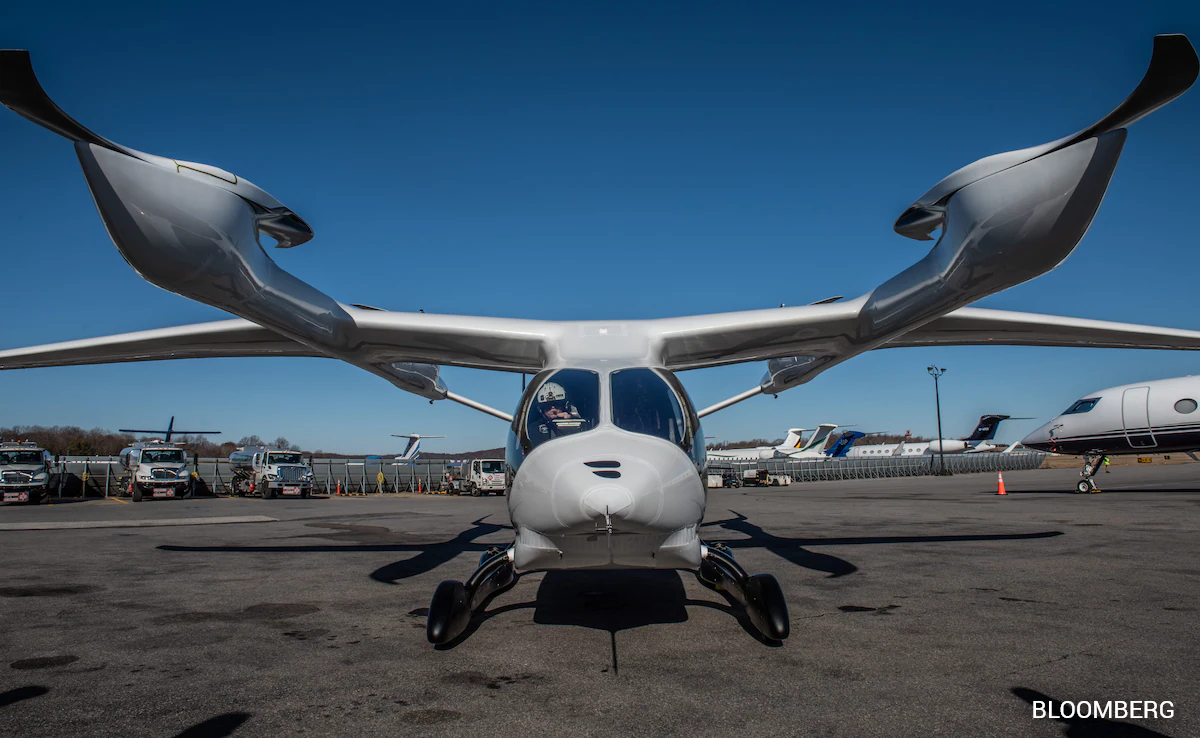
Electrically powered air taxis will start taking to the skies in some states and cities across the US, including in New York, after the government approved several pilot projects under a program meant to accelerate their integration into the US airspace.
The US Transportation Department said Monday that it selected eight proposals under the so-called advanced air mobility and electric vertical takeoff and landing integration pilot program, which was first outlined in an executive order released by President Donald Trump last year. The government received more than 30 proposals, it said.
The selected projects will span more than two dozen states, the department said in a statement shared with Bloomberg. They include a partnership between the Port Authority of New York and New Jersey and companies Joby Aviation Inc., Archer Aviation Inc., BETA Technologies Inc., and Electra.aero Inc. That project will explore several different operational concepts, including air taxi passenger operations at the Manhattan heliport.
"This is the clearest sign yet from the White House, the FAA and the DOT that bringing air taxis to market in the United States is a real priority," Adam Goldstein, Archer's founder and chief executive officer, said in an emailed statement.
Joby shares rose as much as 8.4% in US postmarket trading while Archer gained 2.2%.
Proposals from the Texas Department of Transportation, the Pennsylvania Department of Transportation and the North Carolina Department of Transportation were also among those chosen.
Startups including Joby and Archer have been working with regulators to get the required approvals to start commercial operations. The pilot program allows them, and other makers of next-generation aircraft, to partner with state and local governments to try out their concepts in real-world settings prior to Federal Aviation Administration certification.
The government has said it'll take lessons learned from these trial runs to better inform its regulation of the emerging industry.
"These partnerships will help us better understand how to safely and efficiently integrate these aircraft into the National Airspace System," FAA Deputy Administrator Chris Rocheleau said in a statement.
The pilot program, which will run for three years, will help operators prove the viability of their products, allow cities to begin developing the infrastructure to support the new aircraft and create familiarity among the public. Some cargo flights will even be able to generate revenue under certain circumstances, the FAA said in a question-and-answer document posted to sam.gov about the program.
BETA Technologies is participating in seven of the eight pilot projects, with an emphasis on critical cargo and medical operations. "This program will allow us to begin those missions, bringing connectivity and access to communities across the US," Kyle Clark, BETA's founder and CEO, said in a statement.
Electra's CEO Marc Allen said companies have been asked to be ready to go within 90 days to get the most out of the three-year program. His company manufactures a hybrid-electric aircraft designed to take off and land in spaces as short as 150 feet.
"This is a big deal," Allen said of Monday's announcement. "We're all trying to go fast and this is going to enable that."
(Except for the headline, this story has not been edited by NDTV staff and is published from a syndicated feed.)
Track Latest News Live on NDTV.com and get news updates from India and around the world


