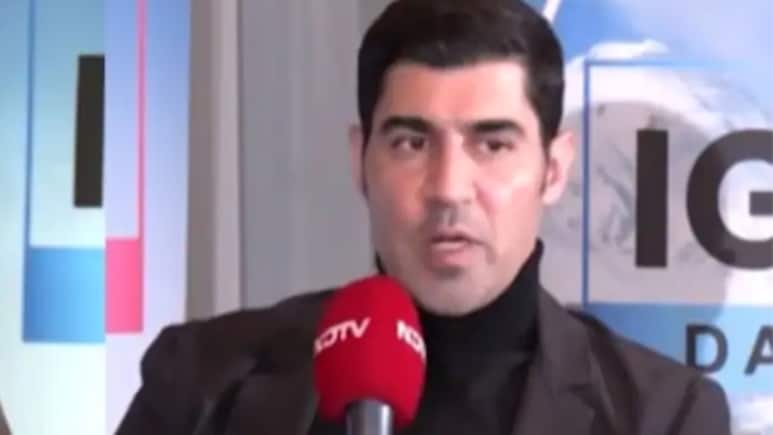
US President Donald Trump dominates headlines, but the bigger picture lies in long-term geopolitical trends shaping the world today, AlphaGeo founder and CEO Parag Khanna has said.
"Donald Trump isn't geopolitics himself," Khanna told NDTV Editor-in-Chief Rahul Kanwal in Davos. "Geopolitics as a discipline helps us distinguish between the day-to-day news, which can be confused by events, due to underlying geopolitical trends."
He points to growing tensions between the US and Europe. "Europe has been seeking more independence for years," he said. "Even 20 years ago, it was clear that the US would focus on North America while Europe aimed for strategic autonomy."
"It's a 19th-century idea, actually, in geopolitical theory, that it would want to also control the hemisphere, even Venezuela and so on. Without making specific predictions, you knew that that's the geopolitical trend," Khanna added.
He said that from a geopolitical lens, you could foresee the United States gravitating toward continental dominance, "what we call continentalism, and Europe moving toward independence in its own strategic decisions."
Khanna said these trends extend beyond US-Europe relations. "You knew it was happening from a geopolitical lens and the rise of China and the rise of India and so forth," he added, mentioning that the shale gas revolution in North America and shifts in industrial policy are all part of larger and predictable patterns.
He described today's world as a "continental drift" where major powers, including the United States, European nations, India, China, Russia, Japan, and Australia, are rethinking globalisation. "Everyone is doing industrial policies and protectionism and increasing their military spending and being more cautious about globalisation, and so forth, we are going to do it, too," he said.
Talking about the next five years, he said they will look very different from today. "Industrial policies are going to be very prominent," he said, adding that countries will focus on protecting their industries and building more strategic capacity by moving away from just-in-time supply chains.
Khanna also highlighted that even though the headlines focus on Trump insulting Canada or Mexico, the numbers show growing cohesion and integration across North American supply chains, regardless of who is in power.
Looking at the world beyond North America, Khanna said countries are practicing "multi-alignment."
"Nations are hedging their bets. They are engaging with multiple powers, China, the US, and Europe, while also focusing on domestic strategic autonomy," he said.
Even if China seems more predictable than the US at times, Khanna pointed out that the volume of trade with the US remains far higher. "Countries are learning from each other, copying strategies, and preparing for the long term," he explained.
"What every country is doing is practicing multi-alignment. You sit out of Singapore, which gives you this unique lens of having an insight into what's happening in China, and you're tracking what's happening in the Western world as well," he added.
Track Latest News Live on NDTV.com and get news updates from India and around the world


