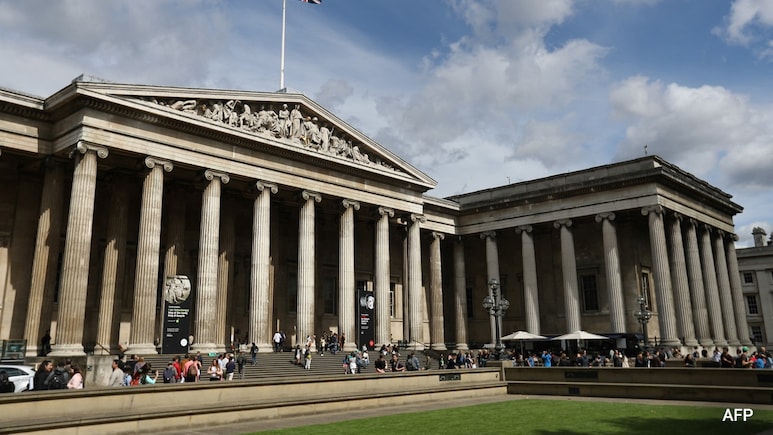
The British Museum in London has removed the word 'Palestine' from some of the displays, stating that the term was used inaccurately and is no longer historically neutral. The move comes after UK Lawyers for Israel (UKLFI) wrote to the Director of the British Museum, Nicholas Cullinan, raising concerns "regarding the anachronistic use of the term Palestine", which risked obscuring the "history of Israel and Jewish people".
"Applying a single name, Palestine, retrospectively to the entire region, across thousands of years, erases historical changes and creates a false impression of continuity," the letter stated, as per a report in The Guardian.
"It also has the compounding effect of erasing the kingdoms of Israel and of Judea, which emerged from around 1,000BC, and of reframing the origins of the Israelites and Jewish people as erroneously stemming from Palestine."
The museum explained that 'Palestine' no longer holds a neutral designation and may be understood in reference to political territory.
"For the Middle East galleries for maps showing ancient cultural regions, the term 'Canaan' is relevant for the southern Levant in the later second millennium (BCE)," a museum spokesperson said.
"We use the UN terminology on maps that show modern boundaries, for example, Gaza, West Bank, Israel, Jordan, and refer to 'Palestinian' as a cultural or ethnographic identifier where appropriate."
UKLFI reports that the British Museum has updated its 2,000-300 BC Levant gallery displays to emphasise the history of Canaan, the Canaanites, and the rise of the kingdoms of Judah and Israel.
Also Read | Meet Param, 'Powerful' Made-In-India Robodog Developed By Bengaluru Startup
Reverse The Decision
Since the changes were made, an online petition urging the museum to reverse the decision has been launched. As of the last update, the petition had received over 19,000 signatures, with critics arguing that the selective removal highlighted inconsistency in curatorial standards and raised concerns about political pressure influencing historical presentation.
"If the British Museum is genuinely concerned about modern etymology, then consistency would require similar scrutiny of terms such as "Britain", which is itself a relatively modern political construct. Yet "Britain" remains unchallenged in the museum's own galleries," the petition highlighted.
Despite the backlash, the museum is expected to make further changes as part of the museum's long-term reconstruction and redisplay programme.
Track Latest News Live on NDTV.com and get news updates from India and around the world


