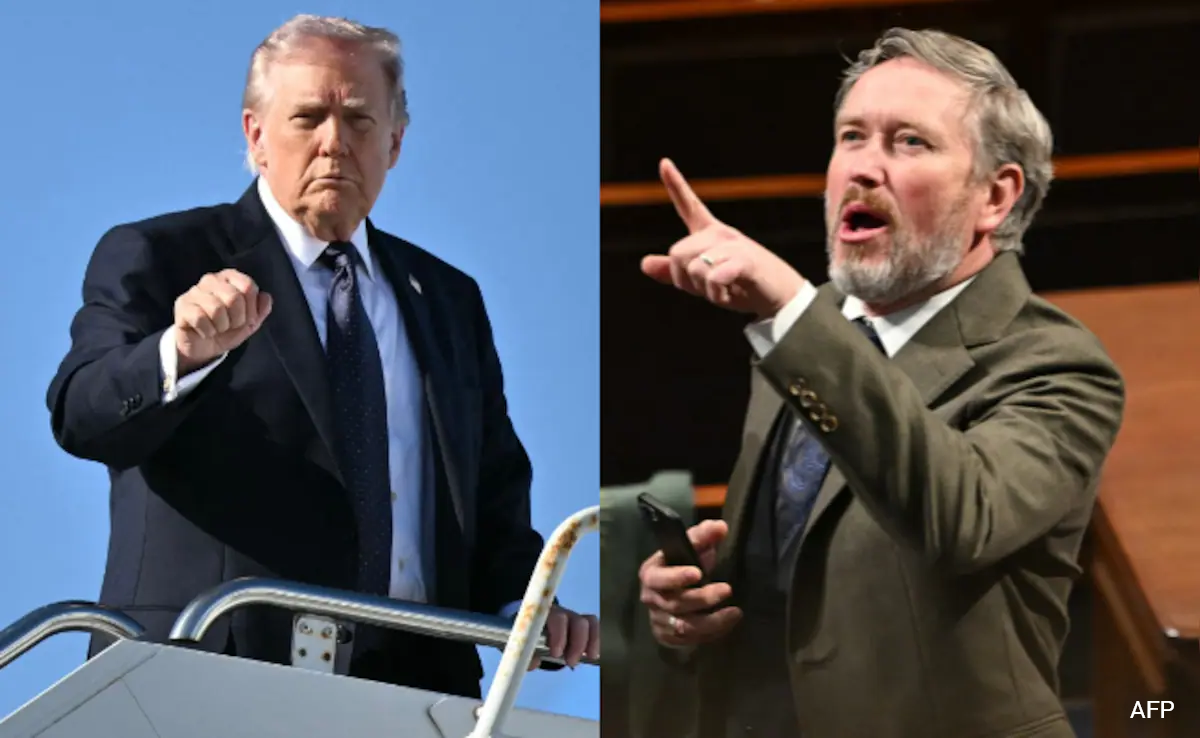
US President Donald Trump bombed Iran to deflect attention from renewed scrutiny over the convicted sex offender Jeffrey Epstein, Thomas Massie has said. The Republican Representative on Sunday said that escalating war overseas would not derail his push to force the full release of Justice Department records tied to Epstein's criminal network.
“PSA: Bombing a country on the other side of the globe won't make the Epstein files go away, any more than the Dow going above 50,000 will,” Massie wrote on X.
-

-
 World-Class Chefs, Food And Music: The Fun Side Of NDTV World Summit 2026
-
 AI, Consciousness And Dharma: Why Ancient Indian Wisdom Matters Now
-
 NDTV World Summit: What To Expect From PM Modi's Keynote Address
-
 NDTV World Summit 2026: What To Watch Out For | PM Modi, Jaishankar, AI And Global Power Shifts
-
 A World Between Orders: What To Expect At NDTV World Summit 2026
-
 Who Is Rajiv Mehta? Lilavati Hospital Trustee To Speak At NDTV World Summit 2026
-
 Alain Ebobisse, Africa50 CEO, To Attend NDTV World Summit 2026. All About Him
-
 Kriti Sanon At NDTV World Summit: A Look At Her Career And Business Ventures
-
 Ex-CIA Director To Decode 'War In Times Of AI' At NDTV World Summit
-
 Who Is Vikram Rai, CEO, South Asia GE Aerospace, Set To Attend The NDTV World Summit 2026
PSA: Bombing a country on the other side of the globe won't make the Epstein files go away, any more than the Dow going above 50,000 will.
— Thomas Massie (@RepThomasMassie) March 1, 2026
Massie is among several critics saying the administration has repeatedly turned to high-profile foreign policy actions amid politically sensitive developments related to Epstein, who died in federal custody in 2019 while awaiting trial on sex trafficking charges.
Over 3 million documents have been released so far, while about 3 million more are still being withheld due to legal, privacy, and national security concerns. The files also name the US President and his wife, Melania, multiple times.
Earlier this year, Massie and Democratic Representative Ro Khanna led efforts to pass the Epstein Files Transparency Act, a bipartisan law requiring the Department of Justice to release all documents related to Epstein. Trump signed the bill into law, even though he had publicly criticised it.
Critics have also cited the administration's January abduction of sitting Venezuelan President Nicolas Maduro, saying it may have been used to shift attention away from scrutiny over Trump's past ties to Epstein, who once called himself Trump's “closest friend.”
Following Saturday's strikes, Massie renewed his objections, labelling the attacks “acts of war unauthorised by Congress.”
In a separate post, he wrote, “I am opposed to this war. This is not ‘America First.'”
I am opposed to this War.
— Thomas Massie (@RepThomasMassie) February 28, 2026
This is not “America First.”
When Congress reconvenes, I will work with @RepRoKhanna to force a Congressional vote on war with Iran.
The Constitution requires a vote, and your Representative needs to be on record as opposing or supporting this war.
Trump has lashed out at Massie, calling him a “loser” and a “moron,” and has endorsed his primary challenger, Ed Gallrein, in Kentucky's 4th Congressional District.
On February 28, the US and Israel bombed the Middle Eastern country and killed Iran's Supreme Leader Ali Khamenei and his family, Iranian state media confirmed.
The US administration defended the offensive as necessary to eliminate what it described as imminent threats.
At least 201 people have been killed in Iran across multiple provinces, with approximately 747 injured, Al Jazeera reported. One of the deadliest single incidents reportedly occurred in Minab, in southern Iran's Hormozgan Province. Iranian media outlets reported that an airstrike struck the Shajareye Tayabeh girls' school, killing over 100 children.
In response to the initial strikes, Iran launched waves of missile and drone attacks targeting the US military apparatus across the Middle East.
Military facilities and allied infrastructure in Bahrain, Kuwait, Qatar, and the United Arab Emirates were among the reported targets, while rockets were also launched toward Israel. Regional air defence systems intercepted many projectiles.
Hezbollah, the Iran-aligned militia based in Lebanon, fired rockets and drones into northern Israel. Israel responded with airstrikes targeting Hezbollah-controlled areas near Beirut.


