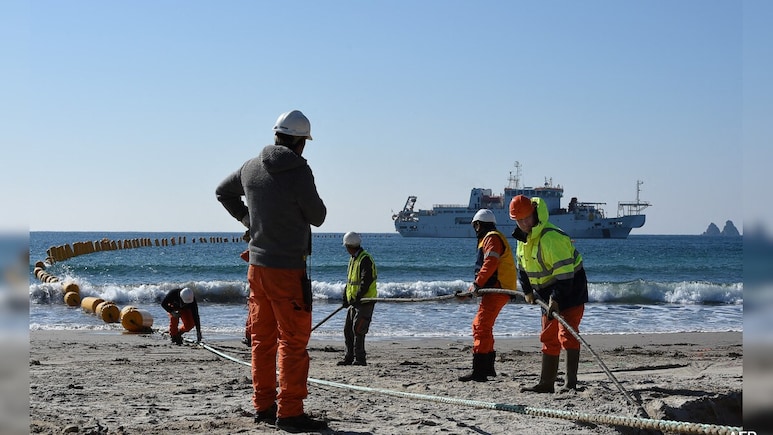
As the US-Israeli war against Iran engulfs the Middle East, a new and largely invisible threat is beginning to surface – one that lies deep beneath the sea. Concerns are mounting over the safety of critical undersea fibre-optic cables running through the Strait of Hormuz and the Red Sea – the hidden network behind the majority of the world's internet.
In this modern information age, undersea cables have become a strong foundation for digital connectivity. According to the International Telecommunication Union, about 99 per cent of the international internet traffic goes through submarine cables.
While Iran has not officially threatened the cables' infrastructure in the war-affected region, there are fears relating to the infrastructure in the Red Sea, especially with Iran-backed Houthis joining the conflict. The Yamani rebel group has, on several occasions, threatened to cut the fibre-optic cables in the Red Sea.
India's Dependency on Internet Cables
Any disruption to these cables could be a massive concern for India, as about 60 per cent of the country's internet traffic is handled on the crucial link that passes through the Gulf, travelling from Mumbai to Europe. The rest goes through Chennai, travelling east via Singapore and the Pacific.
This leaves the majority of India's internet network exposed to geopolitical tensions. While the Red Sea has always faced cable cuts, the war has escalated tensions. According to the Centre for Strategic and International Studies, policymakers perceive the deliberate targeting of seabed infrastructure as an emerging global threat.
Global data routes face disruption risks as Iran war threatens undersea internet cables pic.twitter.com/NSRS8t1Etb
— NDTV (@ndtv) April 2, 2026
What Happens If Internet Cables Are Damaged?

AFP
Around 17 submarine cables reportedly pass through the Red Sea. Each cable, made up of a fibre-optic core, copper wiring, down, and plastic sheaths, transmits an average of 100 gigabytes of data. It can take a year to establish such a route.
Any damage to them is unlikely to trigger a complete data blackout, as the internet doesn't depend on a single route. The connectivity works through a network of cables – if one is blocked, traffic can move through another. But even a temporary disruption to the network can be a costly affair for telecom and internet companies, affecting their traffic management, repair schedules, and service quality.
The networks can still function, but companies may need to reroute data to alternative routes.
"It is not as if the internet will ever be shut down, but it could get slowed down," Amajit Gupta, Chief Executive and Managing Director at Lightstorm Telecom Connectivity Pvt. Ltd, told Mint.
"If this choking continues to happen over a period of time and the traffic on the internet continues to grow over a period of time, then at a certain point the choke effect will be much more visible."
What Happens If Traffic Is Rerouted?
In case any cable is damaged, traffic is pushed onto other routes, crowding them further. This can lead to slower speeds and delays.
If repairing these cables takes long, users may experience slower financial transactions, increased buffering time, decreased download and upload speeds, apps responding with a slight delay, and, most importantly, enterprises such as global capability centres working in a delayed manner due to possible outages.
Track Latest News Live on NDTV.com and get news updates from India and around the world


