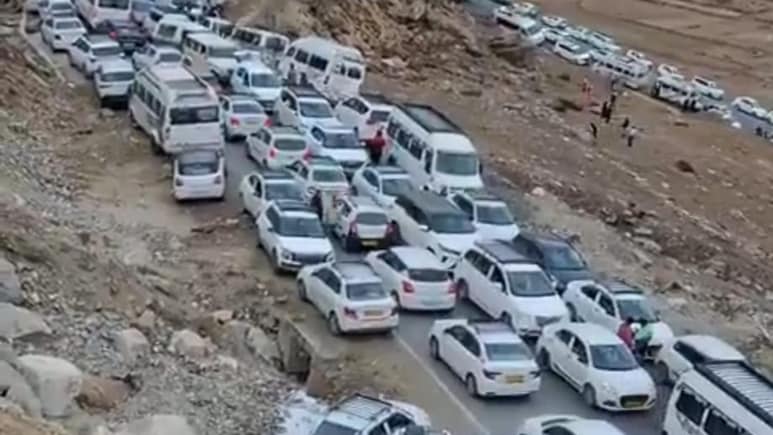
For people in Delhi-NCR and surrounding regions, winter trips to the mountains are no longer just about chasing snow. With air quality in the plains deteriorating sharply between November and January, many are simply looking for cleaner air when they travel. This has naturally led many to go to easily accessible hill stations. But what happens when too many people decide to flock to these destinations? A viral video circulating on social media at present poses this question. It claims to show a long traffic jam near the famous Rohtang Pass near Manali. Vehicles of different sizes are seen on the packed road in both directions.
The caption read, "Escape from toxic AQI or what? This jam isn't on some city road; it's Rohtang Pass. No snowfall yet. No vacations. Still, such massive traffic. So what exactly is pulling everyone up there?"
Escape from toxic AQI or what ? 😅
— Nikhil saini (@iNikhilsaini) December 16, 2025
This jam isn't on some city road, it's Rohtang Pass. No snowfall yet. No vacations. Still such massive traffic. So what exactly is pulling everyone up there? pic.twitter.com/cc21YIujVP
Disclaimer: NDTV does not vouch for the claims in the post by the X user.
Here's how X users reacted to the viral post:
White and White and White Cars! No Snow but still everything is white.
— Rohit Prabhakar (@rohitprabhakar) December 16, 2025
The mountains look less like a mountain pass, more like a road in gurgaon or greater Noida West full of dirt only
— Chhabi 🇮🇳 (@Chhabiy) December 16, 2025
It's striking to see such massive traffic at Rohtang Pass, especially when there's no snowfall or vacations. This is one of the most fragile ecological zones in the region, not equipped to handle such volumes of tourists. Beyond environmental stress, it's also a highly risky zone…
— HealthAsia (@farhadali) December 16, 2025
Horrible as ever. Mountains are not calling anyone.
— Pooja Lapasia (@poojalapasia) December 16, 2025
They are screaming for help and want to avoid all cars.
It's a bizarre sight, right? You're spot on about the AQI—with Delhi currently hitting "Severe" levels (AQI 450-600+) and GRAP Stage 4 in full force, the "pollution migration" is very real.
— Asif khan 🇮🇳 (@_asif) December 17, 2025
It is Gramphu, not Rohtang Pass.
— Avnish Kumar (@imavku) December 16, 2025
Dec is the month when people avail of their left over leaves for the year.
— Dawai Lama? (@DawaiLaama) December 16, 2025
People from plains visit mountains in the hope of seeing snowfall.
Most schools & colleges have winter break from 15th Dec.
If you are looking for fresh air, fewer crowds and a setting that allows you to relax this winter, we have a few niche suggestions. Popular hill stations promise relief but often deliver traffic jams, inflated prices and congested viewpoints. These six lesser-frequented destinations in Uttarakhand and Himachal Pradesh offer a more balanced alternative: places that are accessible, breathable and well-suited to both general travel and the realities of winter.
Also Read: 8 Popular Indian Travel Destinations With AQI Below 50 (At Present)
6 Offbeat Hill Destinations In North India To Escape Air Pollution
Photo Credit: Unsplash
1. Chakrata, Uttarakhand
Chakrata is a former cantonment town surrounded by thick deodar forests and limited commercial development. There are no crowded promenades or heavy traffic - just forest roads, waterfalls and quiet viewpoints. That restraint is precisely what makes Chakrata appealing, keeping air quality noticeably better than in nearby tourist hubs. In winter, the town becomes even calmer. Occasional snowfall adds to the atmosphere, but the real appeal lies in frost-lined forests, clear, cold days and the absence of seasonal crowds. It's best approached as a place for walks and quiet stays rather than packed sightseeing.
How to get there:Chakrata is best reached via Dehradun. From Delhi, travellers can either drive to Dehradun or take an overnight or early-morning train. From Dehradun, Chakrata is a 2.5 to 3-hour uphill drive through forested roads, making the total journey around 7-8 hours by road.
2. Khirsu (Garhwal)
Khirsu is a small Garhwal village set amid apple orchards and oak forests, offering wide Himalayan views on clear days. It remains firmly off the tourist circuit, with little movement beyond local life. This lack of activity keeps the environment quiet and the air consistently fresh. Winter strips the landscape down to its essentials: bare orchards, longer sightlines and a deep sense of stillness. Days here are unhurried, often spent indoors with views or on short village walks, making Khirsu ideal for travellers who value calm over constant activity.
How to get there:From Delhi, the most common route is via Rishikesh, followed by a drive through Srinagar (Garhwal). The final stretch climbs gently into the village and is well-connected by road. The full journey typically takes 9-10 hours. Travellers can also take a train to Haridwar or Rishikesh and continue by taxi.
3. Pangot (near Nainital)
Despite being just 15 km from Nainital, Pangot feels far removed in pace and atmosphere. Set within a dense forest belt, it is known more for birdlife and quiet trails than tourist attractions. Low-volume tourism keeps traffic and construction in check, which helps preserve both the landscape and air quality. In winter, Pangot turns misty and introspective, with cold mornings giving way to clearer afternoons. While Nainital struggles with congestion, Pangot remains largely insulated, making it a strong Kumaon option during peak pollution months.
How to get there:Pangot is accessed via Kathgodam, the nearest railhead to Delhi. From Kathgodam, a drive through Nainital leads to Pangot, with the final stretch passing through forest roads. The total travel time from Delhi is around 7-8 hours, depending on traffic.
Also Read: 6 Lesser-Known Indian Destinations That Deserve A Spot On Your Travel List
4. Shoja
Shoja is a small village tucked into pine forests near Jalori Pass, offering a stark contrast to the bustle of Manali. There's no central market or steady flow of vehicles, just scattered homestays, forest trails and open views. This low density keeps both noise and pollution levels minimal. Winter enhances Shoja's appeal for travellers seeking isolation: snowfall may occasionally affect the pass, but the village itself becomes a quiet, snow-dusted retreat best suited for reading, short walks and staying put rather than rushing between sights.
How to get there:From Delhi, Shoja is usually approached via Aut on the Chandigarh-Manali highway. The drive takes roughly 11-12 hours. Buses from Delhi to Aut are also available, with taxis covering the final stretch.
Photo Credit: Unsplash
5. Barot Valley (Mandi district)
Originally established around a hydroelectric project, Barot has retained a functional, low-key character that sets it apart from more commercial valleys. The Uhl River runs through the settlement, flanked by forests and sparsely populated villages. Even in winter, Barot remains accessible and largely free of crowds. While temperatures drop, heavy snowfall is uncommon, making it a practical choice for travellers who want mountain air without weather-related disruptions. Days here are slow and outdoorsy, balanced by long, quiet evenings.
How to get there:Barot can be reached by driving from Delhi to Mandi, followed by a scenic mountain route via Jogindernagar. The total travel time is usually around 10-11 hours by road.
6. Chindi (Karsog Valley)
Chindi sits above the Karsog Valley, surrounded by forests and orchards, yet remains largely overlooked by mainstream tourism. There are no headline attractions here; the draw is the setting itself. Clean air, open valley views and minimal construction define the experience. In winter, Chindi remains steady and predictable, avoiding the congestion and price spikes seen elsewhere. It suits travellers who want a quiet hill base that works just as well for longer winter stays as it does in other seasons.
How to get there:Chindi is most commonly reached via Shimla. From Delhi, travellers can drive or take a bus to Shimla, and then continue by road through Karsog Valley to Chindi. The full journey typically takes 10-11 hours. Regular buses operate up to Shimla, after which taxis are the most convenient option.
What is common across these destinations is space, forest cover and low tourist density. Visitors can generally expect cleaner air, reduced travel stress and a slower style of mountain travel. These places are thus compelling alternatives to the overcrowded classics.
Track Latest News Live on NDTV.com and get news updates from India and around the world


