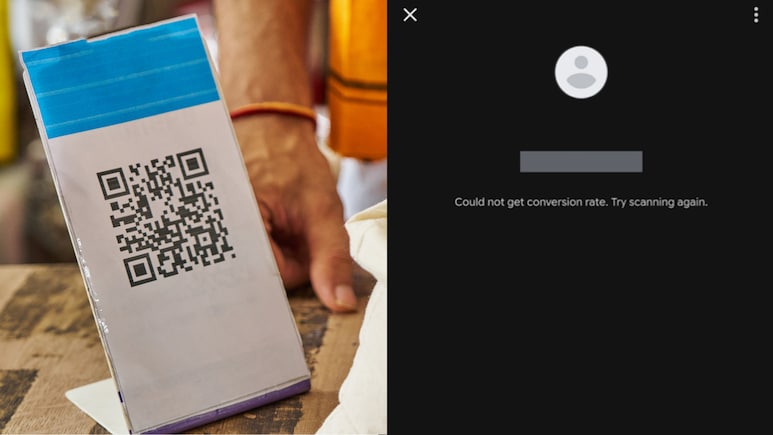
For Indians, scanning a UPI QR code has become almost second nature. So when the same payment method does not work overseas, it can be a little surprising. That is what happened to X user Nikhil George at Singapore's Changi Airport, where he tried paying at The Cocoa Trees using UPI.
George said the cashier warned him before the attempt that UPI "almost never works" there. He decided to try anyway. He scanned the QR code using GPay, but the payment did not go through. Instead, the screen showed, "Could not get conversion rate. Try scanning again."
Tried paying with UPI at The Cocoa Trees in Changi Airport today.
— nikhil george (@nikhilgeorge) September 27, 2026
The cashier warned me upfront that it almost never works, but I insisted on trying.
Scanned the QR using GPay and it just stalled and threw: "Could not get conversion rate. Try scanning again."
Despite all the… pic.twitter.com/T3KPWsa60b
George shared a video of the attempt along with his post on X. His point was that while UPI is expanding internationally, using it abroad may not always be as seamless as it is in India. He advised travellers to keep their cards handy.
The post then turned into a discussion about how international UPI actually works, with people sharing very different experiences.
The Internet Has Different Experiences
One user said UPI had worked for them in two countries and called the experience "very good". Another said they had used it in Sri Lanka through Lanka QR. PhonePe also came up in the replies, with one person saying they found it to be the most successful option for international UPI.
Another user asked George to try UPI at Mustafa in Singapore's Little India, saying the experience depends on the "end point terminal" and whether it has been updated.
Someone else said they use UPI at Mustafa roughly once a month because the 10% discount on UPI payments makes up for the exchange markup.
There was also a separate point about international booking websites. One commenter said GPay works for them on such websites, suggesting that UPI-related payments can work differently depending on the platform and payment setup.
The Exchange Rate Brings Up The Total
One of the replies said, "Even if it works, the exchange rate kills it." This does not mean that UPI itself charges a fee for making the payment.
The UPI app does not add a platform fee. The additional cost can come from the bank handling the foreign currency conversion.
Banks can apply a forex markup, generally around 1.5% to 3.5%, depending on the bank and account type. There can also be a small processing fee, often around Rs 15 to Rs 50 per transaction.
Also Read: Philippine Airlines To Launch Direct Flights From Manila To Delhi, Mumbai In December
For example, say your purchase in Singapore works out to Rs 10,000 at the applicable exchange rate. If your bank adds a 2% forex markup, that is about Rs 200 over the converted amount. Add a Rs 20 processing fee, and the extra cost would be around Rs 220.
So even when the UPI payment goes through, the final amount you pay can be higher than the simple rupee-to-Singapore-dollar conversion you may have checked online.
NPCI International Responds
NPCI International Payments Limited also responded to George's post. "Hi Nikhilgeorge, we apologize for the inconvenience. Kindly share any additional details with us via DM, and we'll be happy to assist you further," it wrote.
Clearly, international UPI isn't a uniform experience everywhere. Some users reported successful payments in Singapore and Sri Lanka, while George's attempt at Changi ended with a conversion-rate error.
Track Latest News Live on NDTV.com and get news updates from India and around the world


