





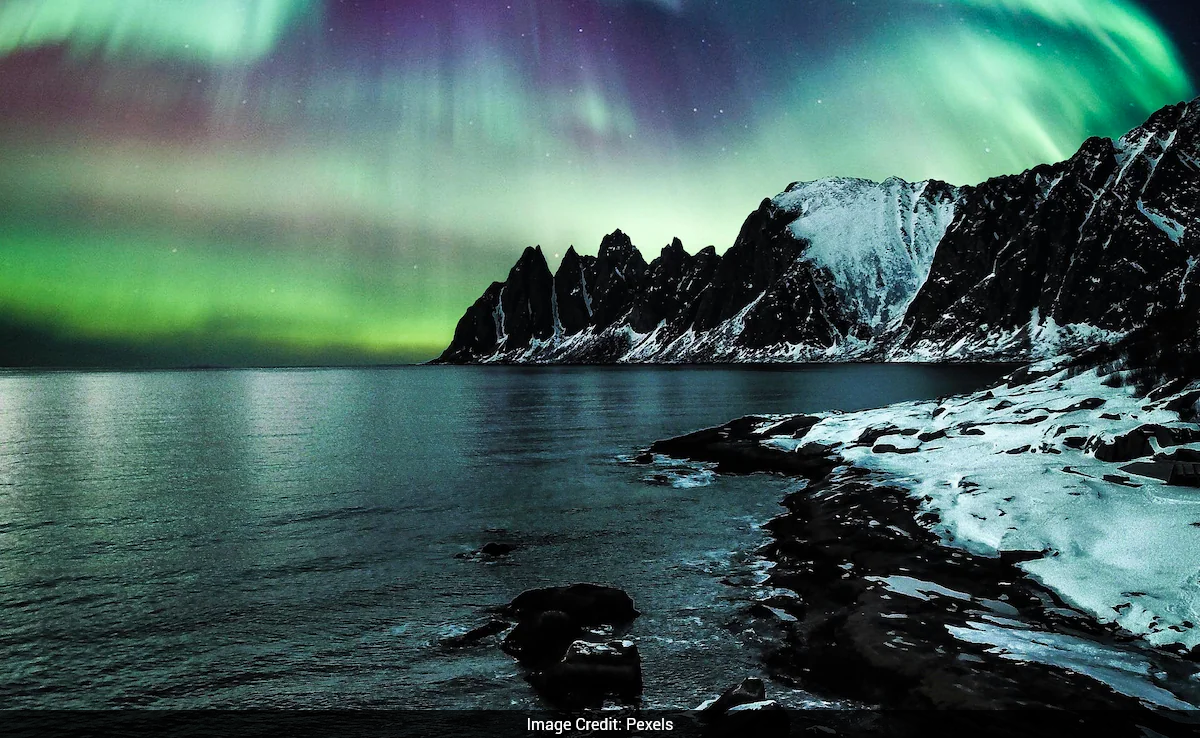
The skies over the UK lit up with stunning auroras in November 2025, giving people across the country a rare and beautiful natural display. This dazzling phenomenon was caused by a large solar flare erupting from the Sun, highlighting the ongoing activity of our star as part of its natural cycle, reported BBC.
Sun's Activity And Its Cycle
The Sun follows an 11-year cycle, moving between periods of low activity with few sunspots and phases of high activity with many sunspots. During the peak of the current cycle, confirmed by NASA in October 2024, a greater number of sunspots led to more frequent solar flares and coronal mass ejections.
During solar activity, intense waves of energy and charged particles from the Sun are transmitted into space, interacting with Earth's atmosphere to create the aurora we see.
On November 11, 2025, the Sun erupted with a massive solar flare of magnitude X5.1. This flare sent a massive amount of energy towards Earth, producing the most spectacular aurora seen this year. The flare was also visible in southern regions such as Devon and Cornwall.
Although this was the largest flare of 2025, it was less intense than the major flares recorded in May and October 2024, which measured X8.8 and X9, respectively.
The Sun has now passed the peak of its cycle and is approaching a solar minimum around 2031-32. However, solar activity is expected to remain relatively high until 2026. Even a single large flare or coronal mass ejection can produce spectacular aurorae across the UK.
The alignment of the Sun and Earth during the spring and autumn equinoxes can slightly increase activity, known as the Russell-McPherron effect. The likelihood of seeing aurorae during these times almost doubles.
In recent years, improved forecasting, sun-monitoring satellites, and modern technology have made auroras more visible in the UK. Smartphones make it easier to capture and share these sights, allowing people to enjoy the aurora close to home.
BBC Weather Watchers captured images of the aurora in November 2025, showcasing this amazing natural spectacle for all to see.
Track Latest News Live on NDTV.com and get news updates from India and around the world

