





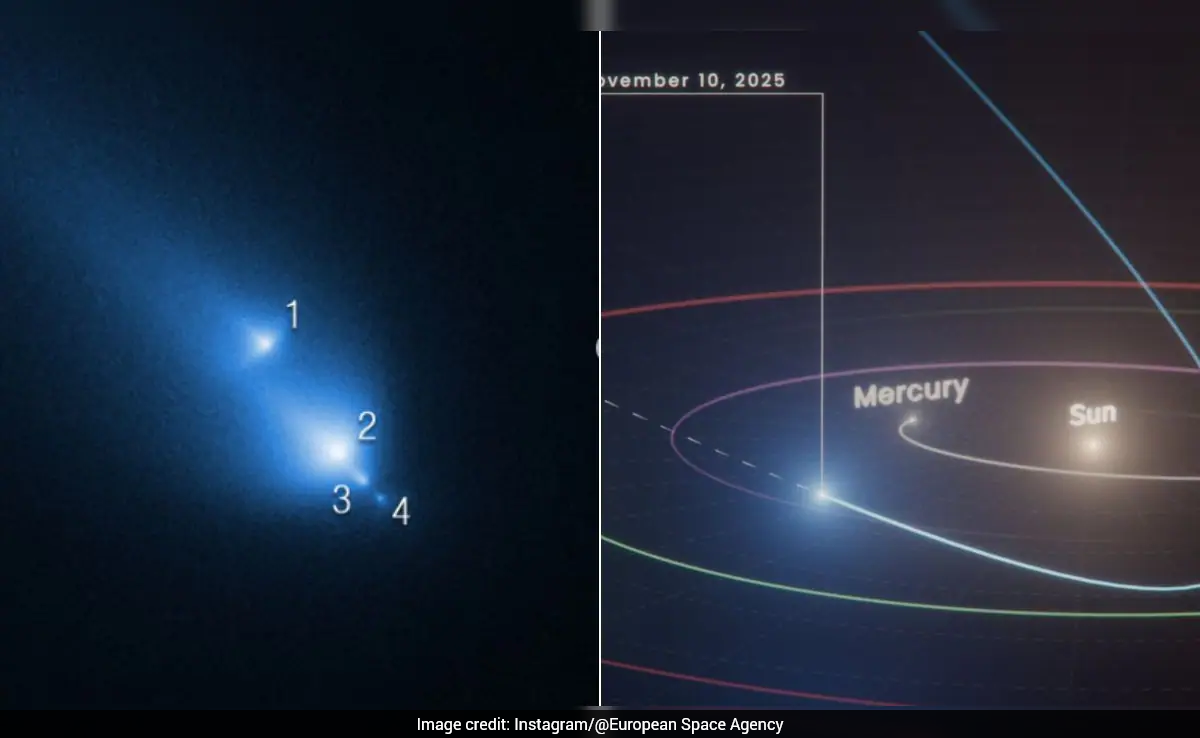
The European Space Agency (ESA) has shared dramatic and rare footage of a comet breaking apart in real time. The clip, shared on Instagram, showed NASA's Hubble Space Telescope capturing comet C/2025 K1 (ATLAS) in the act of fragmenting that occurred in November 2025. The space agency shared a sequence of three images taken on November 8, 9 and 10 showing the comet splitting into at least four distinct pieces, each surrounded by its own cloud of gas and dust, called a coma. One of the smaller fragments even split again during the three-day observation window.
ESA explained that the comets are "ancient leftovers" from the birth of our Solar System, and over time, sunlight and cosmic radiation reshape them.
Watch the video here:
"Sometimes the best science happens by accident," co-investigator John Noonan, a research professor in the Department of Physics at Auburn University in Alabama, in the United States, said as quoted by ESA.
"This comet got observed because our original comet was not viewable due to some new technical constraints after we won our proposal. We had to find a new target - and right when we observed it, it happened to break apart, which is the slimmest of slim chances."
Comets are loose collections of ice, dust and frozen gases left over from the solar system's formation 4.6 billion years ago. They aren't solid rock. When a comet passes close to the Sun, solar heating builds pressure inside the nucleus, which can trigger cracks, outbursts or in some cases, complete disintegration.
"Something really, really special"
When C/2025 K1 (ATLAS) shattered, each piece carried its own coma. "While I was taking an initial look at the data, I saw that there were four comets in those images when we only proposed to look at one," Noonan said. "So we knew this was something really, really special."
Events like this give scientists a direct look at the comet's interior composition, which is normally hidden beneath kilometres of surface material.
"The irony is now we're just studying a regular comet and it crumbles in front of our eyes," principal investigator Dennis Bodewits, also a professor in Auburn University's Department of Physics, said as quoted by ESA.
"Comets are leftovers of the era of Solar System formation, so they're made of 'old stuff' - the primordial materials that made our Solar System," explained Dennis.
"But they are not pristine - they've been heated, they've been irradiated by the Sun and by cosmic rays. So, when looking at a comet's composition, the question that we always have is, 'Is this a primitive property or is this due to evolution?' By cracking open a comet, you can see the ancient material that has not been processed."
This isn't ESA's first real-time breakup. In May 2006, ESA scientists used a revolutionary superconducting camera, SCAM, attached to the one-meter ESA Optical Ground Station telescope in Tenerife to track Comet 73P/Schwassmann-Wachmann 3.
Researchers will continue monitoring C/2025 K1 (ATLAS) to see how long the fragments survive and whether more pieces break off.
Track Latest News Live on NDTV.com and get news updates from India and around the world

