





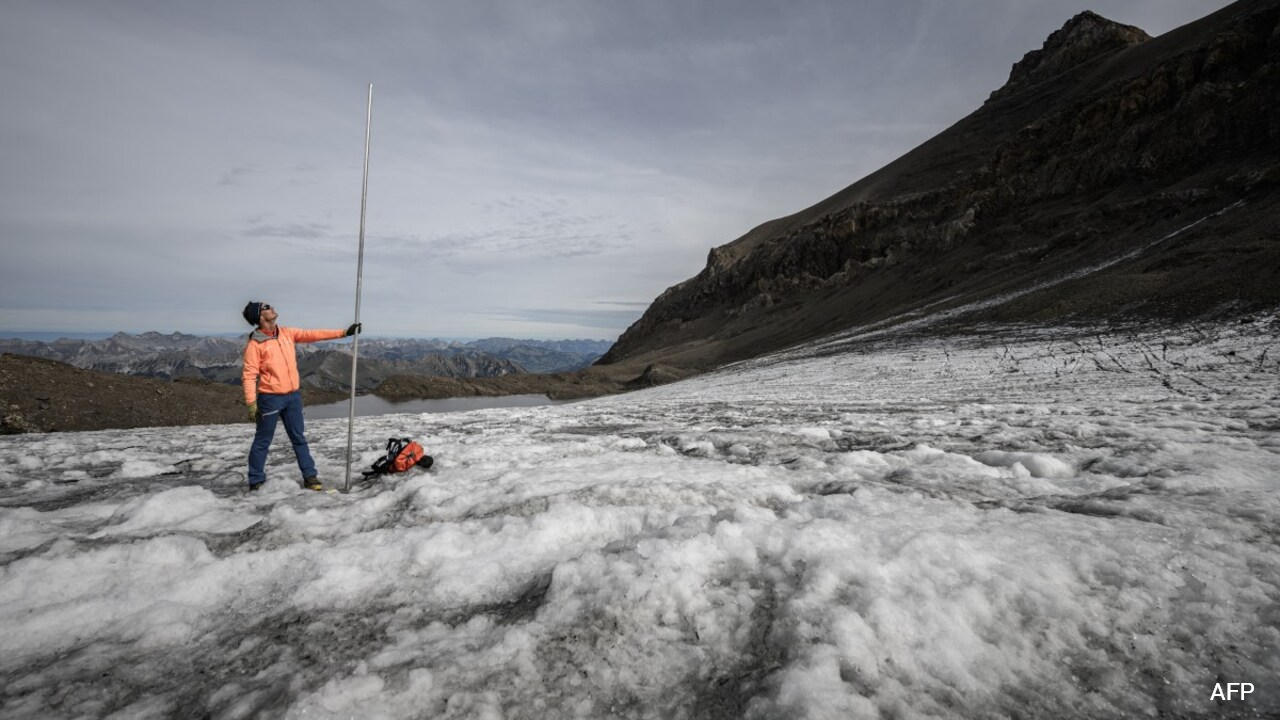
The extreme heat that Europe is experiencing this year is taking a toll on the glaciers in Switzerland. The alpine country has lost almost one-fifth of its ice in just five years, a new study has found. Carried out by GLAMOS - short for Glacier Monitoring in Switzerland - some glaciers have seen unprecedented loss eclipsing the numbers from 2022, the worst meltdown year on record. The primary reason for the rapid ice loss is that Europe is warming twice as fast as the global average due to heat-trapping, atmospheric and air quality shift and fossil fuel pollution.
Glaciologist Matthias Huss, who also leads GLAMOS, told Washington Post he feels the glaciers are evaporating before his eyes. And his fears are not unfounded: Scientists have seen some glacial tongues have lost as much as 10 metres (or 33 feet) of ice in the first eight months of 2026.
Why 2026 Was So Bad?
For Europe, 2026 brought a damaging combination of too little winter snow and exceptional summer heat. Switzerland entered the year with unusually low snow cover, leaving Alpine glaciers with less of the protective snow layer that normally reflects sunlight and replenishes ice.
That was followed by a scorching summer: Switzerland's April-to-September period was the hottest and driest on record, while the freezing level rose above 4,000 metres for extended periods, exposing even high-altitude ice to melting.
Europe is warming faster than the global average, making such extreme heat increasingly consequential for the Alps. The result was a rapid loss of glacier mass. Scientists say extreme melt years are becoming increasingly common across the European Alps.
Like switching off the lights: The ultimate disappearance of Plattalva #Glacier in the extreme summer of 2026.
— Matthias Huss (@matthias_huss) September 10, 2026
Another glacier has gone. It may seem unremarkable but in the 1950s it hosted the maybe most detailed glacier monitoring programme worldwide@glamos_ch @VAW_glaciology pic.twitter.com/V9iwJwXV1t
Why Switzerland's Glaciers Matter Far Beyond The Alps
Switzerland serves as a natural laboratory for glaciers because its dense concentration of Alpine ice mass has been systematically measured for over a century, providing critical insights into global climate change.
But rising temperature is threatening ice masses across the world. According to United Nations, glaciers worldwide lost around 450 billion tonnes of water in 2024, while global glacier loss has accelerated dramatically.
Melting of glaciers is significant because they are not simply frozen landscapes. These ice structures act as seasonal water stores, releasing meltwater when temperatures rise and rainfall is low.
Their rapid retreat not only threatens global water availability for hydropower and agriculture, but also increases landslide and flood risks, especially in fragile mountain zones.
From The Alps To The Himalayas: A Global Glacier Story
The retreat of glaciers is not confined to Switzerland or the European Alps. The World Meteorological Organisation (WMO) says every major glaciated region recorded ice loss for the fourth consecutive year in 2025, with glaciers losing a cumulative 1,400 billion tonnes of water between 2023 and 2025. In the Himalayas, the picture is equally stark - glaciers lost about 12% of their area and 9% of their estimated ice reserves between 1990 and 2020, while ice-loss rates have doubled since 2000, according to ICIMOD.
Further, the great thaw caused by global warming destabilsed a Himalayan slope that collapsed in August and unleashed catastrophic and deadly flooding across Nepal. Satellites have shown vast shrinkage of glaciers in places like Greenland and Antarctica over the last half-century or so.
The Water Tower Of Europe
Switzerland gets more than half of its electricity from hydropower. The melting of glaciers led to the loss of 2.2 trillion litres of water from July to September - four times the annual consumption of water in the country.
But the accelerated glacier melt could have ripples across the continent because Switzerland, the water tower of Europe, feeds some of its most important rivers - the Danube, Po, Rhine and Rhone.
"We just need to stabilize the climate by reducing CO2 emissions and this will help the glaciers," said Huss, of GLAMOS, though he added that it is "almost too late" to save those in the Swiss Alps.
Track Latest News Live on NDTV.com and get news updates from India and around the world

