





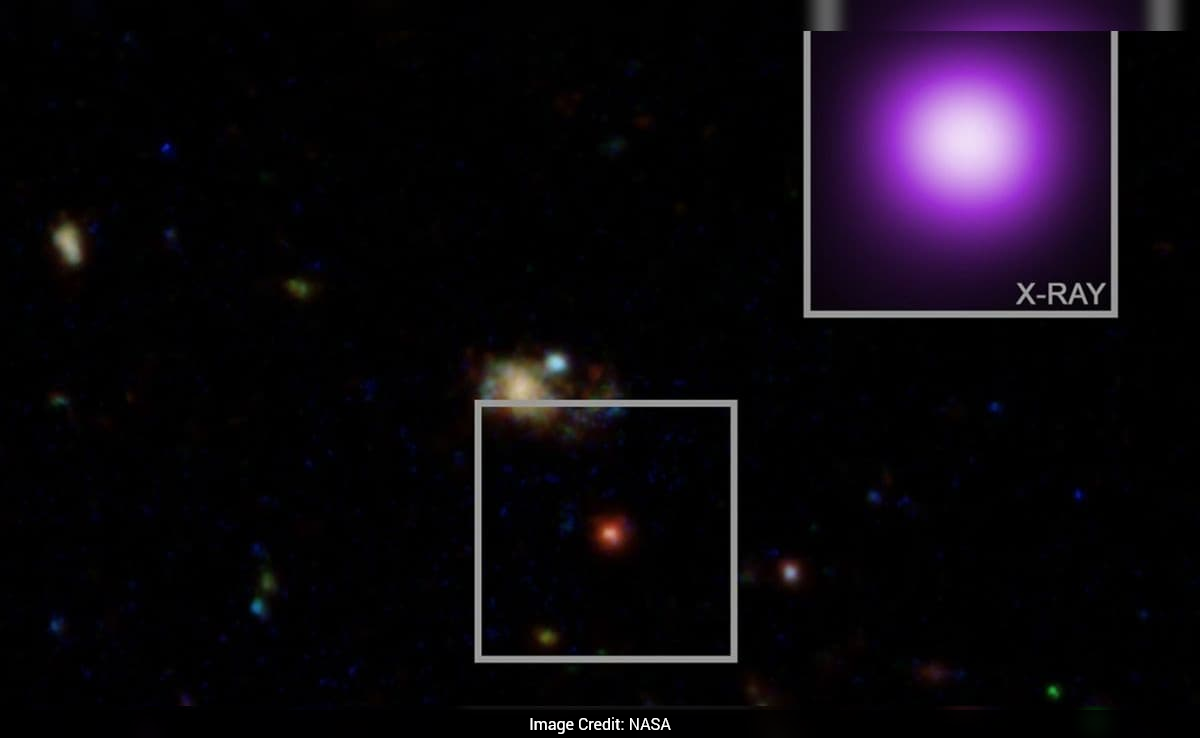
- Newly found X-ray object may reveal secrets of mysterious little red dots in space
- The object 3DHST-AEGIS-12014 is 11.8 billion light-years away and emits X-rays
- Little red dots are thought to be black holes hidden in dense gas clouds
A newly discovered object in deep space may help astronomers solve one of the biggest mysteries about the early universe. Scientists believe a strange "X-ray dot" spotted by NASA's Chandra X-ray Observatory could reveal the true identity of mysterious cosmic objects known as "little red dots."
The findings were published in The Astrophysical Journal Letters after researchers studied the unusual object using data from NASA's James Webb Space Telescope and Chandra.
Soon after the James Webb Space Telescope began observations, astronomers discovered a new class of mysterious objects in the distant universe. These small, red objects, located around 12 billion light-years from Earth or farther, became known as little red dots, or LRDs.
Many scientists believe these objects are supermassive black holes hidden inside thick clouds of dense gas.
The gas blocks some of the usual signals, including X-rays, that astronomers normally use to identify growing black holes. This idea became known as the "black hole star" scenario because of similarities between these objects and stellar atmospheres.
The newly discovered "X-ray dot," officially called 3DHST-AEGIS-12014, is located about 11.8 billion light-years from Earth. Researchers said it shares most features of little red dots, including being small, red, and extremely distant, but unlike other LRDs, it also emits X-rays.
Lead author Raphael Hviding of the Max Planck Institute for Astronomy said astronomers have been trying to understand little red dots for several years, and this single X-ray object may help connect all the clues together.
The team identified the object after comparing new Webb observations with a deep survey previously carried out by Chandra.
Researchers suggested the X-ray dot could represent a transition stage between a little red dot and a normal growing supermassive black hole. According to the study, as the black hole star consumes the gas surrounding it, gaps begin forming in the gas clouds. These openings allow X-rays produced by material falling into the black hole to escape and become visible to Chandra. Eventually, the gas disappears completely and the black hole star stops existing.
Scientists also found hints in the Chandra data that the X-ray brightness of the object changes over time. They said this supports the idea that the black hole is partly hidden by rotating gas clouds with dense and less dense regions moving across it.
Co-author Hanpu Liu of Princeton University said that if the X-ray dot is confirmed as a little red dot in transition, it would be the first known object of its kind. He added that scientists may also be observing the inside of a little red dot for the first time and could gain the strongest evidence yet that supermassive black hole growth is central to at least some of the little red dot population.
Researchers also proposed another possibility that the X-ray dot may actually be a more common type of growing supermassive black hole covered by an unusual kind of dust never seen before. They said future observations are planned to better understand the object.
Track Latest News Live on NDTV.com and get news updates from India and around the world

