Little Red Dots
-
{
- All
- News
-
Scientists Find Rare X-Ray Source That Could Reveal Truth Behind "Little Red Dots"
- Monday May 11, 2026
- Science | Edited by Astitva Raj
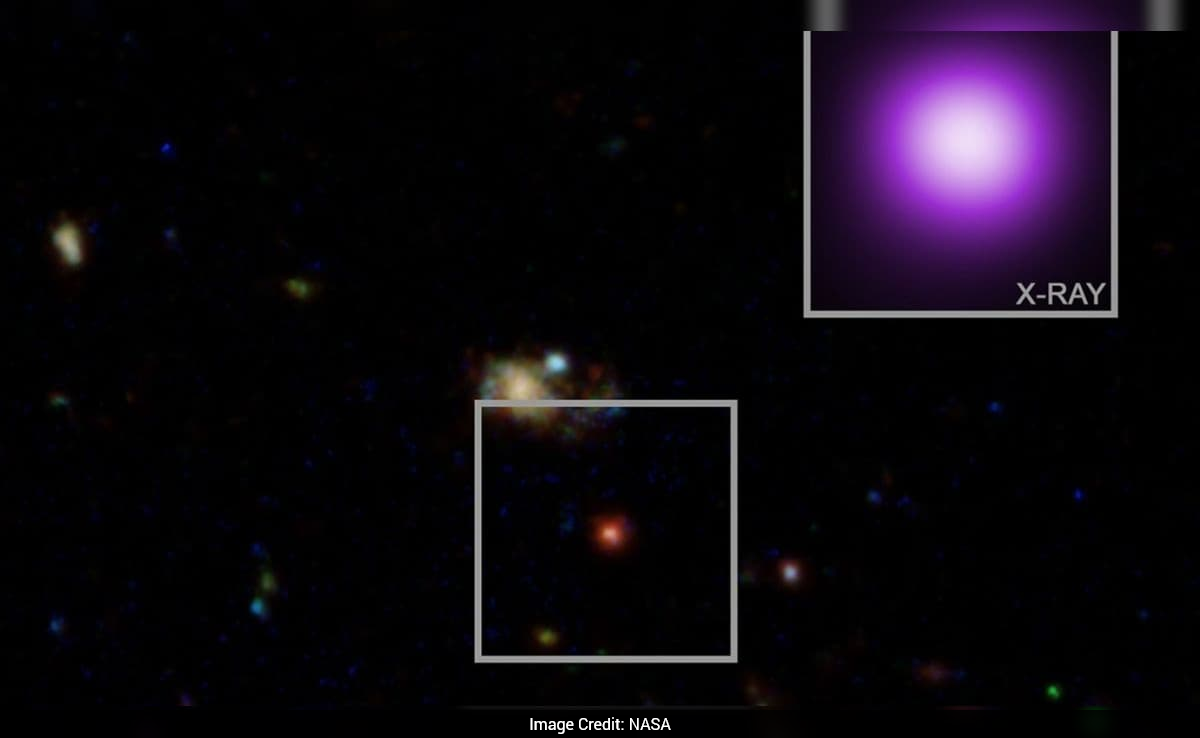
The newly discovered "X-ray dot," officially called 3DHST-AEGIS-12014, is located about 11.8 billion light-years from Earth.
-
www.ndtv.com
-
James Webb Space Telescope Little Red Dots May Reveal Birth of Black Holes
- Saturday May 2, 2026
- Reported by Gadgets 360 Staff, Written by Gadgets 360 Staff, Edited by Gadgets 360 Staff
These Tiny Red Objects Could Be How Black Holes Are Born
-
www.gadgets360.com
-
Hypothetical ‘Dark Stars’ Could Rewrite Early Cosmic History, Research Suggests
- Friday January 16, 2026
- Written by Gadgets 360 Staff
Hypothetical dark stars could explain three early universe mysteries: the abundance of supermassive black holes, dense blue monster galaxies, and compact little red dots. Powered by dark matter rather than fusion, these stars may have formed before normal stars, collapsing to create black hole seeds and influencing early galaxy observations, accord...
-
www.gadgets360.com
-
NASA's James Webb Space Telescope Might Have Spotted Hidden Supermassive Black Holes
- Friday January 16, 2026
- Written by Gadgets 360 Staff
Mysterious “little red dots” spotted by the James Webb Space Telescope may not be tiny galaxies after all. A new study suggests they are supermassive black holes wrapped in dense gas and dust, perfectly disguised in the early universe and shining intensely in infrared light.
-
www.gadgets360.com
-
Tiny Red Dots Spotted By NASA’s James Webb Telescope Could Be Black Hole Stars
- Thursday September 25, 2025
- Written by Gadgets 360 Staff
NASA’s James Webb Space Telescope revealed mysterious “little red dots” that seem too bright and mature for their age. A new study suggests they may be black hole stars—giant hydrogen spheres powered by black holes—helping explain the rapid growth of early supermassive black holes.
-
www.gadgets360.com
-
Earliest Known Black Hole Found Just 500 Million Years After the Big Bang
- Friday August 8, 2025
- Written by Gadgets 360 Staff
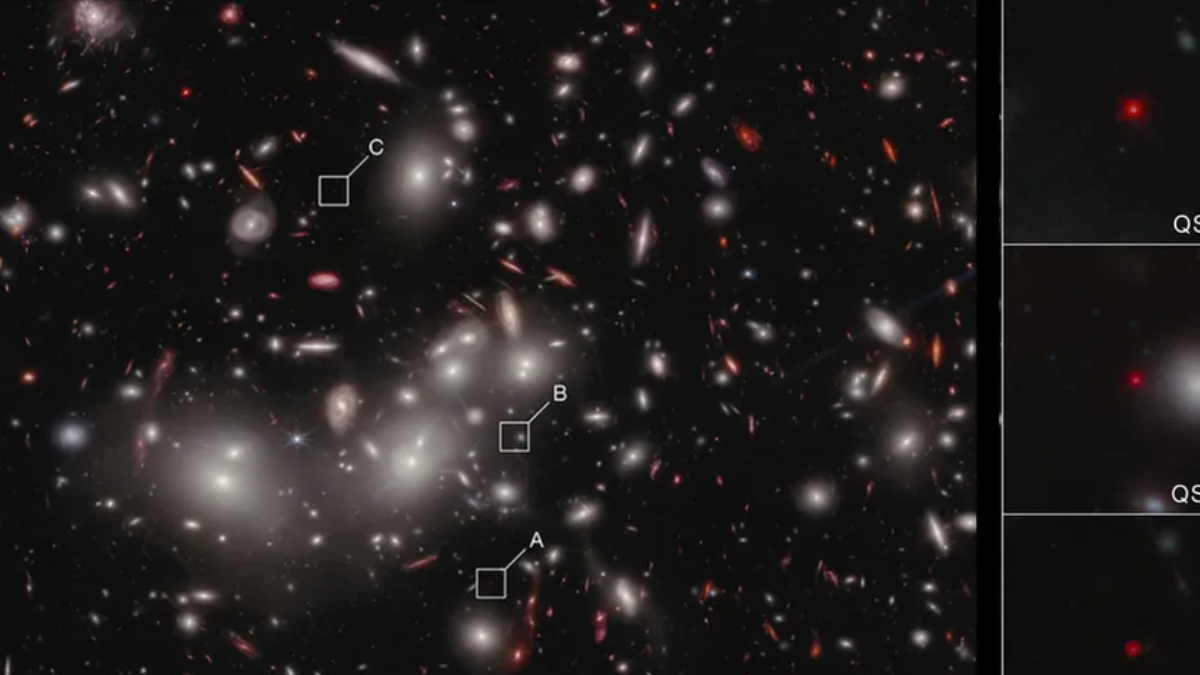
Astronomers have confirmed the most distant black hole ever discovered, lurking in a compact galaxy just 500 million years after the Big Bang. Using the James Webb Space Telescope, the team identified clear spectroscopic evidence of the object, offering new insight into early black hole growth and their role in forming galaxies during the universe...
-
www.gadgets360.com
-
Webb Telescope Uncovers Hidden Active Galactic Nuclei
- Saturday May 31, 2025
- Written by Gadgets 360 Staff
The cosmic mystery of how quasars and Little Red Dots relate may soon be solved, thanks to new research using the James Webb Space Telescope. A study published on May 7, 2025, in arXiv reveals a population of dust-obscured supermassive black holes in the early universe.
-
www.gadgets360.com
-
Scientists Find Rare X-Ray Source That Could Reveal Truth Behind "Little Red Dots"
- Monday May 11, 2026
- Science | Edited by Astitva Raj
The newly discovered "X-ray dot," officially called 3DHST-AEGIS-12014, is located about 11.8 billion light-years from Earth.
-
www.ndtv.com
-
James Webb Space Telescope Little Red Dots May Reveal Birth of Black Holes
- Saturday May 2, 2026
- Reported by Gadgets 360 Staff, Written by Gadgets 360 Staff, Edited by Gadgets 360 Staff
These Tiny Red Objects Could Be How Black Holes Are Born
-
www.gadgets360.com
-
Hypothetical ‘Dark Stars’ Could Rewrite Early Cosmic History, Research Suggests
- Friday January 16, 2026
- Written by Gadgets 360 Staff
Hypothetical dark stars could explain three early universe mysteries: the abundance of supermassive black holes, dense blue monster galaxies, and compact little red dots. Powered by dark matter rather than fusion, these stars may have formed before normal stars, collapsing to create black hole seeds and influencing early galaxy observations, accord...
-
www.gadgets360.com
-
NASA's James Webb Space Telescope Might Have Spotted Hidden Supermassive Black Holes
- Friday January 16, 2026
- Written by Gadgets 360 Staff
Mysterious “little red dots” spotted by the James Webb Space Telescope may not be tiny galaxies after all. A new study suggests they are supermassive black holes wrapped in dense gas and dust, perfectly disguised in the early universe and shining intensely in infrared light.
-
www.gadgets360.com
-
Tiny Red Dots Spotted By NASA’s James Webb Telescope Could Be Black Hole Stars
- Thursday September 25, 2025
- Written by Gadgets 360 Staff
NASA’s James Webb Space Telescope revealed mysterious “little red dots” that seem too bright and mature for their age. A new study suggests they may be black hole stars—giant hydrogen spheres powered by black holes—helping explain the rapid growth of early supermassive black holes.
-
www.gadgets360.com
-
Earliest Known Black Hole Found Just 500 Million Years After the Big Bang
- Friday August 8, 2025
- Written by Gadgets 360 Staff
Astronomers have confirmed the most distant black hole ever discovered, lurking in a compact galaxy just 500 million years after the Big Bang. Using the James Webb Space Telescope, the team identified clear spectroscopic evidence of the object, offering new insight into early black hole growth and their role in forming galaxies during the universe...
-
www.gadgets360.com
-
Webb Telescope Uncovers Hidden Active Galactic Nuclei
- Saturday May 31, 2025
- Written by Gadgets 360 Staff
The cosmic mystery of how quasars and Little Red Dots relate may soon be solved, thanks to new research using the James Webb Space Telescope. A study published on May 7, 2025, in arXiv reveals a population of dust-obscured supermassive black holes in the early universe.
-
www.gadgets360.com