





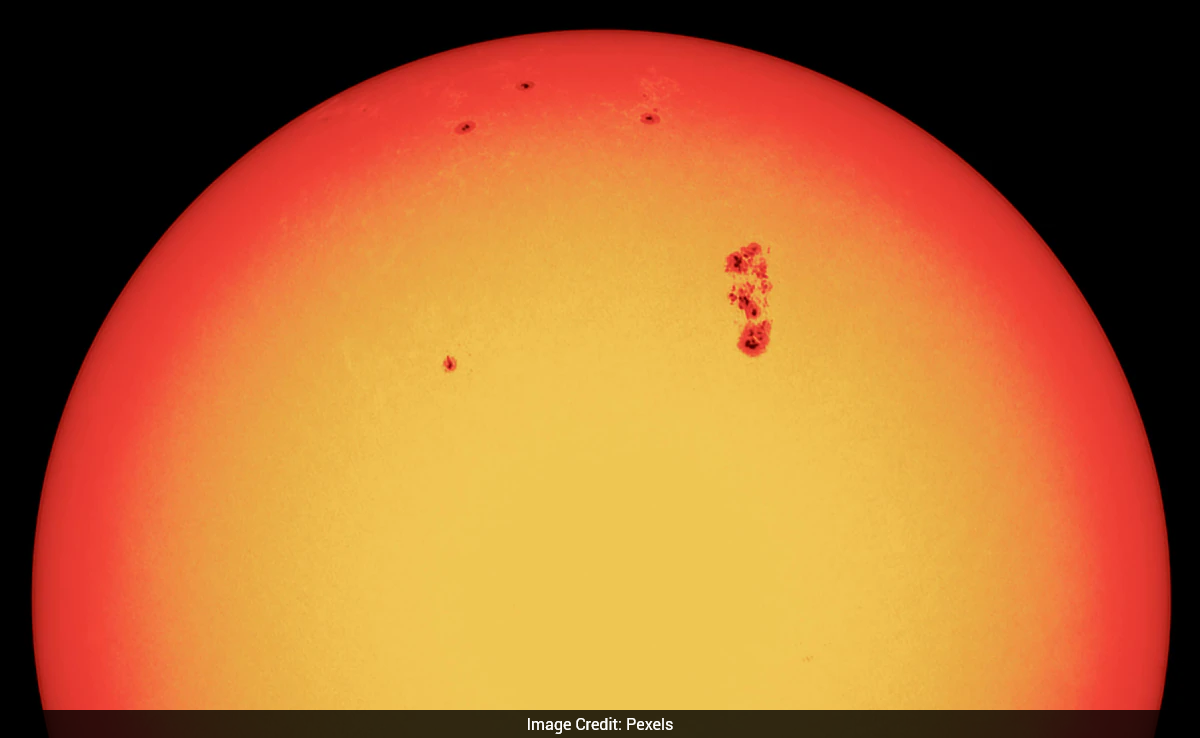
- A powerful X8 solar flare caused radio blackouts over the South Pacific on Sunday
- The flare emitted from rapidly expanding sunspot 4366, releasing multiple X and M flares
- A coronal mass ejection from the flare may mildly impact Earth on February 5th and 6th
A powerful explosion on the sun has caught the attention of scientists and sky watchers. On Sunday, a strong solar flare burst out from a spot on the sun and caused radio blackouts across the South Pacific Ocean. Now, scientists are warning that geomagnetic storms could affect Earth in the coming days, reported Newsweek.
This eruption was of X8 category, meaning its power was extremely high. This solar flare was accompanied by a coronal mass ejection, also known as a CME. This is a massive cloud of plasma and the magnetic field. Scientists predict this CME could mildly impact Earth on February 5th and 6th.
All of this activity is linked to sunspot 4366, which is expanding rapidly and is no longer stable. On Sunday alone, this sunspot emitted four X-category flares and twenty-three weak M-category flares.
This extremely large sunspot was not known until just a few days ago. Now, it is being revealed to be a massive structure, approximately half the size of the famous Carrington sunspot. The same historic sunspot gave rise to the Carrington event in 1859, considered the largest solar storm ever observed.
Radio Services Affected In The South Pacific
Strong ultraviolet rays from an X8-class flare impacted Earth's upper atmosphere on Sunday. These rays ionised the upper layers of the atmosphere, disrupting shortwave radio services in the South Pacific Ocean.
This resulted in ham radio operators in Australia and New Zealand being unable to receive signals below 30 MHz for several hours after the flare's peak.
What Is A Solar Flare?
According to NASA, a solar flare is an extremely bright flash of radiation. It occurs when magnetic energy associated with a sunspot is suddenly released. Such events are among the most energetic events in the solar system. They appear as bright spots on the sun's surface and can last from a few minutes to several hours.
Scientists identify solar flares based on the light they emit, spanning almost the entire electromagnetic spectrum. Most studies focus on X-rays and visible light. Solar flares also occur where particles like electrons, protons, and heavy ions accelerate very rapidly.
How Solar Flares Are Categorised
The most powerful solar flares are classified as X-category. This name comes from a system that categorizes solar flares based on their intensity. At the lowest level are A-category flares, which are around normal background levels. These are followed by B, C, M, and X-category flares.
This classification system works like the Richter scale for measuring earthquakes. Each subsequent level represents a tenfold increase in energy. For example, an X-category flare is ten times more powerful than an M-category flare, and a hundred times more powerful than a C-category flare. Each category is further divided on a scale from 1 to 9.
Track Latest News Live on NDTV.com and get news updates from India and around the world

