





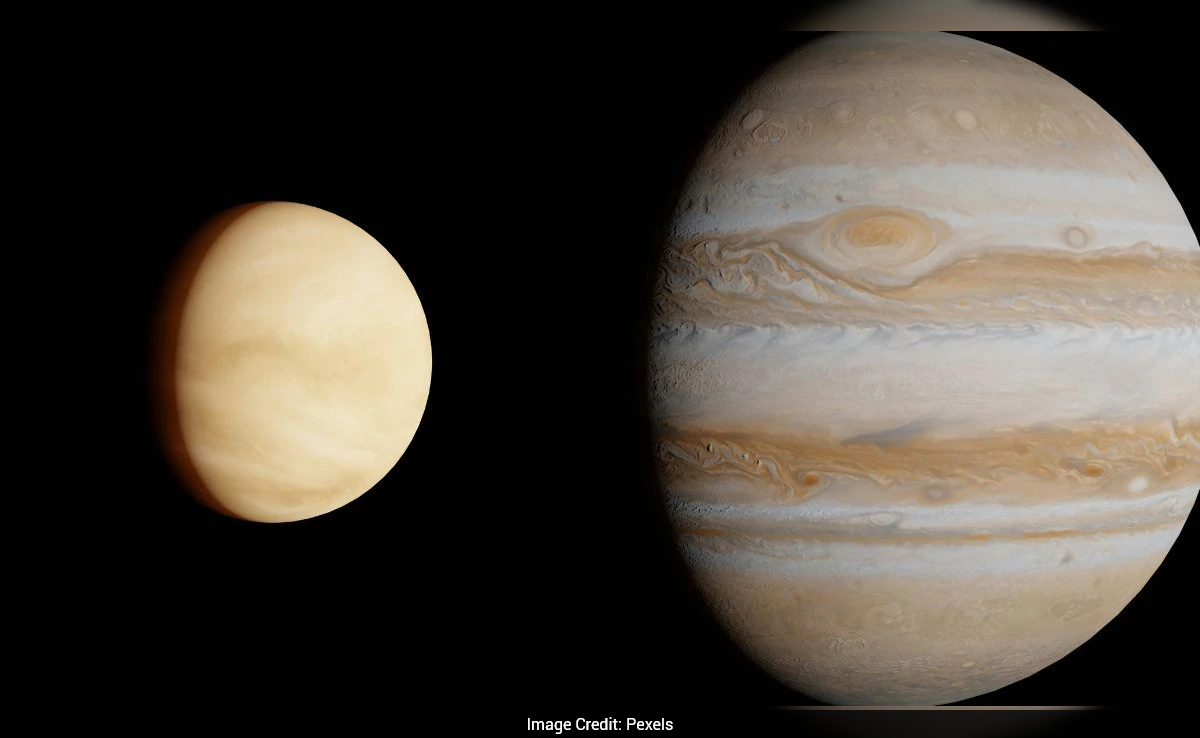
Scientists have highlighted an exciting celestial event for skywatchers, as two of the brightest planets, Venus and Jupiter, are clearly visible in the western sky after sunset throughout May 2026. Their changing positions and increasing closeness make this period especially interesting for observation, reported BBC.
Venus is the brighter of the two planets, shining at a magnitude of -3.8 at the beginning of May and becoming slightly brighter at -3.9 by early June. It is also the planet closest to the Sun during this time.
Jupiter is also prominent, with a brightness of -1.9 at the start of May, though it gradually dims to -1.7 by early June. Despite this slight decrease, both planets remain easy to see in the evening twilight.
Throughout May, Venus and Jupiter steadily move closer together in the sky. Jupiter slowly drifts toward the Sun, while Venus moves in the opposite direction, pulling away from it. As both planets travel along the same path known as the ecliptic, their paths eventually bring them closer.
Scientists explain that this gradual movement makes May 2026 an ideal time to observe the two planets as they approach each other.
Closest Approach In June
The two planets will reach their closest point during a conjunction on 9 June 2026, when they will appear just 1.6 degrees apart. Observers are advised to follow their slow convergence during May, as weather conditions in early June may affect visibility.
At the start of the month, Venus and Jupiter are nearly 40 degrees apart. Venus appears north of Aldebaran, while Jupiter is located near Wasat, south of the stars Castor and Pollux in the constellation Gemini.
By 7 May, the distance between them reduces to 33 degrees. By 14 May, the gap narrows further to 26 degrees. Observers may need to wait until Venus is lower in the sky to view both planets clearly against darker skies.
The Moon also plays a role in this celestial display as it moves along its orbit near the ecliptic. On 19 May, a thin crescent Moon, illuminated at 6 percent, passes close to Venus at a distance of 3.6 degrees.
On the evening of 20 May, the Moon, now 13 percent illuminated, appears between Venus and Jupiter. By 21 May, the crescent Moon, at 22 percent illumination, is positioned about 5 degrees from Jupiter.
By 31 May, the distance between Venus and Jupiter decreases to less than 9 degrees. Despite the bright evening twilight, both planets remain visible as they continue moving closer ahead of their conjunction in June.
This steady approach, combined with the presence of the Moon, offers skywatchers several opportunities to observe and record the changing positions of these bright planets throughout the month.
Track Latest News Live on NDTV.com and get news updates from India and around the world

