





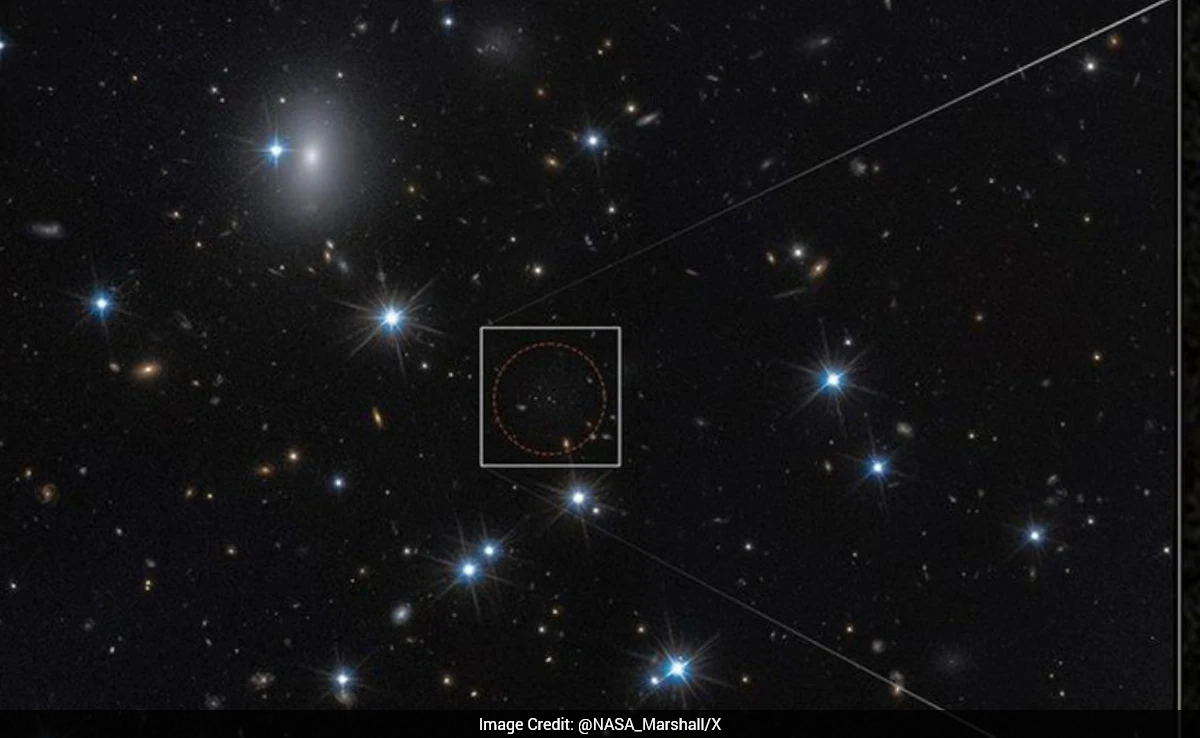
In the huge universe, most galaxies shine brightly and are easy to spot. But some rare galaxies are almost invisible. These are called low-surface-brightness galaxies. They are filled mostly with dark matter and have only a few faint stars. Scientists have discovered a unique and mysterious galaxy that may be among the most dark matter-rich galaxies ever discovered, reported NASA.
A Rare And Invisible Galaxy
This galaxy has been named CDG-2. Dark matter is a type of matter that cannot be directly observed because it neither reflects nor produces or absorbs light. The research based on this discovery has been published in "The Astrophysical Journal Letters".
Identifying such extremely dim galaxies is not easy. David Lee and his team from the University of Toronto, Canada, used modern statistical techniques to find them. They looked for dense clusters of globular clusters, which are dense groupings of spherical stars that typically revolve around normal galaxies.
Using this method, the researchers identified 10 previously documented dim-light galaxies as well as two new dark galaxy candidates. These globular clusters provided scientists with clues to extremely faint and hidden galaxies.
How The Discovery Was Confirmed
To confirm a dark galaxy candidate, scientists used three major observatories: NASA's Hubble Space Telescope, the European Space Agency's Euclid Space Observatory, and the Subaru Telescope in Hawaii.
Hubble images revealed a dense cluster of four globular clusters in the Perseus galaxy cluster, located about 300 million light-years from Earth. A detailed study of the Hubble, Euclid, and Subaru data revealed faint, diffuse light surrounding these clusters. This light provided strong indications of a hidden galaxy.
Li explained that this is the first time a galaxy has been discovered based solely on its globular clusters. He also stated that, based on careful estimation, these four clusters represent the entire globular cluster group of CDG-2.
Initial studies indicate that CDG-2's luminosity is equivalent to that of approximately 6 million Sun-like stars. 16 percent of its visible surface is composed of globular clusters.
According to researchers, approximately 99 percent of this galaxy's total mass is dark matter. Most of its ordinary matter, especially star-forming hydrogen gas, was likely ejected by gravitational interactions with other galaxies in the Perseus Cluster.
Globular clusters are very dense and tightly bound by gravity. This makes them less likely to be torn apart by gravitational pull. This is why they are considered reliable indicators for identifying such faint and mysterious galaxies.
As sky surveys expand through missions like Euclid, the Nancy Grace Roman Space Telescope, and the Vera C. Rubin Observatory, astronomers are increasingly using machine learning and advanced statistical methods to analyze vast amounts of space data.
Track Latest News Live on NDTV.com and get news updates from India and around the world

