





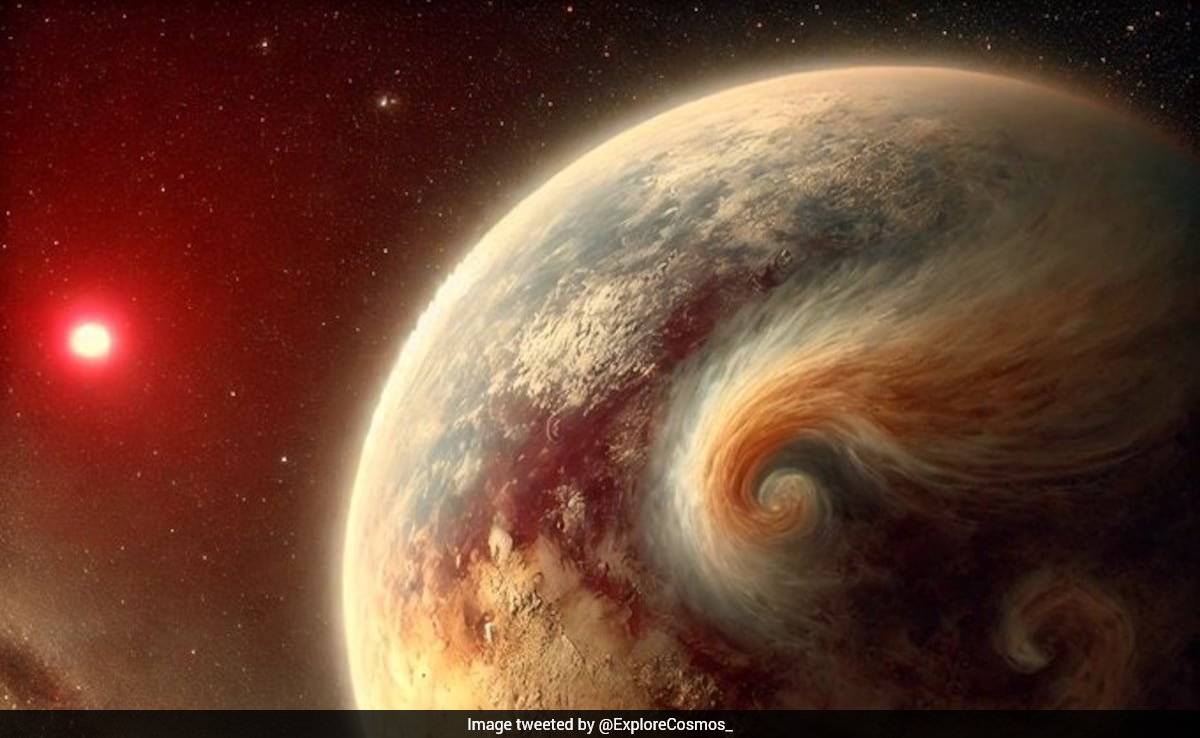
Scientists have identified an entirely new category of "liquid planet" that exists in a permanent, molten state. Traditionally, small exoplanets were categorized as either rocky "gas-dwarfs" with hydrogen atmospheres or "water worlds" with deep oceans and ice. This new discovery, detailed in Nature Astronomy, suggests a third class: planets that are essentially global oceans of magma. The primary example of this new type is L 98-59 d, a planet located approximately 35 light-years away from Earth, Guardian reported. The planet was detected by the James Webb telescope, the most powerful telescope ever put into space.
L 98-59 d
Dr. Harrison Nicholls of the University of Oxford described the planet as being in a "mushy, molten state" similar to molasses, with a mantle made of molten silicate and a likely molten core. Surface temperatures reach a staggering 1,900°C (3,500°F). Nearby planets exert gravitational pulls that cause massive waves to roll across its global magma ocean.
The rocky planet, with a radius about 1.63 times larger and mass about 1.64 times that of Earth's, orbits a small red star 35 light-years away. The molten lava world is enveloped in a thick atmosphere rich in hydrogen sulfide, which would produce a powerful smell of rotting eggs.
"This discovery suggests that the categories astronomers currently use to describe small planets may be too simple. While this molten planet is unlikely to support life, it reflects the wide diversity of the worlds that exist beyond the solar system. We may then ask: what other types of planets are waiting to be uncovered?" Harrison Nicholls said in a statement.
"If there are aliens out there that could live in lava, that would be amazing, but I don't think it's likely that it's habitable. It's nice to revel in the alienness of the planet itself," Nicholls added.
Why It Stays Molten
Unlike Earth, which cooled from its initial molten state billions of years ago, L 98-59 d remains "mushy" due to a runaway greenhouse effect. Its thick, hot atmosphere prevents heat from escaping, while tidal heating from neighbouring planets provides a secondary internal heat source.
This discovery, supported by data from the James Webb Space Telescope, suggests that many worlds previously thought to be habitable "water worlds" may actually be these uninhabitable molten "mush" planets. These planets, acting as time capsules of Earth's early magma phase, help scientists identify potential "hellish" imposters in the search for habitable, Earth-like worlds.
Track Latest News Live on NDTV.com and get news updates from India and around the world

