





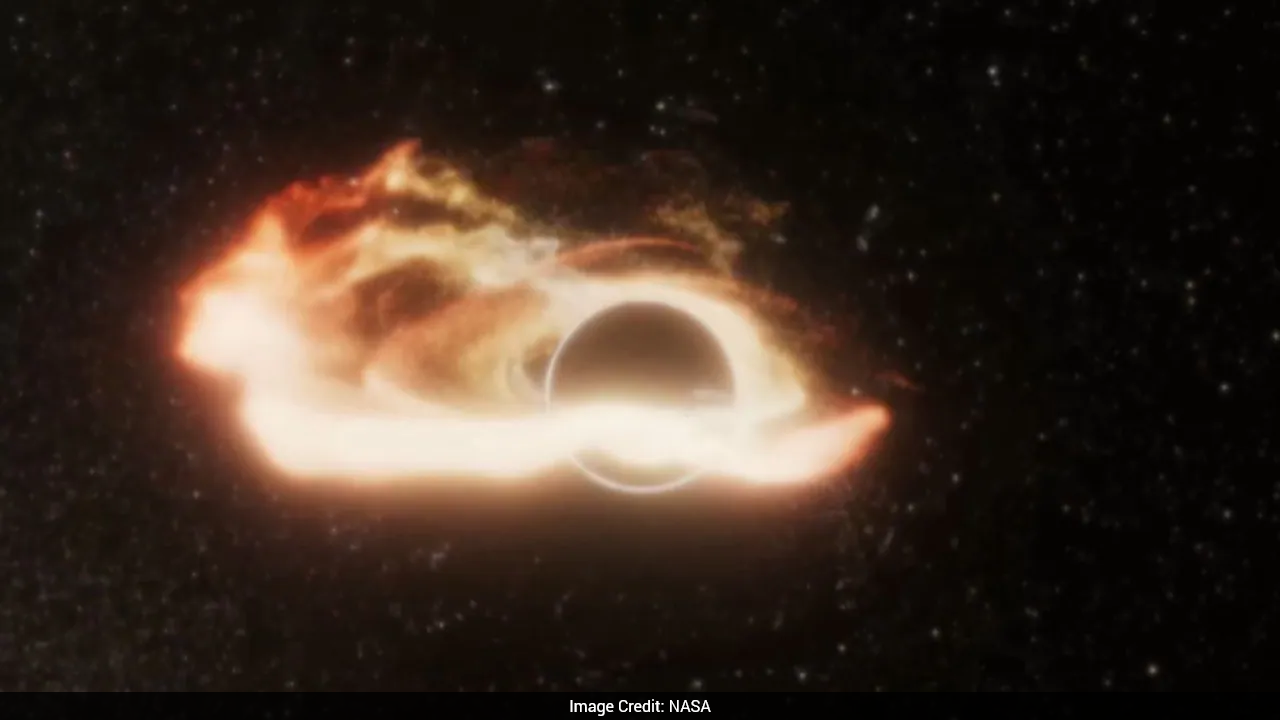
- NASA observed a rare black hole tearing apart a star far from a galaxy's centre
- The event is the first tidal disruption detected so far from a galaxy's core
- A new AI algorithm identified the flare among half a million nightly ZTF flashes
NASA has observed a rare 'Orphan' black hole lighting up after tearing apart a star far from the centre of a distant galaxy. Scientists say it is the first time such an event has been seen so far away from a galaxy's core, opening a new way to find hidden supermassive black holes, reported NASA.
NASA's Neil Gehrels Swift Observatory captured the event, known as a tidal disruption event, in which a star was ripped apart after moving too close to a supermassive black hole. The findings were published in The Astrophysical Journal Letters.
Robert Stein, a research fellow at The University of Maryland, College Park and NASA's Goddard Space Flight Center, said the team had been looking for these star-shredding events to find otherwise invisible supermassive black holes that wander away from the galactic cores where they usually reside. He added that this discovery, which is one of only a couple confirmed so far, validates a new technique that can now be used to search for more such black holes.
The black hole involved in the event has a mass about one million times that of the Sun. It was first identified in November 2025 after the Zwicky Transient Facility (ZTF) detected an unusual brightening in a galaxy about 750 million light-years away.
Stein said that out of the half million flashes detected by ZTF each night, the team's new artificial intelligence algorithm automatically recognised a flare that closely resembled a tidal disruption event despite its unusual location on the outskirts of a galaxy. For a few months, the event outshone its entire host galaxy in ultraviolet light, shining with the brightness of about 10 billion suns.
Scientists used several telescopes, including the SOAR telescope in Chile and NASA's Swift Observatory, to study the event in more detail. Swift's Ultraviolet/Optical Telescope measured the flare's temperature at about 54,000 degrees Fahrenheit (30,000 degrees Celsius).
Jonathan Carney, a doctoral student at the University of North Carolina at Chapel Hill, said the combined observations helped the team rule out other explanations and confidently identify the event as a tidal disruption event despite its unusual location.
Scientists say nearly every galaxy contains a supermassive black hole at its centre, and tidal disruption events usually happen only about once every 100,000 years in a galaxy. Before 2024, such events had only been observed in galaxy cores. In 2024, astronomers detected one about 2,600 light-years from a galaxy's centre. The newly discovered event was found more than 30,000 light-years away from its galaxy's centre, making it the most distant of its kind from a galactic core.
Track Latest News Live on NDTV.com and get news updates from India and around the world

