





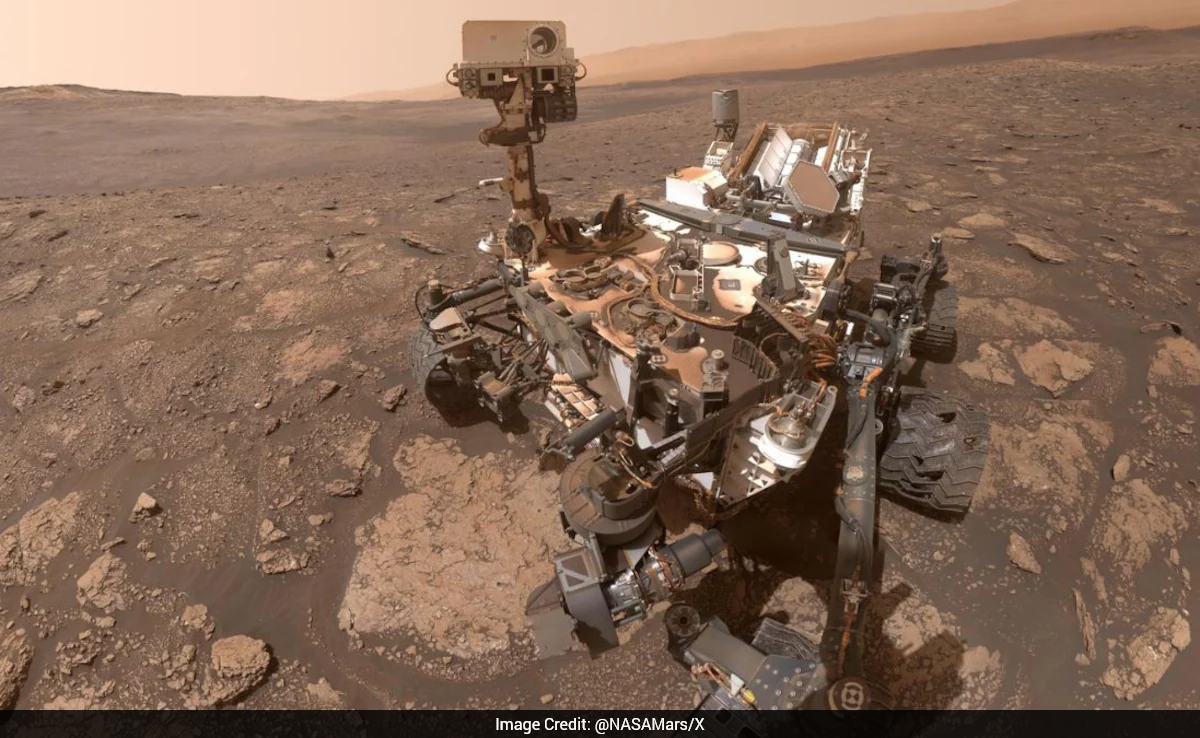
After years of careful research and testing, scientists have made an important discovery on Mars. A rock sample studied by NASA's Curiosity rover has revealed the most diverse collection of organic molecules ever found on the Red Planet. This finding has increased interest in the possibility that Mars once had the right conditions to support life, reported NASA.
The sample, collected in 2020, contained 21 carbon-based molecules. Out of these, seven were identified on Mars for the first time. Scientists explained that while these molecules are important, it is still not known whether they were formed by biological or geological processes.
However, the discovery confirms that ancient Mars had the chemical conditions needed to support life. Researchers also noted that these molecules have survived for billions of years despite exposure to radiation, which usually breaks down such compounds.
The findings have been published in the journal Nature Communications.
The rock sample, named "Mary Anning 3," was collected from Mount Sharp. This region once had lakes and streams billions of years ago. Over time, the area dried and refilled multiple times, leaving behind clay minerals. These minerals are known for preserving organic molecules, which are considered building blocks of life.
The newly identified compounds include a nitrogen heterocycle, a structure made up of carbon and nitrogen. Scientists believe that such molecules may be the earliest forms of molecules like RNA and DNA, which carry genetic information.
According to Amy Williams, lead author of the study, this discovery is significant because such structures may play a role in the formation of more complex nitrogen-based molecules.
She also clarified that nitrogen heterocycles have neither been previously found on the surface of Mars nor confirmed in Martian meteorites.
In addition, another important molecule, benzothiophene, was also found, which contains carbon and sulfur. This compound has previously been found in several meteorites, and some scientists believe it may have contributed to the early chemical evolution of the solar system.
This discovery was made possible through a mini-lab called "Sample Analysis at Mars" on the Curiosity rover. The rover drilled the rock, ground it into powder, and then heated it in a special furnace to analyze the gases emitted.
This process also used "wet chemistry," a technique in which the sample is mixed with a solution to break down large molecules into smaller parts for easier identification. The Mary Anning 3 sample was the first to be subjected to a powerful solution, tetramethylammonium hydroxide.
To confirm the results, scientists conducted similar tests on a sample of the Murchison meteorite on Earth. This test showed that large molecules can be broken down into smaller molecules, similar to those found on Mars.
This new discovery strengthens findings of large organic molecules previously found on Mars. These include long-chain hydrocarbons such as decane, undecane, and dodecane.
Mission project scientist Ashwin Vasavada said this achievement reflects the excellent work of the Curiosity team. They said the presence of these organic molecules further strengthens the possibility that conditions on ancient Mars may have been favorable for life.
Scientists say these findings will help guide future missions to Mars and other planets. Instruments similar to the technology used on Curiosity are being developed for upcoming missions, including the Rosalind Franklin rover and NASA's Dragonfly mission to Saturn's moon Titan.
Researchers believe that continued research and modern technology will lead to a better understanding of Mars' chemical history and the potential for life there.
Track Latest News Live on NDTV.com and get news updates from India and around the world

