





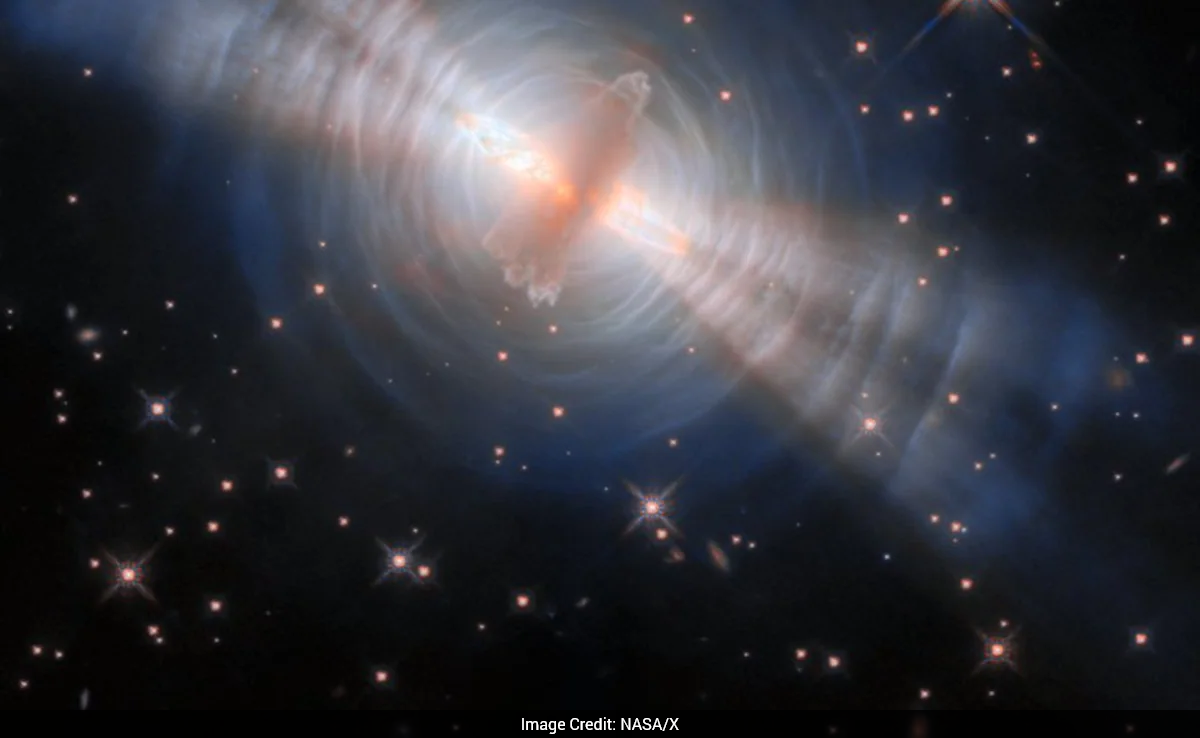
- The new Hubble image reveals detailed light and shadow in the Egg Nebula's stardust cloud
- The Egg Nebula is about 1,000 light-years away in the Cygnus constellation and hides a central star
- It is the youngest, closest pre-planetary nebula, showing early star death before planetary nebula formation
A new image captured by NASA's Hubble Space Telescope has revealed striking details of the mysterious Egg Nebula, showing a dramatic mix of light and shadow created by newly ejected stardust, reported NASA.
The nebula, located about 1,000 light-years away in the constellation Cygnus, contains a central star hidden behind a thick cloud of dust.
According to scientists, the structure appears similar to a yolk surrounded by a dark and opaque egg white, and only Hubble's powerful imaging ability can reveal its complex details.
Based on observations, scientists believe the Egg Nebula is the first, youngest, and closest pre-planetary nebula ever discovered. A pre-planetary nebula is the stage that appears before a planetary nebula forms.
Planetary nebulae are clouds of gas and dust that form when the outer layers of a dying star, such as the Sun, are ejected. Although they contain the word "planetary" in their name, they have no connection to planets.
The Egg Nebula is currently in this early transitional phase. Scientists believe the nebula shines primarily by reflecting light from its central star. This light emerges through a polar hole in the surrounding dust and passes through a dusty disk that was ejected from the star's surface a few hundred years ago.
This image shows two bright rays of light emanating from the dying star, highlighting rapidly moving polar lobes. These lobes rip through the circular arcs of older, slower-moving dust surrounding the nebula.
Scientists say the shape and speed of these structures suggest that gravitational interactions with one or more hidden companion stars may be playing a role. These companion stars are believed to be hidden deep within the dense stellar dust disk surrounding the central star.
Sun-like stars begin to shed their outer layers when their hydrogen and helium fuel begins to run out. The remaining core of the star then becomes extremely hot and ionizes the surrounding gas. This same process further creates the luminous gaseous layers seen in planetary nebulae such as the Helix Nebula, the Stingray Nebula, and the Butterfly Nebula.
But the Egg Nebula is still in its pre-planetary phase, which lasts only a few thousand years. Scientists say this period is crucial for understanding the process of material ejected from dying stars, as evidence of this is clearly visible during this phase.
The balanced and symmetrical patterns visible in the Hubble image indicate that this structure was not formed by a powerful explosion like a supernova. Instead, scientists believe that the arcs, lobes, and central dust cloud were formed by several coordinated, yet still incompletely understood, processes within the dying star's carbon-rich core.
According to astronomers, these types of aging stars produce large amounts of cosmic dust and spread it into space. This dust further contributes to the formation of new stellar systems, including systems like our solar system, where Earth and other rocky planets formed about 4.5 billion years ago.
The Hubble Space Telescope has studied the Egg Nebula several times before. Initially, an image was taken in visible light using the WFPC2 (Wide Field and Planetary Camera 2). A near-infrared image taken by NICMOS (Near Infrared Camera and Multi-Object Spectrometer) in 1997 provided a closer look at the light emanating from the nebula.
Subsequent observations from the ACS (Advanced Camera for Surveys) in 2003 revealed the full spectrum of dust waves surrounding the nebula. Images taken in 2012 with the WFC3 (Wide Field Camera 3) revealed the central dust cloud and strong gas flows in detail.
The newly released image combines data from observations in 2012 with additional observations from the same program, creating the clearest picture yet of this complex and mysterious cosmic structure.
Track Latest News Live on NDTV.com and get news updates from India and around the world

