





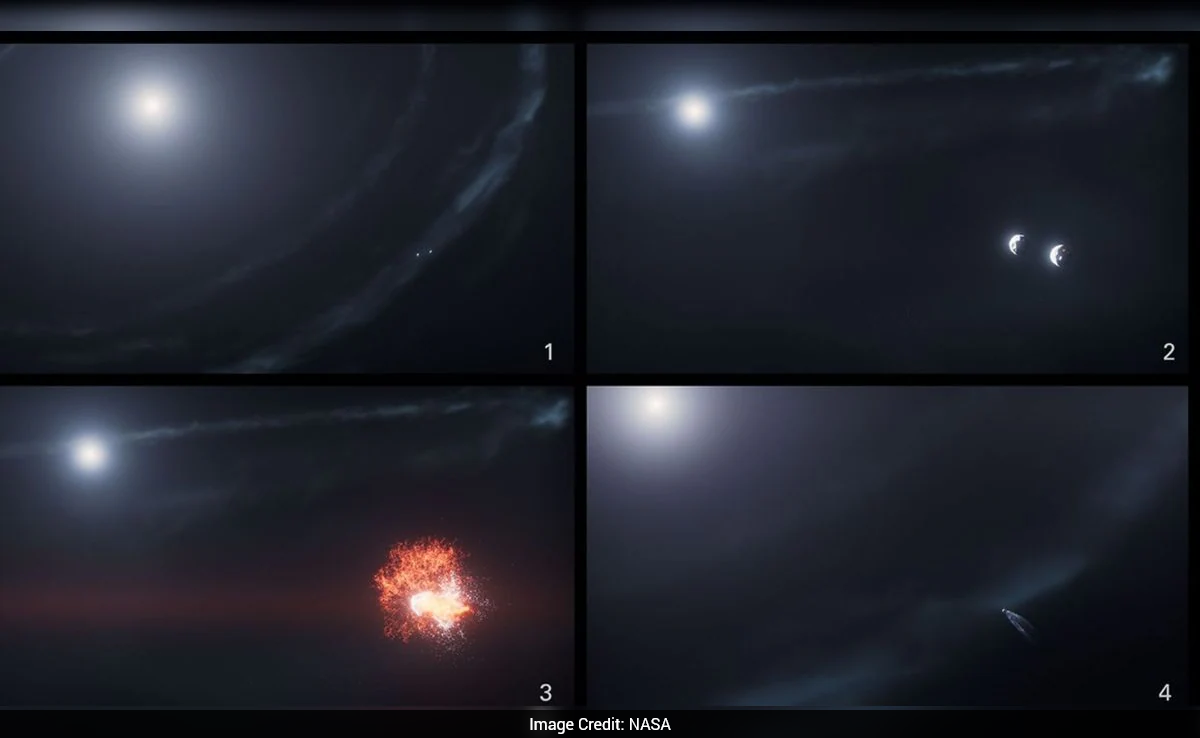
- Hubble captured images of two massive debris clouds around star Fomalhaut 25 light-years away
- The debris clouds result from collisions of planetesimals in Fomalhaut's debris belts
- Two collisions occurred in 20 years, challenging models predicting one every 100,000 years
In a spectacular glimpse into the violent early days of planetary systems, NASA's Hubble Space Telescope has captured images of catastrophic collisions in a star system beyond our own. According to NASA, the observations show two massive debris clouds forming around the bright star Fomalhaut, 25 light-years from Earth, offering a rare look at the chaos that shaped planets billions of years ago.
Astronomers believe the solar system's early days were a cosmic bumper-to-bumper, with planetesimals, asteroids, and comets colliding and pelting Earth, the Moon, and other inner planets with debris.
Principal investigator Paul Kalas of the University of California, Berkeley, explained that they had never seen such a sudden point of light in an outer planetary system.
He explained that this object was not present in previous Hubble images, which suggests the team witnessed a violent collision between two massive bodies, creating a vast debris cloud unlike anything seen in the solar system today.
Fomalhaut, located in the constellation Gemini and also known as the Southern Fish, is larger and brighter than the Sun. It is surrounded by several dust belts, making it an ideal location for studying planet formation and collisions. In 2008, Hubble detected a possible planet near Fomalhaut, named Fomalhaut b. Recent observations revealed that this object is actually a dust cloud formed by planetesimal collisions. During this search, scientists observed a second nearby spot of light, now called "Circumstellar Source 2," or CS2, while the first object was named CS1.
The proximity of these two debris clouds remains a mystery. If these collisions were random, CS1 and CS2 should have appeared in different locations, but they are located near Fomalhaut's inner layer of outer debris. Another surprising finding is that two collisions were observed in such a short period of time. According to previous models, a collision should have occurred every 100,000 years, whereas Hubble observed two collisions in just 20 years. Kalas said that if the past thousands of years were observed in accelerated motion, Fomalhaut's system would appear to be constantly brightening from these collisions.
Such collisions are crucial for the evolution of planetary systems, but they are rare and difficult to study. Co-author Mark Wyatt of the University of Cambridge explained that this observation allows scientists to estimate the size and number of colliding objects. He said the planetesimals that formed CS1 and CS2 are about 37 miles (60 kilometers) across, and about 300 million similar objects are orbiting Fomalhaut.
The temporary nature of CS1 and CS2 is a warning for future exoplanet missions. Such dust clouds can appear like planets and confuse telescopes. Kalas explained that CS2 looks exactly like an exoplanet reflecting starlight, and the study of CS1 showed that a large dust cloud can appear planetary for many years.
Kalas and his team will continue to monitor CS2 using Hubble for the next three years to observe its evolution. CS2 is closer to the dust belt than CS1, so it may collide with other material, causing a large influx of dust and increasing the brightness of the surrounding region. This continued observation will provide important information about the formation and behavior of planetary systems.
Track Latest News Live on NDTV.com and get news updates from India and around the world

