



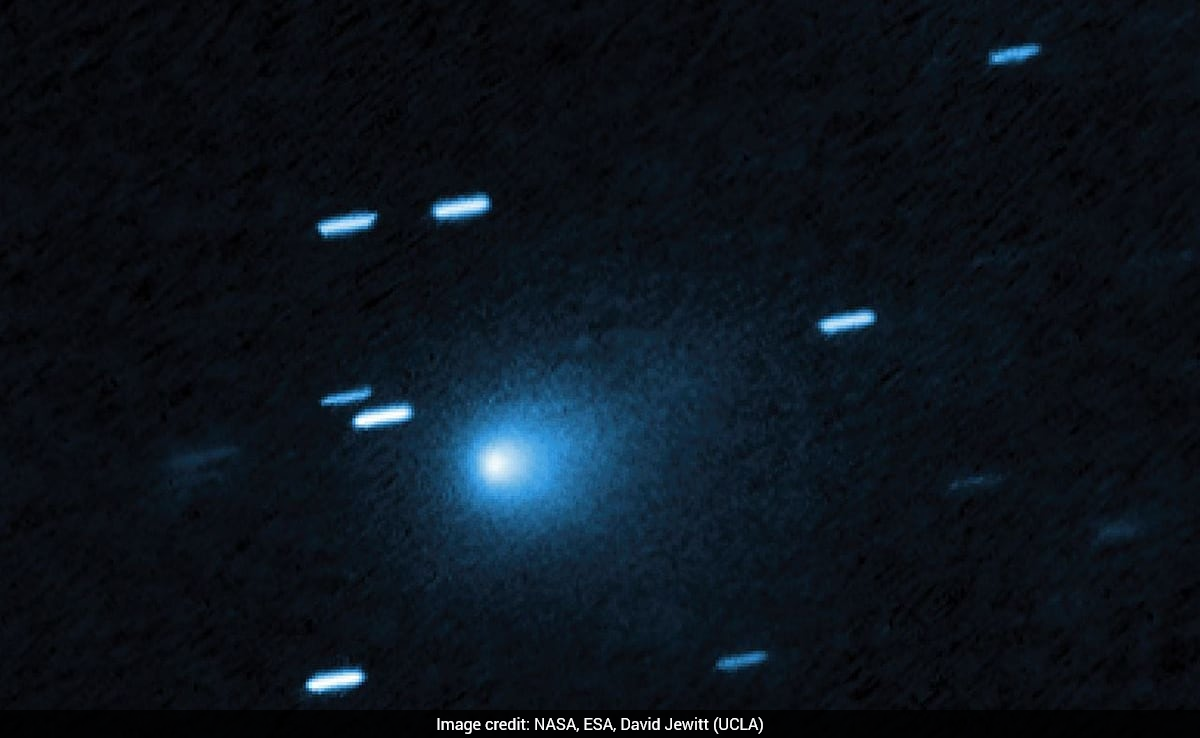
- The interstellar object 3I/ATLAS is identified by NASA as a comet with an unusual anti-tail.
- Harvard's Avi Loeb suggests the anti-tail may be a swarm of solid objects near 3I/ATLAS.
- Images show a tear-drop shaped coma extending toward the Sun by about an arcminute.
The interstellar object 3I/ATLAS, which NASA clearly described as a comet, still sparks intense debate among astronomers due to its unusual "anti-tail" pointing toward the Sun. Harvard astrophysicist Avi Loeb suggests this feature might not be a typical comet tail, but rather a swarm of solid objects accompanying 3I/ATLAS.
While writing a new Medium blog post, Loeb said that the post-perihelion images of the interstellar object showed a tear-drop shape of its coma with an extension by about an arcminute towards the Sun, with the JPL Horizons reporting a non-gravitational acceleration during the same period.
Also Read | Breathtaking Image Shows Colours Of Earth's Atmosphere As Seen From Space
He suggested that this unusual anti-tail could be comprised of a swarm of non-evaporating objects, unlike typical comet tails composed of gas and dust. Loeb proposes that these objects don't experience the same non-gravitational acceleration as 3I/ATLAS, causing them to appear closer to the Sun.
"If 3I/ATLAS is surrounded by a swarm of objects that do not share its non-gravitational acceleration, then these objects will tend to be closer to the Sun relative to 3I/ATLAS, because 3I/ATLAS is pushed away from the Sun relative to the objects through its non-gravitational acceleration," he wrote.
Also Read | Molecule Crucial For 'Happy Hormone' Found In Asteroid Bennu's Sample
"At the current separation of 3I/ATLAS from the Sun of 270 million kilometers, the displacement would imply that the objects are closer to the Sun than 3I/ATLAS by about 54,000 kilometers, corresponding to an angular separation of 0.7 arcminutes in the sky. This separation is comparable to the sunward elongation of the teardrop glow around 3I/ATLAS."
The objects could be rocky fragments, structures formed during interstellar travel, or something entirely different. NASA has confirmed 3I/ATLAS is a natural comet, but Loeb's theory highlights the object's unusual behaviour, leaving room for further investigation.
"If the anti-tail is indeed associated with a swarm of non-evaporating objects around 3I/ATLAS, the interesting question is what is the nature of these objects? Are they rocky fragments or something else?" Loeb asked.
Track Latest News Live on NDTV.com and get news updates from India and around the world

