





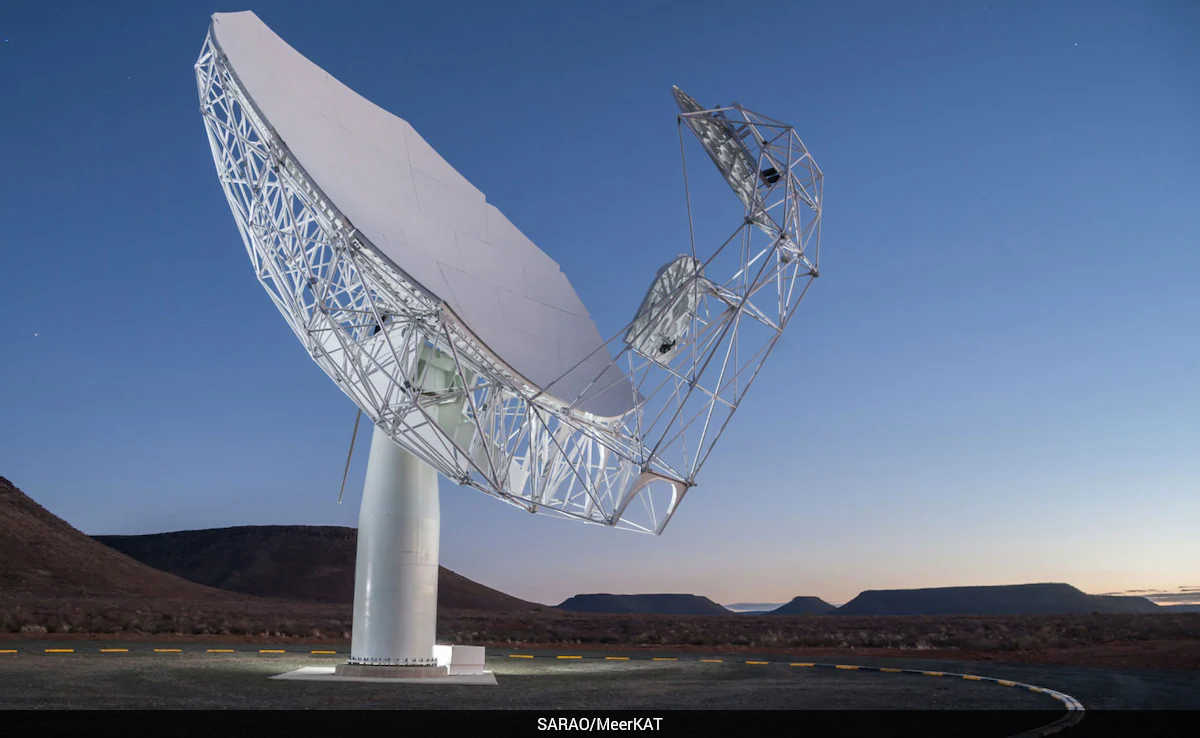
Astronomers have discovered a powerful "cosmic laser" more than 8 billion light-years away using the MeerKAT radio telescope, marking the most distant detection of its kind.
The phenomenon, known as a hydroxyl megamaser, was identified in a pair of colliding galaxies where intense gas compression amplifies radio emissions. Unlike lasers on Earth, these megamasers operate at radio wavelengths and can shine across vast cosmic distances.
The newly detected system, HATLAS J142935.3-002836, lies at a redshift of 1.027, significantly beyond previous observations. Scientists have dubbed it a "gigalaser" due to its exceptional brightness and energy output, making it the most powerful example ever recorded.
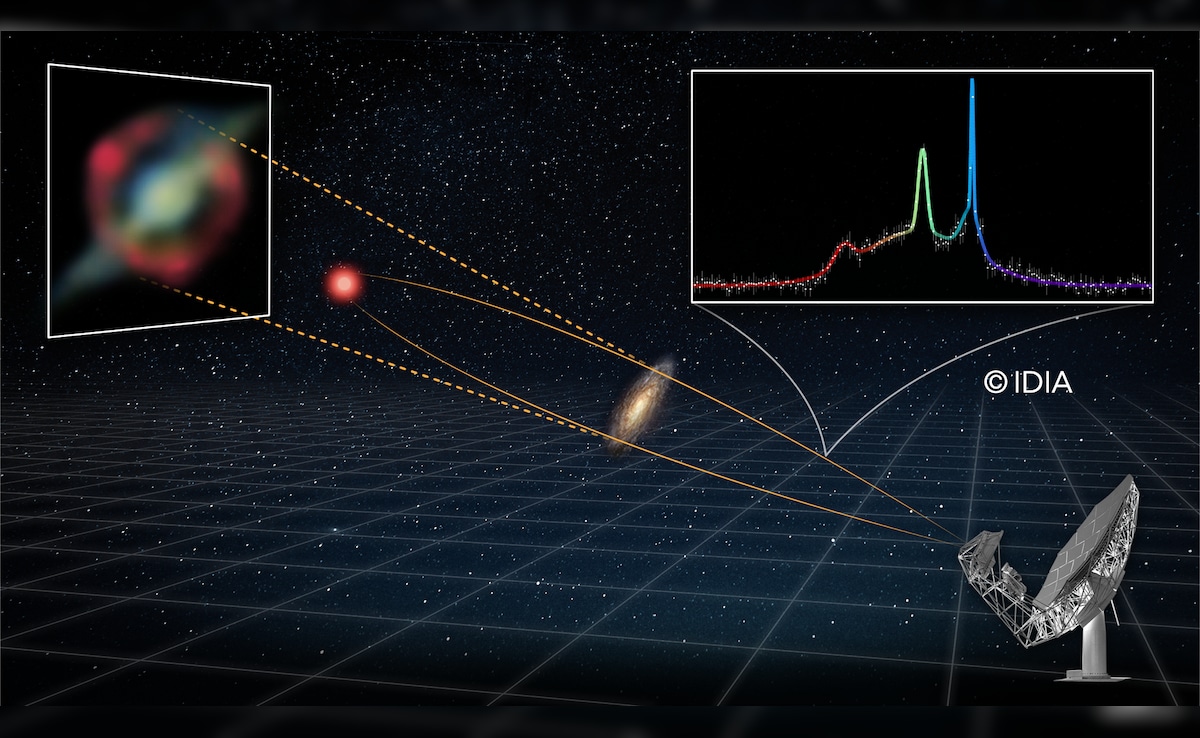
Galaxy 8 billion light-years away, magnified by foreground galaxy, reveals hydroxyl gigamaser through radio light spectrum analysis.
Photo Credit: Inter-University Institute for Data-Intensive Astronomy (IDIA)
Lead researcher Thato Manamela described the discovery as extraordinary. "We are seeing the radio equivalent of a laser halfway across the universe," he explained in a South African Radio Astronomy Observatory (SARAO) press release. "During its journey to Earth, the radio waves are further amplified by a perfectly aligned foreground galaxy, which acts like a natural lens."
This effect, known as gravitational lensing, bends space-time and magnifies distant light sources, allowing astronomers to detect objects that would otherwise remain hidden.
Manamela added, "We have a radio laser passing through a cosmic telescope before being detected by MeerKAT - all together enabling a wonderfully serendipitous discovery."
The findings, accepted for publication in Monthly Notices of the Royal Astronomical Society Letters, offer a rare glimpse into the Universe when it was less than half its current age.
Researchers believe this breakthrough highlights the growing power of radio astronomy and sets the stage for future discoveries with the Square Kilometre Array, which aims to uncover hundreds more such systems.

