





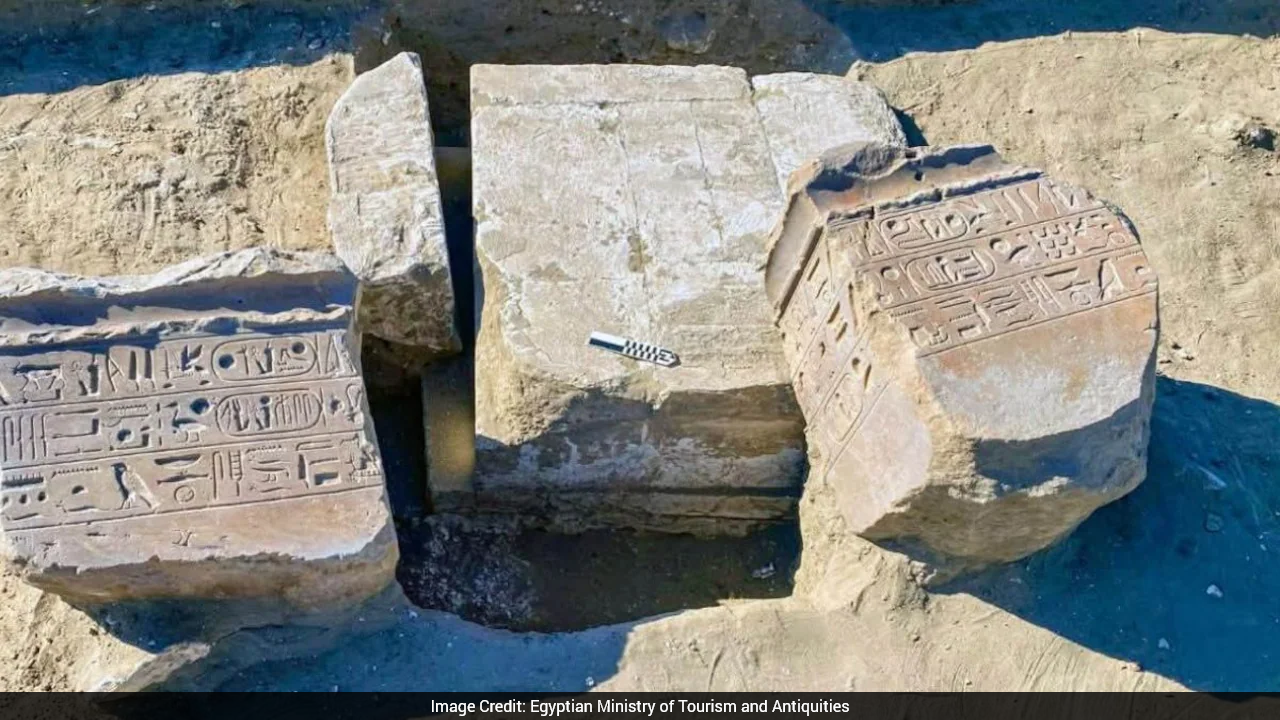
A 3,000-year-old sandstone block found in Egypt could help archaeologists learn more about a lost city linked to an ancient route mentioned in the Old Testament, reported NYPost.
The artifact was found at Tell Abu Seifi, an archaeological site in northeastern Egypt near the Sinai Peninsula, according to an announcement by the Egyptian Ministry of Tourism and Antiquities, as reported by Fox News.
Archaeologists speculate that this site could be the ancient and long-lost city of Mesen. The city is believed to have once been situated near the Horus Military Road-a crucial route connecting Egypt to the eastern Mediterranean region.
Scholars have compared this ancient route to the "way of the land of the Philistines" mentioned in the Book of Exodus.
According to the religious text, the Israelites departing Egypt were warned against taking this short, direct route to Canaan. It was believed that traveling this path could expose them to warfare and potentially cause them to return to the very land they were leaving.
The most significant clue in this discovery is a massive sandstone beam found broken into two pieces. According to Arkeonews.com, several sections of the stone bear inscriptions.
Three surfaces of the stone display the titles of Ramses II, a prominent ruler of Egypt's New Kingdom era, a period spanning roughly 1570 to 1069 BCE. Ramses II is also commonly associated with the story of Moses.
Another inscription on the stone identifies the Egyptian god Horus as the lord of the city of Mesen, a detail considered a vital indicator regarding this discovery.
Recent excavations at the site have also revealed the remains of a heavily fortified temple complex. Storage chambers were found there, and the entire complex was enclosed by mud-brick walls and gateways. Two paved stone roads leading to the fortifications were also uncovered.
This discovery could help archaeologists understand a vast network of temples, fortresses, and administrative buildings. All these structures were part of a strategic New Kingdom route used to transport troops and supplies.
In later periods, the site came under the control of the Persians, Ptolemies, and Romans, in addition to the Egyptians. Ptolemy was a Macedonian Greek ruler who governed Egypt from 305 to 30 BCE. The Romans also extracted stone from parts of the ancient complex to use in the production of lime.
However, the inscription on the sandstone does not yet provide conclusive proof that Tell Abu Seifi was the ancient city of Mesen.
According to cultural officials, the inscription found on the stone and the remains unearthed during excavations collectively present a strong archaeological and historical case linking the site to the ancient city of Mesen.
Officials stated that excavations and scientific studies would continue in order to further clarify the identity of Mesen.
Track Latest News Live on NDTV.com and get news updates from India and around the world

