




Having spent nearly four decades working across education, industry and international partnerships, I have observed India's rapid evolution closely.
I have seen generations of young Indians leave our shores with ambition and return with new skills, ideas and perspectives. I have seen universities deepen their global outlook, industries become increasingly knowledge-driven and international education mature into a collaborative pillar between nations.
Yet today, I find myself pondering a different question.
When we look back at this period, international education will not be as much about crossing borders as about the knowledge created, the capabilities strengthened, and the institutions built collaboratively.
I believe we are entering a new chapter and a very important one.
Student mobility will always remain important and continue to change lives, broaden horizons and create enduring connections between nations. But India's aspirations and potential to match it today are much larger, and international education is a mainstream pathway for achieving it.
The aspiration to be a developed nation by 2047 has shifted the focus on education from a stand-alone aspect to a convergent aspect of capability creation. Beyond imparting education, the efforts seek to develop the researchers, innovators, entrepreneurs and skilled professionals who will shape India's future.
This demands more of universities than traditional models of internationalisation. It requires universities, industries, governments and communities to work together and create lasting value that outlasts individual programmes or partnerships.
Internationalisation through a different lens
Throughout my career, one observation has remained constant: that the most significant breakthroughs do not happen in isolation.
Be it healthcare, technology, sustainability or artificial intelligence, the challenges defining our future are neither just local nor institution- or community-specific. The solutions therefore emerge from a meeting of minds across disciplines, cultures and communities with a global purpose.
This presents a tremendous opportunity for India that would leverage its unparalleled combination of talent, scale, entrepreneurial energy and ambition.
This brings me to the conclusion that what is increasingly important is to create environments that facilitate talent to collaborate globally while remaining deeply connected to local priorities and aspirations.
For international universities, this calls for a strategic rethink and agility of partnership. Transplanting an existing model from one country into another rarely yields much success. Meaningful partnerships built through listening, learning and aligning with local strengths are the most effective way forward.
Over the years, that philosophy has guided Deakin's engagement with India. Our commitment of working ‘in India, with India, for India' underpins our most enduring partnerships, built over decades working alongside each other rather than as a market that works as a number cruncher.
Partnerships for shared capability
A privilege of long years of work in higher education is the opportunity to witness a long arc of impact.
The true value of a partnership emerges over time. It emerges with researchers who collaborate, students and scholars who discover new opportunities, industries that gain new expertise, and institutions that become stronger together while working toward mutual goals.
That belief underpins Deakin's four HUB partnerships in India with Manipal Academy of Higher Education, O.P. Jindal Global University, Symbiosis International University and Chitkara University.
What excites me most about collaborations is what becomes possible when complementary strengths are combined.
At their impactful best, partnerships become platforms for capability building. They create new opportunities, strengthen industry engagement, expand access to expertise and help develop the skills required for emerging sectors. Most importantly, they allow institutions to achieve outcomes that none could realistically accomplish alone.
Research at the heart of the conversation
I have often observed that discussions around international education focus on the most tangible outcomes of numbers, enrolments and programme growth.
While important, they do not outline the depth and breadth of impact.
For me, one of the strongest indicators of a university's contribution is the knowledge it helps create.
Long after students graduate, the scholarly excellence continues to shape industries, influence policy, improve lives and create resilience for future generations.
India has everything necessary to become one of the world's most influential research ecosystems. Achieving that potential will require sustained collaboration between universities, industry and international partners, with a shared focus on solving real-world challenges.
This is why initiatives such as joint doctoral research, cotutelle programmes and collaborative research projects matter so deeply. Our partnerships with Indian Institutes of Technology, Roorkee, Madras and Hyderabad, The Energy Resources Institute and more do more than produce research outputs.
These partnerships cultivate research cultures, develop scholars and create networks that continue generating pathways of value for years to come.
Looking at success differently
Over the years, I have become increasingly convinced that the most valuable outcomes in education are often the hardest to measure.
Unlike the number of partnerships, graduating student numbers and new programs launched, there is the intangible and lasting potential value of knowledge creation.
What lacks metrics and can only be evidenced over time are the most profound measures of success – Capability creation, creation of graduate and research scholar pathways, skilling and industry-interfaced ecosystems, incubation centres and think-tanks that deep-dive into problem-solving for global communities
This, in my opinion, will determine the direction of transnational education.
India's scale and size of ambitions are far too significant for internationalisation to be confined to mobility alone. The opportunity before us is much larger: to create partnerships that strengthen knowledge ecosystems, accelerate innovation and contribute meaningfully to national development.
For Deakin, that has always been the essence of our engagement with India. Since inception, our work has transcended the role of a provider of international education. We see ourselves as a long-term partner in India's growth story, working alongside universities, industry, government and communities to help build capability where it matters most.
Ultimately, the next chapter of international education will be defined by what we are able to build together, and by how effectively we equip the next generation to shape not only India's future, but the world's.
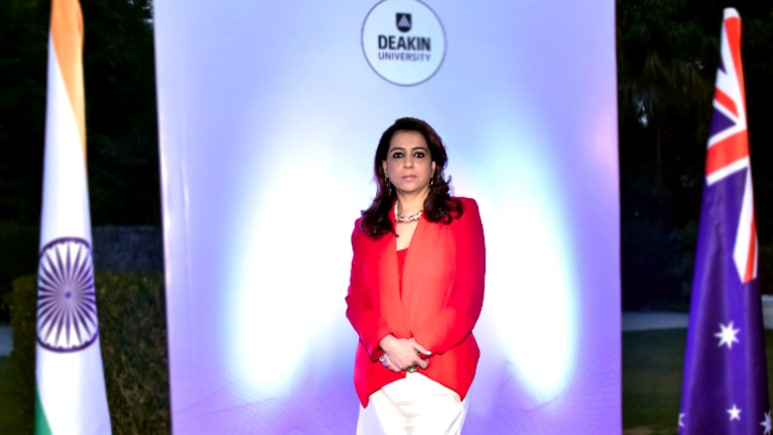
(Ravneet Pawha is the Vice President (Global Engagement) and CEO (South Asia) at Deakin University, Australia, and a prominent advocate for international education, research, and community engagement. With over 29 years of pioneering experience, Ravneet has played a transformative role in shaping the global education landscape.)
Disclaimer: The above sponsored content is non-editorial and has been sourced from a third party. NDTV does not guarantee, vouch for or necessarily endorse any of the above content, nor is responsible for it in any manner whatsoever.
Track Latest News Live on NDTV.com and get news updates from India and around the world

