





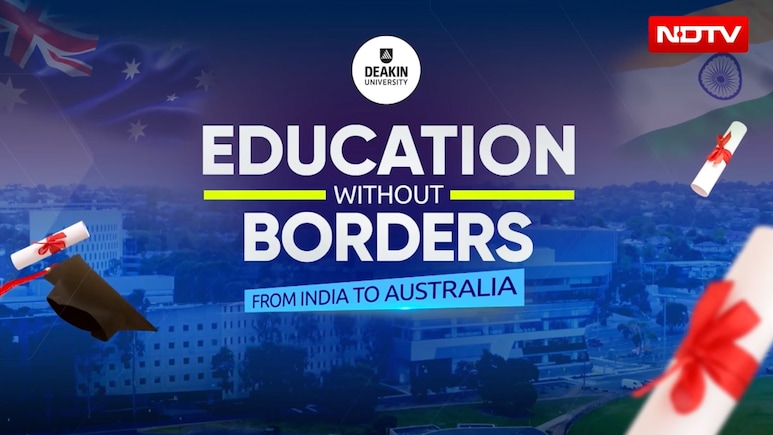
For Indian students, studying abroad has long been an important step towards building a global career. However, rising education costs, visa uncertainty and changing job markets have made families more careful about making this decision. Today, students are looking for options that give them international exposure without requiring them to move overseas right at the start of their academic journey.
Deakin University, Australia, is working towards making this possible through its Hub Programme in India. The initiative brings together Deakin and four leading Indian universities to create study pathways that combine local learning with international education.
What Is The Deakin Hubs Programme?
The Deakin Hubs model is the university's flagship initiative for strengthening its presence in India and expanding academic collaboration with local institutions. Rather than following the traditional route of moving abroad immediately after school, students can explore a pathway that allows them to begin their education in India before progressing to Australia.
The hubs offer a mix of student mobility, academic support, hybrid learning, industry engagement, research collaboration and innovation-focused programmes. The courses cover fields such as engineering, artificial intelligence, business, management, sports science and liberal arts.
The idea is to bring together the academic strengths of both countries, giving students access to international curricula and opportunities while allowing them to start their journey in a familiar environment.
Professor Amanda Pyman, Dean of Deakin Business School, highlighted the university's partnerships with O.P. Jindal Global University, Symbiosis International University and Manipal Academy of Higher Education.
“We are delighted by the partnerships that we have throughout India. But particularly the hub partnerships with OP Jindal, with Symbiosis and with Manipal,” she said.
She added that these pathway agreements combine regional strengths with internationally recognised qualifications, allowing students to begin their studies in India before moving to Australia.
Professor Nick Birbilis, Executive Dean of Deakin University's Faculty of Science, Engineering and Built Environment, also spoke about the collaborative nature of these partnerships.
“With Manipal Academy of Higher Education, Symbiosis International University and Chitkara University, we have well-articulated articulation pathways, which are not really transactional,” he said.
He explained that the programmes bring together academic syllabuses and local experiences, adding that the students involved become part of something special.
Symbiosis International University, Pune
The partnership between Deakin and Symbiosis International University, Pune reflects a broader shift in international education.
Vidya Rajiv Yeravdekar, Chancellor of Symbiosis International University, explained how the meaning of internationalisation has evolved.
“So internationalisation of higher education really means cross-border education,” she said.
She added that international education now goes beyond student mobility. It also involves transnational education, where universities can take their academic programmes to other locations instead of requiring students to travel abroad.
This approach allows students to experience international learning within their own campuses while opening up opportunities for further study overseas.
O.P. Jindal Global University, Haryana
One of the key offerings of the Hub Programme at O.P. Jindal Global University is the Global B.Com pathway, which allows students to complete the first two years of their Bachelor of Commerce at JGU before moving to Deakin University in Australia.
Students then undertake one year of a Bachelor of Business programme, followed by 1.5 years of an MBA International. The integrated pathway allows eligible students to earn three qualifications over four and a half years.
Dr Akhil Bhardwaj, Executive Dean and Director of the Office of International Affairs and Global Initiatives at JGU, said the partnership goes beyond student programmes.
“Our partnership with Deakin is very holistic in a sense that we not only collaborate for the students' perspectives, but we also collaborate for faculty-level engagements including joint conferences, seminars, joint publications and so on and so forth,” he said.
He added that student-focused activities remain central to the partnership. Along with dual-degree programmes and student exchanges, JGU also hosts Deakin students for short-term India Immersion programmes.
Chitkara University, Punjab
At Chitkara University in Punjab, the partnership follows a curriculum licensing model. Students can study Deakin's curriculum in India for the first two years of either a Bachelor of Software Engineering (Honours) or a Bachelor of Artificial Intelligence (Honours).
They can then transfer to Deakin University in Australia to complete the remaining two years and earn an Australian degree.
The arrangement also supports research collaboration between the two institutions. By combining academic resources and teaching expertise, the universities aim to make the transition between India and Australia smoother for students.
Dr Madhu Chitkara, President and Co-founder of Chitkara University, said the partnership was designed to offer more than a simple transfer between institutions.
“It's not just a transfer of students from Chitkara to Deakin. This is a program which is bridged very beautifully,” she said.
She explained that the curriculum is co-created, co-designed and co-taught by professors from both universities.
Manipal Academy Of Higher Education, Karnataka
Deakin and Manipal Academy of Higher Education have been partners for more than two decades, with opportunities for students to explore cross-border learning and academic collaboration.
MAHE has built a strong presence in higher education, with students coming to its campus from across India and beyond. Its partnership with Deakin further supports research and academic development across areas of shared interest.
Lieutenant General Dr MD Venkatesh, Advisor to the Manipal Educational and Medical Group, highlighted the wider value of such international partnerships.
“Partnerships of this nature are very important for nation building, collaboration between nations, for joint research, for capacity building and more than anything else for the global good,” he said.
He pointed to areas such as sustainability, technology and health sciences as fields where international collaboration can make a meaningful difference. He also described the Deakin partnership as a model that could be followed by other universities, noting the strong relationship between India and Australia despite their cricket rivalry.
Building New Pathways For Global Education
Through its four Indian university partnerships, Deakin University is exploring a model of international education that brings together local learning and global opportunities. The hubs support academic exchange, research, industry engagement and study pathways that can help students prepare for careers in an increasingly connected world.
Disclaimer: The above sponsored content is non-editorial and has been sourced from a third party. NDTV does not guarantee, vouch for or necessarily endorse any of the above content, nor is responsible for it in any manner whatsoever.
Track Latest News Live on NDTV.com and get news updates from India and around the world

