





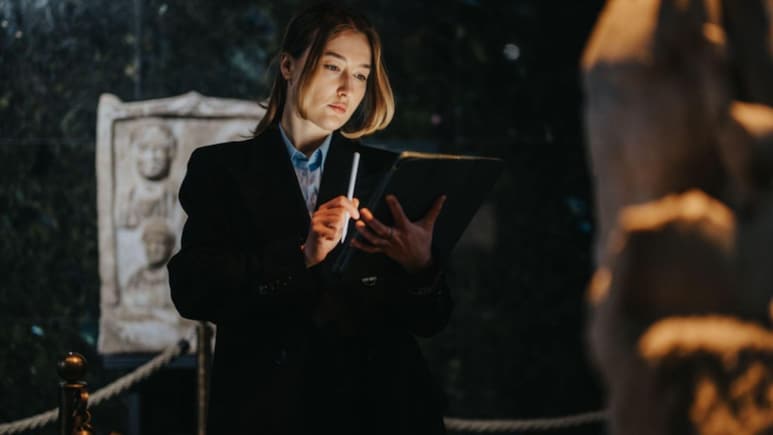
Millions of photographs, artworks, and documents are languishing in museums, archives, and galleries across the globe. Spilling out of basement vaults and packed into cardboard boxes, damaged negatives, fading ink, brittle paper, and arcane cataloguing systems mean much of this priceless collection is locked away or inaccessible.
The pressing issue for curators and conservationists is no longer simply preservation itself, but rather tackling the monumental task efficiently and within realistic timeframes. Many cultural institutions aren't ready. Large parts of their collections may exist only as physical copies or as images tucked away in disparate databases with little to no metadata. Institutions with running digitisation projects are still decades away from analysing their backlog.
Artificial intelligence (AI) is starting to change all that. By automating routine tasks and enhancing human effort, AI is helping to restore damaged imagery, digitise ancient texts, and reveal meaning from millions of documents and artworks across India's cultural archives.
Here's a closer look at how AI is revolutionising the relationship between cultural institutions and their audiences.
Restoring the Past with AI-Powered Image Enhancement
Old photographs, art, and documents can be digitised in high resolution by museums using an AI image upscaler, which works to recreate and bring back elements that have faded into history.
Upscalers use machine learning to make sense of the pixels in these old images, intelligently filling in details so they can be enlarged without losing quality. For museums and archivists working to digitise their collections and make them accessible online, AI image upscaling brings old photos back to life.
AI can improve the clarity of digital scans of old photos and documents, sharpening faces, text and other important details while removing grain and noise. It can also help mask damage caused by stains, tears, scratches, or poor photo quality so they are less distracting when viewed digitally.
Colourisation is another popular use of AI in historical photo editing. Applying colour to black-and-white images makes them more relatable to modern viewers and can help humanise stories from centuries past.
In addition to restoring old photos and documents to a readable state, AI image enhancement can make archives more accessible.
This makes text more readily searchable via optical character recognition (OCR), enables more precise subject-based image searches, and boosts the visibility of restored photos in search engine results. By helping archivists make digital collections more searchable, AI allows historical documents and photos that would otherwise linger on dusty shelves to find new life online.
Key takeaway:
- This capability is increasingly being used to standardise archival image quality across entire collections, not just individual restorations.
- It also enables comparison between multiple historical versions of the same image to support more accurate historical interpretation.
Digitising and Preserving Fragile Historical Collections
Some of our most precious archival materials are in formats vulnerable to degradation. Photographs, paper documents, and artwork fade and decay over time due to environmental factors, physical contact, and age. Digitisation allows organisations to preserve our cultural history safely by minimising damage to the original pieces.
At the same time, AI is transforming how museums, libraries, and archives digitise large backlogs. We're already seeing machine learning applied to automate aspects of photo and document tagging. Instead of having technicians manually sort through countless files, AI can learn to recognise particular subjects, write metadata, and organise files at a fraction of the time. These workflows allow institutions to easily preserve their wealth of media and create collections that are far easier for researchers and the public to discover.
Digitisation is especially crucial for ensuring iconic imagery endures. Many of the photos that changed the world are digitised so we can continue to access them hundreds of years from now, even if the original copies fade beyond repair. Digitisation also allows us to minimise physical interaction with originals. While glass cases help preserve precious documents and photos, digitisation removes the need to take them out of storage whenever someone wants to learn more about them.
Key takeaway:
- AI can help predict which materials are most at risk of deterioration, helping institutions prioritise preservation efforts.
- It also enables cross-institutional linking of archives, making dispersed collections easier to unify digitally.
Using AI To Analyse And Authenticate Artworks
Art authentication has always been carried out by art historians, conservators and specialists. Although human assessment is still key to the process, artificial intelligence (AI) can be used to evaluate artworks in new ways and assist the professionals who authenticate art. Rather than replacing human experts, AI is being used to undertake labour-intensive or near-impossible manual tasks when examining artworks.
When trained using thousands of images of an artist's work or art from a specific movement, AI can use pattern recognition to evaluate elements like brushstrokes, colour use, texture, and other stylistic details. As it 'reviews' the artwork, AI can help spot similarities or abnormalities when compared to known works by that artist or others from that period.
All of this information can help authenticate artworks by allowing experts to compare findings against larger datasets. AI is also being used to identify areas of restoration, repair, or alteration. These areas may be difficult to detect just by examining a painting.
By feeding images into AI technology, conservators can use the additional information gathered to learn more about the artwork. Additionally, AI can help examine provenance by making it easier to analyse historic documents and records.
Key takeaway:
- AI analysis is increasingly being used as a secondary "review layer" to challenge or confirm expert assessments rather than replace them.
- It can also detect subtle inconsistencies across an artist's entire body of work that are invisible at a single-piece level.
Making Vast Collections Searchable and Accessible
With museums, galleries and archives digitising their collections at a rapid pace, one of the challenges has been information overload. How do you sort through hundreds of years' worth of history and access the information you need? Artificial intelligence is providing powerful solutions that are helping to unlock archives by analysing, sorting and linking historical data in ways that would take humans years to complete.
AI tools can generate metadata by analysing images, documents and artefacts for key details, then creating automatic labels and descriptions that help categorise collections. AI can recognise objects within digitised material too, automatically identifying faces, places, nouns and visual elements that are mentioned in historical records. This allows researchers to locate specific topics of interest across entire collections at unprecedented speeds.
AI is also helping to transcribe handwritten archival documents, letters, and manuscripts. By translating handwritten collections into searchable text, AI technologies are preserving past knowledge and making archives accessible to vastly larger audiences.
From one direction or another, AI allows us to connect with digital archives quicker and more easily than ever before. Rather than requiring individuals to go to these archives in person, anyone can access AI-linked databases to explore museum collections, uncover historical materials and learn about the past from anywhere.
Key takeaway:
● AI enables semantic search, allowing users to search by meaning or concept rather than exact keywords.
● It also helps uncover hidden relationships between artefacts that were never previously catalogued as connected.
Virtual Reconstruction Of Lost Or Damaged Cultural Heritage
Historical artifacts, buildings and sites don't always make it to the present due to damage caused by war, natural disasters or decay. Now, artificial intelligence is helping solve the mystery of how these cultural artifacts looked by digitally piecing them back together.
AI can use reference images like photographs, blueprints, scans, or other materials to complete partial artifacts or render damaged objects with finer detail. By digitally reconstructing these objects, AI is providing historians with new ways to analyse old materials and the general public with a better idea of what these objects could have looked like if they had survived through time.
Similar to how AI is being used to repair artifacts, it's being used to repair historical sites. Using AI, old environments can be rebuilt virtually, allowing historians to experience what a site may have looked like if certain buildings or structures were intact. This also opens up the possibility of virtual reality integration as well as digital museum exhibitions to allow visitors to immerse themselves in the experience.
From reading ancient inscriptions to restoring iconic moments captured through history in pictures, AI-powered reconstruction is helping preserve stories that might otherwise fade over time. Using AI to reconstruct history allows for people to continue to learn about our collective past rather than just specific civilisations and cultures.
Historians can leverage AI to protect vulnerable historical elements that risk being lost, complementing rather than replacing existing conservation techniques.
Key takeaway:
● These reconstructions are increasingly used as interactive educational tools in museums rather than static visualisations.
● AI also allows multiple reconstruction "hypotheses" to be generated, showing different possible historical interpretations.
Balancing Innovation With Conservation Ethics
Ethical considerations are also a concern when it comes to AI and art conservation. Artifacts and artworks have value because they are tied to the real world. Ensuring that conservation efforts don't accidentally change the story that these objects tell is of utmost importance. AI-generated restorations should therefore always be properly reviewed by professionals.
AI is only as good as it is trained to be. When using AI to fill in missing pieces of an image or add information to an older artwork, there is no guarantee that its machine-learning predictions are actually accurate. The details it fills in may not be historically correct.
For these reasons, conservators should avoid artificially enhancing the history behind an artifact using AI. If AI is used to clean or restore an object, museums should clearly state that fact. And while AI can predict and fill in missing information to an image, it should not be used to create new historical details.
AI can be a great tool for art restoration, but it should not replace human experts. Practitioners still need to review AI Restorations to confirm they are historically accurate. AI should simply be used as another tool in a conservator's toolbox.
Key takeaway:
● A growing focus is the development of audit trails that track every AI intervention made to an artefact.
● Institutions are also beginning to define standards for how much "creative inference" is acceptable in restoration outputs.
The Future of AI in Museums, Galleries and Archives
AI will likely play an even larger role in preserving humanity's cultural heritage moving forward. Other technologies on the horizon include more advanced image recognition software, virtual restoration programs, and smart archiving that will allow historians and museums to conserve, analyse, and share their collections in new ways.
The future of conservation will likely see AI technology working hand-in-hand with human experts. By taking on the more technical aspects of large data analyses and mundane tasks, AI can free up the time of conservation experts to focus on their historical knowledge, interpretation, and nuances of ethical obligations.
This allows institutions to not only conserve as much as possible but also make more educated decisions about what to conserve and how to allow access to certain collections. AI can also impact how we experience cultural heritage moving forward. From digital museums and archives to virtual reality experiences, there are many ways that people can interact with history from all around the world.
By balancing new technology with preservation efforts, AI can allow more people to learn about and explore history.
Disclaimer: The above sponsored content is non-editorial and has been sourced from a third party. NDTV does not guarantee, vouch for or necessarily endorse any of the above content, nor is responsible for it in any manner whatsoever.
Track Latest News Live on NDTV.com and get news updates from India and around the world

