






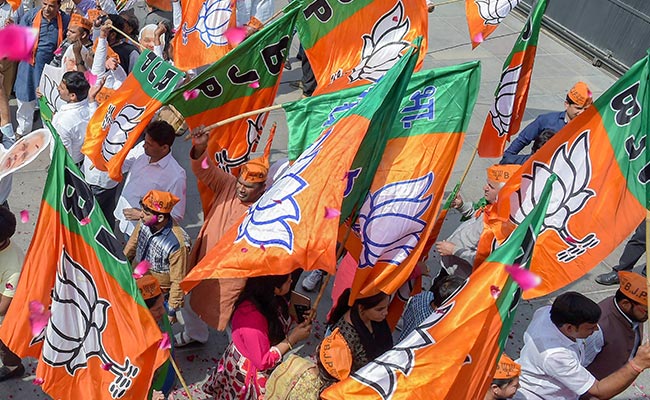
The 2026 Gujarat local body elections have delivered a decisive and politically consequential verdict - a near-total dominance by the BJP across urban and rural institutions. Held on April 26 with counting on April 28, these elections are widely seen as a "mini referendum" ahead of the 2027 Gujarat Assembly elections.
The BJP's performance was sweeping in the truest sense. It won all 15 municipal corporations and 78 out of 84 municipalities - crossing the 50% vote-share mark in each - an indicator not just of victory, but dominance in urban areas. By winning 33 out 34 district panchayats and 220 out of 260 taluka panchayats, BJP established itself as the clear favourite in rural areas. The opposition parties Congress and AAP (Aam Aadmi Party) had scattered gains.
In a nutshell, BJP won 7,491 out of 9,992 seats across local bodies; Congress won 1,740, AAP 489 and rest by others (as per reports).
Post the results, both Congress and AAP staked claim as the No. 2 party in Gujarat.
The scale, spread, and nature of the BJP's victory carry significant implications not only for the ruling party but also for its principal challengers - the Congress and the AAP.
Reinforcement of BJP's hegemony
The BJP has been in power in Gujarat for nearly three decades. This result reaffirms that its political supremacy remains structurally intact. The party's dominance extended geographically - from major cities like Ahmedabad, Surat, and Rajkot to rural and semi-urban belts - suggesting a statewide consolidation of voter support rather than isolated urban success.
The BJP also debuted in nine newly formed municipal corporations - Navsari, Gandhidham, Morbi, Vapi, Anand, Nadiad, Mehsana, Porbandar and Surendranagar. The party's ability to win across all four tiers of governance (urban and rural) indicates a deeply entrenched organisational network and voter base.
Historically, the BJP's strength lay in urban Gujarat. However, these results show it has successfully bridged the urban-rural divide, with strong performances in district and taluka panchayats as well.
This is crucial because Assembly elections are often decided by mood in rural constituencies.
The BJP is likely to frame this as a vote of confidence in governance - from municipal delivery (infrastructure, sanitation) to state-level administration. The party leadership has already emphasised that "public trust" stems from performance across levels of government.
With the next Assembly election due in December 2027, this victory has given the BJP and its cadre both momentum and motivation. These results underline a fundamental truth of Indian politics: local elections are organisational elections. And the BJP's cadre strength and booth-level management remain unmatched.
Shrinking base for Congress
The Congress's performance was below par across all tiers. In municipal corporations, it lagged far behind, and even in rural areas - traditionally its relative stronghold - it failed to mount a serious challenge.
It had few wins in the urban areas. In the Ahmedabad Municipal Corporation, Congress improved its tally to 32 seats, up from 24 in 2021. Similarly, in Rajkot, the party increased its strength from four to seven seats. In Surat, the party managed to open its account with one seat.
However, Congrss' score in district panchayats fell from 169 seats in 2021 to 135 in 2026. Likewise, its tally in taluka panchayats dropped from 1,252 seats to 1,050.
This reflects a deeper issue: erosion of grassroots organisation. Without strong local leadership or cadre networks, the party struggles to convert voter dissatisfaction into electoral gains.
Also, the Congress is increasingly squeezed between a dominant BJP, an emerging AAP (especially in urban pockets). On the ground, there is already a buzz about Gujarat evolving into a BJP versus AAP contest, marginalising Congress further.
Unlike the BJP (development) or AAP (governance alternatives), Congress lacks a clear, compelling state-specific narrative. This election reinforces that voters do not currently see it as a credible alternative government.
If this trend continues, Congress' seat share could decline further in the 2027 state election, and it will automatically become a third player. Its role may shift from challenger to spoiler.
Unless there is major organisational restructuring and leadership revival, the 2027 Assembly election could deepen its marginalisation.
Setback for AAP in urban strongholds
The Gujarat local body election results have dealt a setback to AAP's aim of evolving as the main opposition in the state.
AAP's Gujarat strategy relied heavily on urban centres like Surat, where it had previously emerged as a strong opposition force. However, in 2026, it won just 4 seats in Surat, sharply down from 27 seats won in 2021. This signals that AAP's urban experiment has stalled.
The only relief for AAP was in select pockets, particularly tribal areas, where AAP's Dediapada MLA Chaitar Vasava helped the party win the Narmada district panchayat and a few taluka panchayats. There were some gains in Saurashtra also under local leadership.
While numerically small, this suggests the party is attempting to expand beyond cities - an essential step for long-term relevance.
The results expose a key weakness: inconsistent performance. Unlike Delhi or Punjab, where AAP built sustained campaigns, its Gujarat presence appears fragmented and episodic. The numbers suggest the party remains far from replacing Congress as the main opposition, making its path to the next Assembly elections significantly more challenging.
The 2026 Gujarat civic polls are less a surprise and more a confirmation of existing political realities. The BJP's sweeping victory reinforces its status as the default governing party in the state, with a broad and stable coalition of voters.
Unless there is opposition unity or a major political disruption, the BJP enters the 2027 Assembly elections as the clear frontrunner.
However, Indian electoral politics has shown that dominance can breed complacency. The real test will be whether the BJP can sustain governance delivery and avoid anti-incumbency over the next 18 months - and whether the opposition can reinvent itself before time runs out.
(The author is Contributing Editor, NDTV)
Disclaimer: These are the personal opinions of the author

