






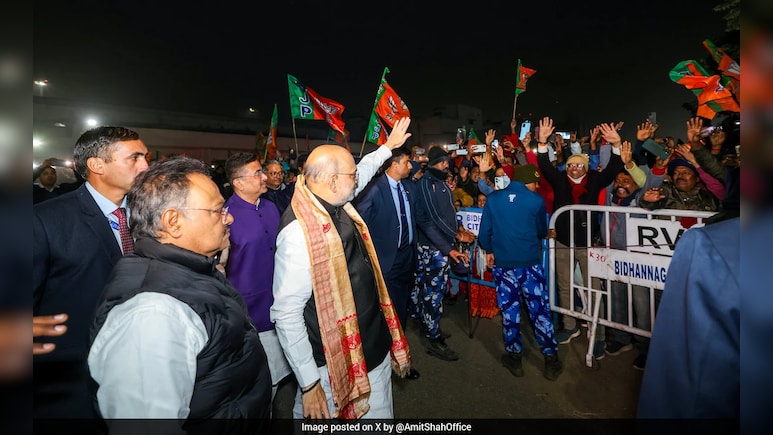
Union Home Minister Amit Shah arrived in Bengal for a three-day visit. This is not a tour marked by public rallies; instead, the focus is firmly on strategy. What exactly is Amit Shah's 'Mission Bengal'?
The key focus areas of Amit Shah's visit are as follows:
1. Organisational Stocktaking
Amit Shah is concentrating on the party's organisational strengths and weaknesses. Taking stock of the BJP's organisational activities in West Bengal is a central objective of this visit. Shah is meeting organisational leaders at multiple levels, listening to opinions and complaints, and directly receiving feedback from district-level units and other entities, in addition to office bearers. He places a high priority on strengthening the party's campaign machinery.
2. The Matuas
Shah is placing particular emphasis on the Matua community. The SIR has created considerable confusion around Matua votes, with the Trinamool Congress running a campaign suggesting that the community feels insecure because of it. At a press conference, Shah sought to counter this narrative, stating that there is no insecurity or fear among the Matuas. He even mockingly remarked that Mamata Banerjee has failed to win Matua support despite her efforts. This narrative is especially significant given the rivalry between Union Minister Shantanu Thakur and TMC leader Mamata Bala Thakur in Matua-dominated areas, where political competition and internal tensions run high.
3. Core Themes
What will be the BJP's principal campaign focus? Issues such as Hindu identity, alleged Muslim appeasement, the BJP's Hindutva agenda, and Mamata Banerjee's use of religious symbolism and temple-building are likely to dominate this election season.
4. Infiltration and the SIR
Infiltration is a central concern linked to the SIR process, but it also forms part of a broader, ongoing narrative. For the BJP, infiltration is not a new issue. Since the RSS's inception, it has been projected as a major concern. The party hopes to use the SIR to communicate its vision of a West Bengal free of infiltrators. The challenge is how to turn this into a major electoral issue beyond the administrative question of voter lists.
5. Coordination With RSS
Amit Shah is also meeting Bengali RSS leaders to improve coordination. He is expected to visit the RSS headquarters in Bengal, Keshab Bhavan, signalling close cooperation between the RSS and the BJP. The aim is to demonstrate that there are no coordination gaps.
6. Religious and Cultural Outreach
Shah is visiting ISKCON and Sister Nivedita's house, locations that Mamata Banerjee has also visited recently. Banerjee has worked closely with ISKCON, including supporting the Jagannath Temple in Digha. On December 5, she visited Sister Nivedita's house and addressed several site-related issues. Against this backdrop, Shah has prioritised these visits alongside Belur Math and Swamiji's ancestral home.
7. Leadership and Organisational Challenges
Amit Shah faces a significant challenge in what can be described as a leadership crisis within the Bengal BJP, alongside broader organisational weaknesses. Resolving these issues may require deeper public engagement.
8. Solving Internal Friction
The party is also marked by internal splits, miscommunication, and rivalry among leaders and organisational units. Shah has personally stepped in to address these problems, aiming to unify the party so it can move forward collectively.
9. Corruption as a Campaign
Corruption is another major focus. During a detailed press conference in Kolkata, Shah repeatedly raised the issue, naming TMC ministers, MLAs, MPs, and leaders who have been jailed on corruption charges. He urged the state BJP unit to turn corruption into a central campaign issue.
10. Projecting a 'New Bengal'
The BJP seeks to project a vision of a peaceful, development-oriented West Bengal free from corruption. Shah advised state leaders on countering Mamata Banerjee's claims regarding land acquisition and the BSF's role. He argued that border management issues persist because the state government has failed to provide land. On development, he stated that while the Union government is willing to provide funds, the state government has failed to utilise them properly due to corruption.
Shah also issued a statement in Bengali, shared on X, and addressed the public in the language for the first time. Also, throughout his press conference, Shah referred to Rabindranath Tagore, Bankim Chandra Chattopadhyay, and other Bengali icons to counter the charge that the BJP does not understand Bengali culture.
However, questions remain over whether the BJP has the organisational capacity to translate this momentum into an effective campaign. The party has so far struggled to make decisive electoral gains in Bengal.
(The author is Consultant Editor, NDTV)
Disclaimer: These are the personal opinions of the author

