






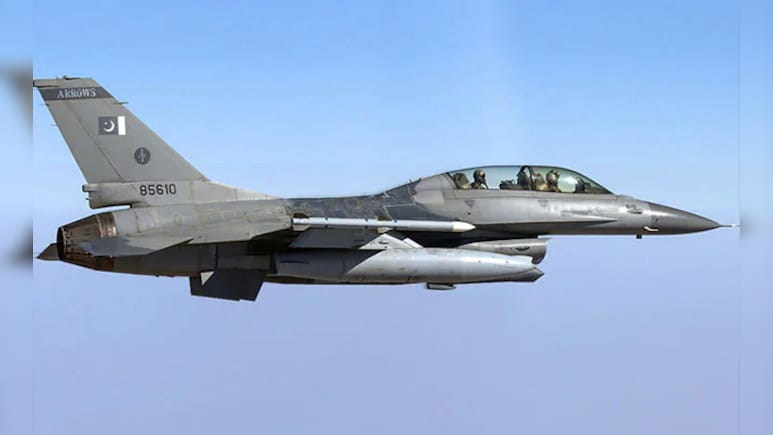
The news of the United States approving a substantial $700 million package for the upkeep and sustainment of Pakistan's F-16 fleet has triggered predictable concern in India. But the decision itself is neither new nor surprising. It is part of a larger agreement entered into in 2022 and follows a long tradition of US engagement with Pakistan's air force that has survived every cycle of political turbulence in both countries.
Across decades - Republican and Democratic administrations alike - the supply, upgrade, and maintenance of Pakistan's F-16s have remained a constant, justified in Washington as essential for "aviation safety" and counter-terrorism missions. The latest tranche confirmed by the Defence Security Cooperation Agency (DSCA) on December 4 fits squarely into that pattern. It is a sustainment package, not a new sale, and merely extends the service life of an ageing fleet.
The announcement, therefore, is not revealing something previously unknown. Nor should New Delhi treat it as a dramatic departure in American policy. What makes the development interesting is not the deal itself, but its timing. It comes at a moment of renewed churn in India-US political communication, and a moment when Pakistan is proving more than willing to play ball with a Trump administration that responds enthusiastically to flattery and transactional cooperation.
What New Delhi Can and Cannot Control
Can India control what decisions are taken in Washington-whether "good, bad, or ugly"? Perhaps not. The latest US National Security Strategy has already offered confusing signals about how this administration values the long-term strategic partnership with India. With bilateral expectations having slipped to unusually low levels, the approval of an F-16 sustainment package should hardly catch New Delhi off guard.
This comes at a time when India is navigating an American administration that pays little attention to the geopolitical impact of its actions on allies, partners, or even its own long-standing cooperative frameworks. A White House that is willing to create deep fissures within its transatlantic alliance, rewrite its terms of engagement with Europe, and make its foreign policy more transactional than at any time since the Cold War, is certainly capable of much more disruption than simply welcoming a Pakistani general for dinner or signing off on an aircraft support deal.
Nor can one ignore the very real possibility of Trump using such announcements as bargaining tools - pressure points designed to influence India on trade, investment rules, or defence imports. This is not new. During his first term, defence sales, market access issues, and tariff disputes were regularly entangled. Even so, it is equally true that US-Pakistan defence cooperation is now an independent vector, just as India-Russia defence ties are an independent vector. No country makes its defence choices solely to please or displease another.
How Pakistan Will Play This
If India views this development with caution, Pakistan will position it with choreography.
Domestically, Islamabad will frame the package as a validation of the Pakistan Air Force and the military establishment - proof that relations with Washington are "back on track" after years of strain. It will be touted as reassurance that Pakistan retains a credible air deterrent, even as India modernises aggressively. The timing is convenient at home: the economy is fragile, domestic politics are turbulent, and the army's need to project competence and external legitimacy is at a peak.
Internationally, Pakistan will pitch the upgrade to the US as a continuation of counter-terrorism cooperation. To China, it will present the move as evidence of foreign policy balance - not a shift away from Beijing. In the Gulf, where Pakistan seeks both financial and political support, the White House decision will be showcased as proof of Pakistan's enduring military relevance. And in dealings with the International Monetary Fund (IMF) and other lenders, Islamabad will subtly cite this as evidence that Western capitals still see Pakistan as strategically useful, not isolated.
This multi-layered signalling is deliberate. Pakistan's strength has long lain in its ability to leverage its vulnerabilities and sell its geostrategic location to external powers. Even now, as it receives American technical support for US-made fighters, it continues to expand its dependence on Chinese systems-from drones to surface-to-air missiles to JF-17 variants. For Islamabad, both vectors are valuable, and neither is exclusive.
The Broader Strategic Picture
Great powers use arms transfers not merely as defence transactions but as tools to shape regional balances. Washington's decision reflects that logic. Regardless of how India perceives the F-16 issue, history shows that Indian concerns have rarely been decisive in the American military-industrial calculus. US decisions on Pakistan's air fleet - from the Reagan era, through the Pressler years, to post-9/11 counter-terrorism cooperation - have always formed part of a larger geopolitical storyboard.
The present decision is no exception. It signals that the US does not intend to sever security links with Pakistan, especially at a time when Washington is recalibrating its footprints in the Middle East, Central Asia, and the Indo-Pacific. To the US, retaining a minimal but functional relationship with Pakistan's military establishment offers optionality - even if the ties lack the depth or trust seen during the Cold War and post-9/11 years.
For India, this must be read not as a crisis but as context. New Delhi has, over the past decade, built a far deeper, multi-sectoral partnership with the United States, spanning technology, defence innovation, maritime cooperation, space collaboration, supply-chain resilience, critical minerals and more. None of this is undone by a maintenance package for an old fleet across the border.
What is unfolding is a more complex strategic churn: a US-Pakistan relationship that is trying to find relevance; a China-Pakistan axis that continues to sharpen; and an India-US partnership that remains critical but is experiencing an inevitable period of friction under a Trump-led administration.
A Calm, Realistic Assessment
India's response should be anchored in strategic realism, not alarm. The sustenance package will keep Pakistan's F-16s functional, but it does not alter the fundamental military balance in South Asia. India's own modernisation trajectory-from Tejas Mk-2 to S-400 systems, from MQ-9B drones to advanced surface warfare platforms-continues to widen the capability gap.
What matters now is clarity: clarity in recognising that US decisions on Pakistan are part of a broader geopolitical game; clarity in communicating India's red lines and expectations to Washington; and clarity in ensuring that India's long-term defence and diplomatic strategies remain insulated from short-term noise.
Pakistan will play its hand. The US will pursue its interests. India must do the same - calmly, confidently, and with an eye on the deeper shifts reshaping Asian geopolitics.
(The author is President, Chintan Research Foundation)
Disclaimer: These are the personal opinions of the author

