






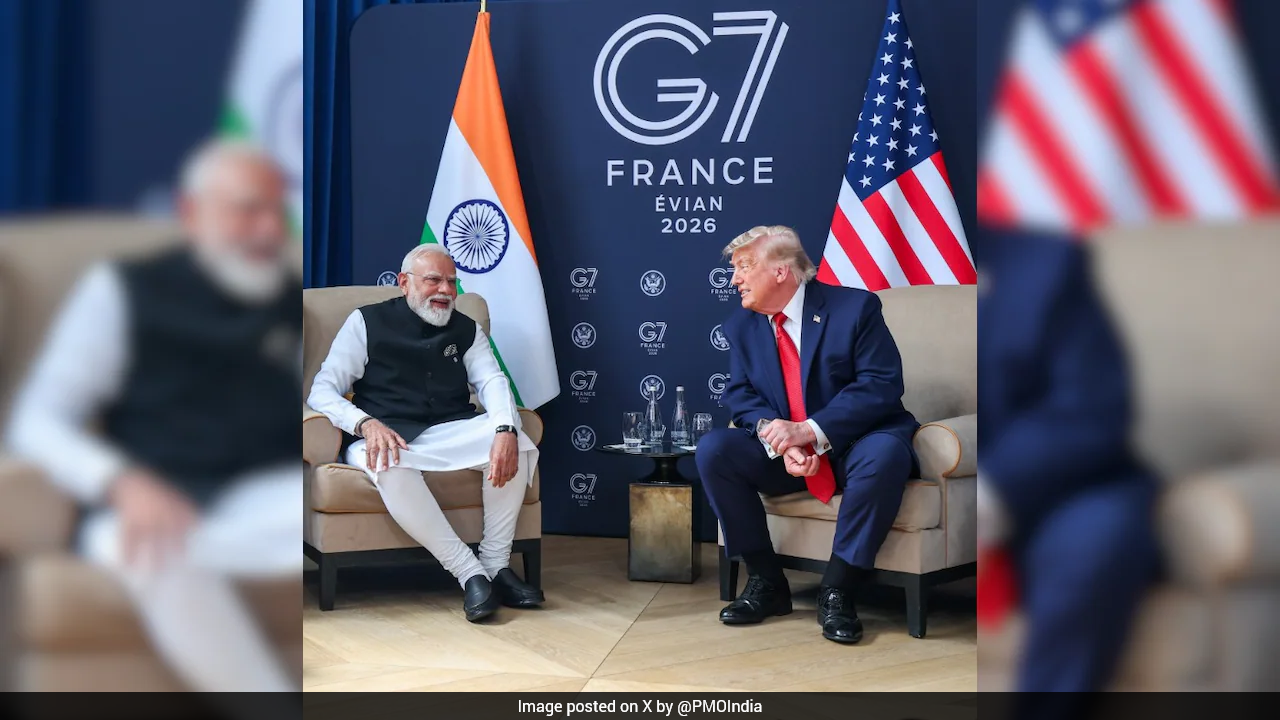
The highly anticipated meeting of Prime Minister Narendra Modi and the mercurial US President Donald Trump is over, and the Ministry of External Affairs can heave a sigh of relief. No disruptive comments were noted, and Trump, in fact, was lavish in his praise of the longest continuously serving democratically elected Prime Minister. Everything played out well. But this is no time to let the guard down.
First the meeting itself. Both sides noted 'satisfaction' at progress in ties, and PM Modi brought up the issue of safety of seamen. Trump's response was swift. The US would never allow anyone to attack India, as long as PM Modi was around, the US president said.
Trump is a politician, and he would typically respect the fact that he's talking to the longest continuously serving democratically elected Prime Minister. And he is hardly likely to have forgotten the massive backing with "Abki baar, Trump sarkar". And whatever the ups and downs, he has never once denigrated the Prime Minister, which he has not hesitated to do with myriad allies, like French President Macron.
Does it mean anything? Hardly.
But it matters to audiences in India and the US.
The whole 'strategic'issue
Indian policy makers have been slow to adjust to the realities in the new US administration. No more does your democracy count, as an important facet of a 'strategic' partnership. The present lot couldn't care less. The 2020 perception of India as the most 'consequential partner' coined by the then US Defence Secretary Mark Esper, was made ahead of the 2+2 talks between Foreign and Defence ministers. The State Department at the time noted Chinese aggressiveness along the Indian border, as well as with neighbours around. That aggressiveness has only increased. But the White House is handling China with kid gloves, apparently allowing China to get its oil through Iran earlier, and in President Trump's continued delay on a $14 billion arms sale to Taiwan. With Russia, Washington did reach out, but has now also provided Ukraine with immense weapons aid, though mostly with European funds. The most telling is the failure to hold the Quadrilateral Summit when India was the chair, and the deliberate renaming of the Indo-Pacific Command to its original name of the Pacific Command. Apart from reducing the salience of India, both moves are key irritants in the US-China relationship.
The Donroe doctrine is expansionist
Then is the reality of the 'Donroe Doctrine'. The whole Venezuela adventure, the threat to Cuba, and then the Iran adventure, didn't happen in a vacuum. Remember the irate speech of Secretary of State Marco Rubio at the Munich Conference, where he denigrated the term, 'rules based order' (in which he was not far wrong) and more worryingly, pointed out that a once expanding West, with its missionaries and its 'vast empires' had entered into terminal decline as colonies freed themselves. This is a country that wants Europe to join it in 'recreating' the 'West' that once was. Now through this lens, consider the relationship with India.
The partnership on the ground
In 2025 there was certainly a phenomenal amount of cooperation on the ground, at least on paper. Take a look at the text of the COMPACT (Catalyzing Opportunities for Military Partnership, Accelerated Commerce & Technology) initiative signed in 2025. It covers a huge number of areas including defence, energy security, trade and investment, space cooperation, critical minerals, innovation and industry. An overview of the progress of these initiatives is however disappointing. Defence cooperation has been lacklustre, with GE Aerospace's F404 and F414 for the Light Combat Aircraft have been slow to arrive, negatively impacting the program.
Forward movement was seen, again in 2025, in the signing of the Reciprocal Defence Procurement and its accompanying 'Security of Supplies arrangement' (SOSA), which is designed to remove bottlenecks in processes, and to an extent this has been delivered. India now operates some 8 US systems, and exports of defence items to the US - which includes fuselages, and tail empennages - all indicates a climbing graph. A number of private industries like Kalyani Defence, and Tata Aerospace among others have entered into co-production, all of which could accelerate, except that the Trump administration's continuous tariff threats, and recent threatened sanctions on firms on using goods made from 'forced labour' are hardly likely to encourage business houses.
A range of sanctions on the Iran and Russia front have also targeted Indian companies, which means that working with the US may not be as attractive for industry, unless there is a strong political assurance. That needs to be the bottom line in the yet to be released trade deal.
Are we really strategic partners?
The question then arises as to whether India and the US are truly 'strategic partners'? Scholars generally assume that this means a loose relationship between countries with strong common interests, helped by common ideologies or belief systems. That last is not critical, as apparent in our relationship with Russia. It's the core interests that count. For the US, it's the opening of the Indian market, renewed sales of US weapons - witness the call of Secretary of War Peter Hegeseth at the Shangri-la dialogue to partners and allies to raise defence expenditures to the 'global standard' of 3.5 per cent of GDP - and along with that an offer of US weapons at a 'reasonable price'. The crux was his promise " to unleash America's arsenal of freedom and expand America's military dominance for decades to come". That's the bottom line. Is that really what Delhi wants? Not a 'strategic partner' but a hegemonic boss.
In sum, a certain policy direction has been set, which is unlikely to change drastically in the coming years. The idea of a powerful US striding across the world appeals to US voters, the Iran war notwithstanding. Along with it is a clear deference to US business priorities. Chinese media was gleefully pointing out - rightly or wrongly - that far from moving out of China," 80 percent of responding US companies consider Chinese market to be "very important" or "important" to their global competitiveness...(and) a report published by the German Chamber of Commerce in China also shows that the share of German automotive companies conducting R&D in China has increased significantly. Money talks louder in the present administration. Democracy and the like are out of the door.
While Delhi's foreign policy establishment is moving quickly to diversify our investment sources, and diplomatic support, it also needs to realise that the discourse has changed. Trump's lavish praise of his 'favourite Field Marshal' means little in real terms, but it shows the values - or lack of it - that underlies this administration. Diplomacy has to understand that joint statements and large declarations have little value in Washington. What matters is your clout. For that the bureaucracy has to be able to get its act together to attract foreign investment to India in diverse fields. Tax holidays, and larger investment slabs are good, but in the end it's the ability of business to operate that counts. That means cutting the mess of bureaucratic red tape, setting clear processes for investors, punishing corruption with a heavy hand, and dealing with the incredible filth that coats more 'industrial areas'. It also means settling for now all talk of 'Sindoor -2' being unleashed. It simply doesn't sell to investors. What places you at the big table is your economy. True, your muscle counts, but as the global economic growth stumbles seriously, it's the former which will bring in the much needed moolah. Meanwhile, keep your head low. Things are likely to get more dangerous.
(Tara Kartha is a former Director, National Security Council Secretariat)
Disclaimer: These are the personal opinions of the author

