






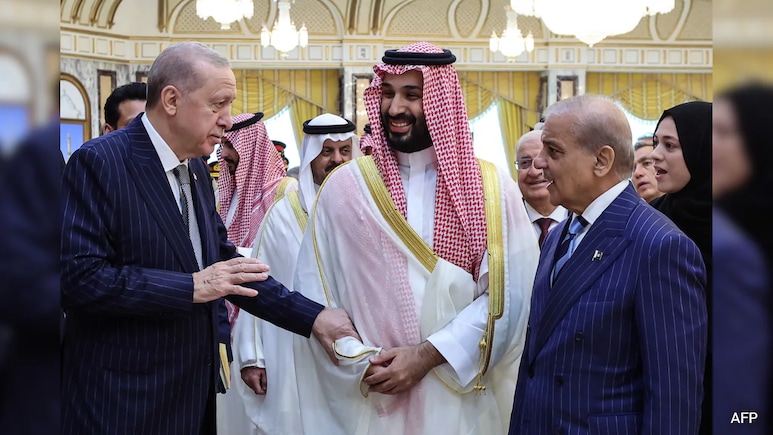
The tripartite Saudi-Pakistan-Turkey defence pact follows the Saudi-Pakistan defence pact. The latter came as a surprise, even though Saudi Arabia and Pakistan have had known security links. Pakistani troop contingents have reputedly provided security protection to the Saudi monarchy. The former Pakistani Army Chief, Raheel Sharif, is heading the grouping, which again points to security-related understandings between Pakistan and Saudi Arabia. It is also believed that the Saudis had played a role in financing Pakistan's nuclear weapons programme.
Formalising a defence pact between the two countries is, of course, a major step. Especially if it contains a provision that the attack against one country will be considered an attack on both. The timing of the pact was politically very sensitive as it came during an armed conflict in the region involving US-Israel and Iran, with Iran attacking several Gulf countries hosting US bases and threatening to cause havoc to the energy and water desalination infrastructures of these countries should the US begin destroying the energy and other vital infrastructure of Iran. This continues to be a nightmare scenario for Saudi Arabia.
In addition to the Iranian threat, Saudi. Arabia faces a threat also from the Houthis with which it has been engaged in a conflict for some years now, but without success. The Houthis threaten maritime shipping in the Bab el Mandab Strait. This, coupled with the closure of the Strait of Hormuz, constitutes a vice-like grip on the movement of oil from the region internationally, including that of Saudi Arabia. whose oil terminals on the Red Sea are also vulnerable to Houthi attacks.
Why Saudi Arabia calculates that Pakistan can join hands with it to counter the threat from Iran or Houthis is not clear. Even the US and Israel have not been able to deal with Iran successfully, or with the Houthi threat to maritime shipping. Can Saudi Arabia count on Pakistan to treat an Iranian attack on it as an attack against Pakistan itself? What capacity does Pakistan have to deal with the Houthi threat?
Turkey has been lobbying for some time to join the Saudi-Pakistan defence pact to convert it into a tripartite one. It appears that Saudi Arabia has been resisting this but has finally yielded. The details of the tripartite pact have not been divulged, but it has been made known that it has the same provision as the bilateral Saudi-Pakistan defence pact, viz., an attack against any of the three parties will be considered an attack against all three. The Turkish President and the country's Foreign Minister have likened this to Article 5 of the NATO pact.
This hype surpasses reality. Will Turkey attack Iran if it attacks Saudi targets? If US bases in the region have proved so vulnerable to Iranian missile and drone attacks, and Israel too has suffered extensive damage from Iranian counter-attacks, can Turkey protect itself from Iranian retaliation? As it is, Turkey seems to be aware of its own vulnerabilities and seems to have strongly opposed US/Israeli plans to mobilise a land attack against Iran by Kurdish forces, knowing that arming the Kurds for such an adventure would recoil on Turkey itself, as it has been battling the Kurds for decades now.
In terms of military capabilities, Saudi Arabia is well supplied with advanced US weaponry. Turkey and Pakistan could bring to the table their military assets by way of drones and missiles, but would that match the military assets that the US and Israel have deployed against Iran, including B2 and B-52 bombers and Tomahawk missiles, etc., without success?
If the argument is that this tripartite defence pact is meant to deter Iran, the question arises why the combined military power of the US and Israel has failed to deter Iran. The inability of the US to force open the Strait of Hormuz despite often-repeated doomsday threats by Trump against Iran shows that deterrence has not worked against a country fighting for its life.
Pakistan's nuclear capacity brings no additional force to this pact in security terms. The US is a very formidable nuclear power, and Israel is widely believed to possess nuclear weapons. Their nuclear capacities have not deterred Iran.
Beyond all this, drawing an analogy with Article 5 of NATO is political rhetoric, and unwise at that. The text of the NATO pact is a public document, unlike in the case of this tripartite pact. The garrulous Pakistani Foreign Minister has said that the text should be made public, but he is wont to express his personal opinions loosely. NATO has an integrated military command, with a US General heading it. The weapons are NATO standard to allow interoperability. NATO troops are stationed in different member countries.
Does the tripartite pact envisage an integrated military command? Without such a command and interoperability, how will this Article 5-like pact work? Pakistan is largely equipped with Chinese weapons, while Turkey and Saudi Arabia are equipped with US weaponry. Will China permit its weapons to operate alongside US weapons in a joint operation?
There is much talk of this pact bringing peace and stability to the region. For this, the three countries involved must be stable and peaceful themselves. Turkey is in permanent confrontation with Greece. It periodically bombs the Kurds in Iraq in violation of international law. It is illegally occupying a part of Iraq as well Syria, where it has physically intervened. It has intervened in Libya. It has violated UNCLOS in the eastern Mediterranean. It is now arming Ukraine. Turkey has intervened in India-Pakistan issues, including militarily during Operation Sindoor. Erdogan's ties with the Muslim Brotherhood are a source of concern to the Gulf countries, including Saudi Arabia.
Pakistan is facing internal liberation movements and insurgencies. It is engaged in a conflict with the Taliban regime in Afghanistan, which it helped propel to power there. The Pakistani Taliban are operating against Pakistan from Afghan soil. Pakistan's relations with Iran are not tension-free, having exchanged limited missile attacks against each other not too long ago. Pakistan is locked in permanent hostility towards India, which would limit its capacity to deploy sizeable troops for security in the Gulf region.
Other than this, the Pakistani economy is in shambles. The Turkish economy is in a bad shape with 32% inflation. The Saudi economy, despite the country's oil earnings, is under budgetary strain. Any calculation that Turkey and Pakistan, in particular, can milk Saudi Arabia for funds and find a lucrative arms market in the kingdom may prove mistaken.
This tripartite pact is likely to create more divisions within the GCC. The UAE, which has already walked out of OPEC, is a geopolitical rival of Saudi Arabia. Oman, which is careful in preserving a neutral position, is likely to be uncomfortable with a move that further weakens GCC unity. Qatar may believe that this pact will erode its mediatory role. Iraq will be wary of the role Turkey is acquiring in the region. The Shia-Sunni angle will be present in the mind of the leaders of this region, given the earlier effort by Turkey, along with Pakistan and Malaysia, to seek the leadership of the Islamic world because of the reformist impulses of the Saudi Crown Prince.
Trump has welcomed this tripartite pact as providing meaningful security to the region, admitting, whether it was his intention to do so or not, that the US itself could not provide "meaningful security" to the region despite numerous bases and arms supplies. The US is not going to walk away from this region that is massively rich in energy, especially because of President Trump's ambition to control the global oil market. The US companies are heavily invested in the energy infrastructure of the region.
If, as the protagonists of this pact claim, it is not directed against anyone, then why create it? Even if deterrence is the objective, it has to be deterrence against a perceived threat. Iran knows the reality, as this pact has surfaced after the emergence of Iran as a dominant power in the region. Iran is diplomatically willing to go along with the narrative that it is not the target of this pact. If, as Erdogan says, all countries can join the pact, what then is the rationale of having such a pact at all? There is no history of all these countries working together. How will they suddenly bury their rivalries and competing ambitions?
One can legitimately argue that those behind this pact are aware of all this, have taken all these factors into account, and have a game plan. This would not be the first time that such presumably well-thought-out plans and initiatives have not worked. The mess in the Gulf region and today's world, subject to Trump's disruptive policies, proves that.
(Kanwal Sibal was Foreign Secretary and Ambassador to Turkey, Egypt, France and Russia, and Deputy Chief Of Mission in Washington)
Disclaimer: These are the personal opinions of the author

