






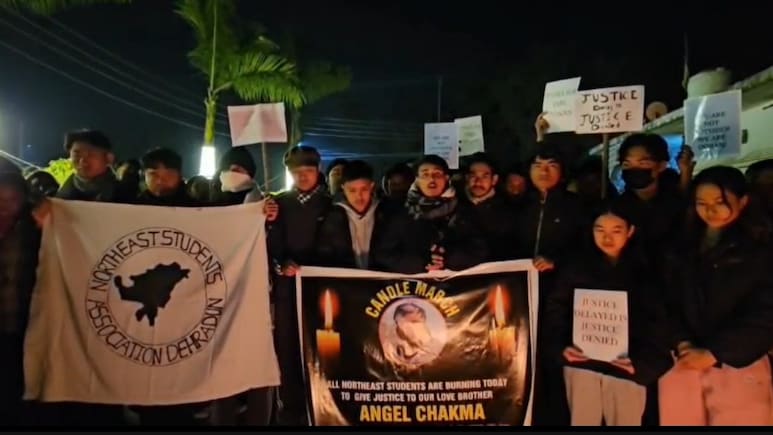
The brutal stabbing and subsequent death of 24-year-old MBA student Anjel Chakma in Dehradun, after he objected to racial slurs hurled at him and his brother, is more than an isolated crime. When an ordinary life ends in violence over identity in one's own country, while fetching groceries far away from home, it compels the nation to ask tough questions about prejudice, belonging and citizenship in modern India.
It is a stark reminder of deep-seated inequalities in Indian society.
On December 9, Anjel and his younger brother were shopping in Dehradun's Selaqui area when they were reportedly confronted by a group of men, allegedly intoxicated, who hurled racial slurs such as 'Chinese', 'chinki' and 'momo' - derogatory taunts aimed explicitly at the appearance and ethnic background of Chakma. The confrontation escalated within minutes, culminating in a fatal stabbing that left Anjel fighting for his life for more than two weeks before he succumbed to his injuries.
His haunting last words, "We are not Chinese, we are Indian. What certificate do we need to show?", echo far beyond Dehradun, capturing the heartbreak of many Indians whose belonging is questioned without evidence or justification.
Violence As A Pattern, Not An Exception
Like people from other states, residents of the northeastern states migrate across India for education and employment. Many pursue professional courses in educational institutions, while others seek opportunities in government services. Thousands of civil services aspirants from the northeast enrol in coaching centres in metros and Tier 2 and 3 cities. Similarly, many move to large cities for jobs in multinational companies, the hospitality sector, and other industries.
Yet, the Dehradun tragedy is not an anomaly. For years, people from northeast India have faced discrimination and harassment in other parts of the country. Government-linked surveys and academic studies have repeatedly documented how this manifests in daily life, scarring victims psychologically forever.
A study commissioned by the Indian Council of Social Science Research on racial discrimination and hate crimes against people from the northeastern states, published in 2021, found that "northeast India seamlessly fits (into a mainland) Indian's imagination of a Chinese person". It revealed that around 78% of respondents from the northeast believed physical appearance was the primary reason for prejudice against them in major Indian cities. A significant number reported experiences of offensive language, social exclusion and mistreatment - experiences severe enough to alienate patriotic citizens of northeast India.
Earlier data from the government's M.P. Bezbaruah Committee - constituted after a similar racist killing in 2014 - showed that about 86% of people from the northeastern states living in Delhi had faced some form of racial discrimination. These figures point to a persistent structural problem, not sporadic incidents. Cases of racial taunting, refusal of service, verbal abuse and physical assault have been reported repeatedly across Indian cities.
Yet, despite these documented experiences and recommendations, legal recognition and enforcement of protections against racial discrimination remain limited. The Bezbaruah Committee had recommended legal and institutional reforms, including amendments to the Indian Penal Code to criminalise racial insults and hate crimes, but progress has been slow.
The Rot Within
The killing of Anjel Chakma exposes several uncomfortable truths about India's social fabric.
Despite constitutional guarantees of equality, many Indians continue to assign "otherness" based on appearance, language or region. People from the northeast are often stereotyped as 'foreigners' or 'Chinese', even when they are Indian by birth and upbringing. This undermines the very idea of Indian citizenship and unity. Anjel's plea - a simple declaration of national identity - should never have been necessary. Worse, it was met with violence.
A recurring theme in surveys and interviews with migrants from the northeast is the lack of awareness among mainland Indians about the country's cultural, ethnic and linguistic diversity. Misidentifications - from being called 'Chinese' to caricatures about food or language - are not merely insensitive; they reveal ignorance of India's pluralism.
From the perspective of a civilised society, killing someone for being perceived as 'Chinese' is equally abhorrent.
This incident also highlights the wider landscape of everyday prejudice based on caste, class, religion and regional identity in India. The same social hierarchies and mindsets that fuel discrimination against Dalits, religious minorities and linguistic groups also enable bias against those who look different. When such prejudice goes unchecked, it can erupt into violence. Daily slurs and insults, if unchallenged, normalise exclusion and can escalate rapidly into deadly encounters.
The Cost Of Silence
The societal costs of ignoring racial prejudice are immense. They extend beyond individual tragedies to affect national cohesion and India's image as a diverse democracy. When students feel unsafe in institutions far from home, educational mobility suffers. When people face constant discrimination in the cities where they live and work, it erodes their sense of security and belonging.
Such incidents also reverberate back to the regions the victims come from, fuelling resentment and alienation, with potential political consequences that deepen regional divides.
The killing of a young student in Dehradun demands action. Conversations about race, identity and unity must move beyond social media to the mainstream, incorporating voices from all regions of the country.
Alongside implementing laws that explicitly criminalise racial discrimination and violence, schools, colleges, law enforcement agencies, employers and communities must be trained to recognise and respond to racial bias and hate crimes effectively.
(The author is Contributing Editor, NDTV)
Disclaimer: These are the personal opinions of the author

