






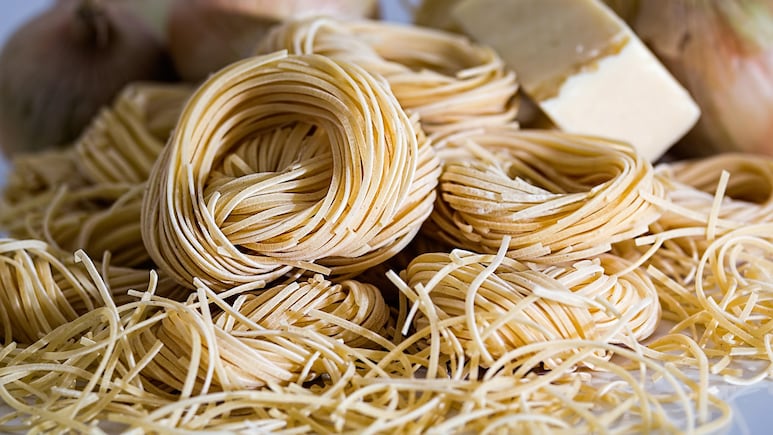
For all those who had been waiting since 2007 for the much-anticipated India-European Union (EU) Free Trade Agreement (FTA), the wait will end only next year after the European Parliament finally ratifies the "mother of all deals" sealed in New Delhi on Tuesday. Does that mean it will now be raining Italian pasta and German sausage? Definitely not in this financial year (so hold your party plans), but from FY2027-28 and FY2028-29, we will definitely see more European food products in the market than we have in the past.
India is not yet a substantial market for agricultural commodities and processed foods from the 27-nation EU, yet pasta is one of the most visible everyday items that will tell the story of what impact the FTA will have on our everyday lives. In 2024, EU agrifood exports to India amounted to 1.3 billion euros, a mere 0.6 per cent of the bloc's total agrifood exports. It is also a negligible fraction of the total 75-billion-euro EU-India trade (based on 2024 numbers shared by the European Commission's Trade and Economic Security Department).
Yet, the food sector will be watching with bated breath as the deal crosses the mandatory legal and procedural hurdles in Europe. Although the FTA will impact different sectors differently, its provisions have brought joy to European producers of food and alcoholic beverages, and their importers in India. They have never had it so good.
Import duties on processed food (breads, pastries, biscuits, pasta, chocolate and pet food) will be down from 50 per cent to nil; in the case of fruit juices and non-alcoholic beers, the tariff also drops to zero from 55 per cent. Also exempt from tariff are olive oil, margarine and other vegetable oils (45 per cent at present) and sheep meat (down from 33 per cent). For sausages and other meat products, the tariff has been brought down from 110 per cent to 50 per cent, and for kiwis and pears, from 30 per cent to 10 per cent, though imports of these fruits will be limited by quotas.
Yes, European food producers have reasons to celebrate, but will these tariff concessions impact their homegrown competition? Local producers of pasta, European-style breads, sausages, olive oil from Rajasthan, and even pet food have seen a surge in recent years. The domestic market for these products took off during the Covid interregnum, and subsequent rapid growth was powered by the social media explosion (which gave them national visibility) and the rise of app-based food delivery services such as Zomato, Swiggy and Blinkit, which delivered them faster into the homes of consumers. These became poster labels for the government's 'Vocal for Local' credo, and brands such as Suchali's (artisanal breads), Weikfield and Sunfeast (pasta), and Wingreens (from fruit juices, chips and dips to pasta) are now household names.
The lifting of the floodgates for processed food products from the EU is unlikely to significantly upset the market share of domestic products, which are now firmly entrenched in the middle-class mindset.
A bigger worry, especially for the Indian importers of European food products, is the declining value of the rupee against the euro. To quote Rakesh Banga of Banyan Fine Foods, a Delhi-based importer of European seafood and meats, "The rupee has weakened from Rs 90 to Rs 109 to a euro in just over the past year. The sharply rising euro will negate the positive impact of the new tariff regime that will kick in next year."
What will most likely happen is that chefs of five-star hotels and upper-crust restaurants, who have bigger budgets, will have greater choice, especially for top-end products. "I may be a votary of local produce, but I will still want my bronze die, high-protein Garofalo pasta and 'pelati' (peeled) tomatoes from Italy," says Dhruv Oberoi, Executive Chef, Olive Bar & Kitchen, New Delhi. "What I am also likely to see is the growing presence of European fruits and berries in marriages. These will be the new symbols of food snobbery.'
Nadia Sood, serial entrepreneur and co-founder, Bebida Hospitality, who straddles the India, UK, EU and Japanese markets, sees the FTA easing market access for upper-end food products from Europe, but she also makes a case for a nuanced view of the Agreement. "The FTA will definitely result in a price reduction on European luxe food products in the Indian market due to lower tariffs," Sood says. "But don't expect the agreement to have any immediate impact - the European Parliament will need to approve it first before any benefits can be passed on to Indian consumers, and that process takes time." It is clearly a story that will unfold over this year and the next.
There seems to be one solitary dark cloud on the horizon, but it doesn't worry the experts. As recently as January 17, the EU leadership concluded a similar agreement with the South American trade bloc Mercosur, but the European Parliament, following stiff opposition from France and Poland, voted by a narrow majority of 10 to refer the deal to the European Court of Justice. This move will delay the process of implementation of the FTA by at least two years. The area of contention in this case is the import of agricultural commodities and meats. Could this happen to the India-EU FTA?
Experts have ruled out the possibility - hence the near certainty of the FTA taking effect in 2027 - because exports of Indian agricultural commodities to the EU are not big enough to be considered a threat to the livelihood of European farmers. In the words of Abhijit Das, a trade policy expert at New Delhi's Centre for WTO Studies, "Our coffee, tea and spices, after all, are not competing with European farm produce."
Coffee is the only agricultural commodity to figure in the list of the top 12 exports from India to the EU - ranking at No. 12 and pegged, according to news reports, at US $775 million in 2025. As the European Commission's Trade and Economic Security Division points out, "Both sides have agreed to exclude the most sensitive agricultural products from liberalisation. The Agreement balances market access with the protection of sensitive sectors." The EU therefore maintains its current tariffs on "sensitive products" such as beef, sugar, rice, chicken meat, milk powder, honey, bananas, soft wheat, garlic and ethanol.
Das is more concerned about the chapter on 'Trade and Sustainable Development' in the FTA, which is legally binding and enforceable through a dedicated consultation mechanism. "The mechanism," to quote the European Commission's Trade and Security Department yet again, "will provide an avenue to address labour, environmental and gender equality issues in a sustainable and inclusive manner, so that improvement is achieved on the ground, and not just on paper." This, cautions Das, could "lead to disagreements between the EU and India because our laws and our cultural sensibilities are different." Will these disagreements, if they arise, be irreconcilable? That, only time will tell.
The devil, as they say, is in the details. The FTA is just the first chapter of an unfolding story that promises to be of epic proportions.
(Sourish Bhattacharyya is a noted New Delhi-based food columnist, author and blogger, and a print journalist with more than three decades of experience.)
Disclaimer: These are the personal opinions of the author

