






For decades, corruption in India was largely portrayed as a political problem. Whenever a major scam surfaced, attention naturally turned towards ministers and elected representatives. Bureaucrats, particularly members of the IAS (Indian Administrative Service), were often seen as the permanent and supposedly neutral machinery that merely implemented political decisions. The current government's approach is beginning to challenge that perception.
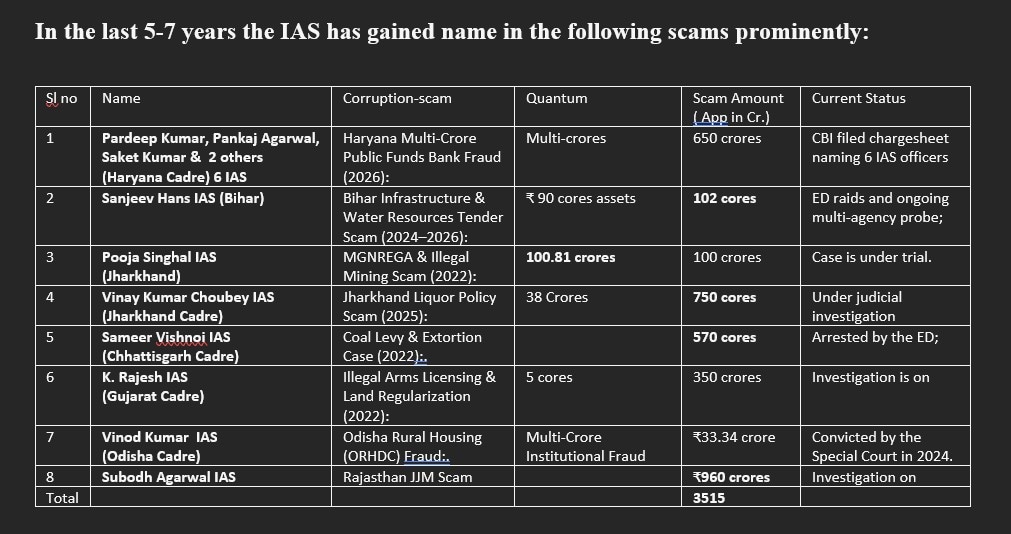
Over the past few years, senior IAS officers have increasingly faced CBI investigations, Enforcement Directorate probes, arrests, suspension, prosecution sanctions and scrutiny of their assets. The emerging message is straightforward: administrative power cannot become a shield against accountability.
The most important change is the movement from traditional departmental vigilance to multi-agency financial investigation. Instead of examining only whether an officer violated a service rule or approved an irregular file, agencies are increasingly following the money trail—bank accounts, properties, investments, shell companies and alleged proceeds of crime. The Enforcement Directorate's latest annual report says that prosecution complaints increased sharply in 2024–25 and 2025–26, averaging about 600 complaints a year, compared with an average of about 130 a year during 2014–15 to 2023–24. These figures cover the ED's entire PMLA workload, not IAS officers specifically, but they demonstrate the much larger financial-enforcement environment in which corruption cases now operate.
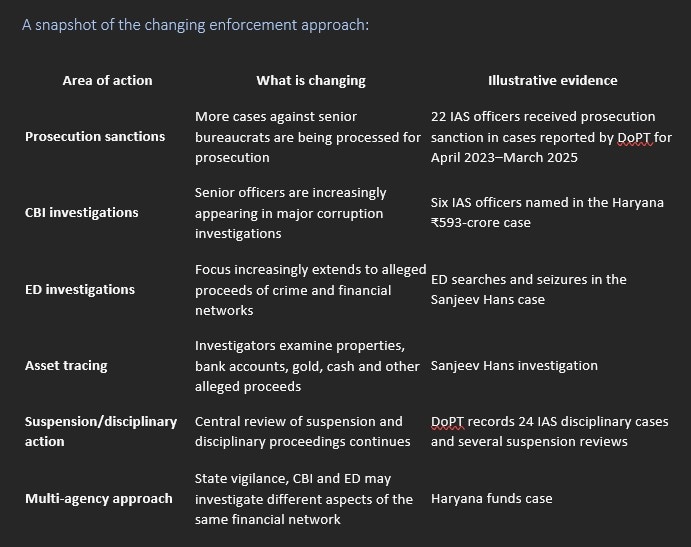
The Department of Personnel and Training's own figures provide more direct evidence concerning the IAS. Its Annual Report 2024–25 records that prosecution sanction was granted in 22 cases involving 22 IAS officers under the Prevention of Corruption Act between April 1, 2023 and March 13, 2025. It also records 24 disciplinary proceedings against IAS officers at different stages, five cases in which suspension periods were extended, and 1,272 complaints against IAS officers received during April 2024–March 2025, of which 1,213 had been processed and disposed of. These numbers are not convictions and should not be interpreted as proof of wrongdoing, but they demonstrate substantial institutional scrutiny.
The recent Haryana government-funds case illustrates the new approach particularly well. The CBI has filed chargesheets naming six IAS officers among 19 accused in a case concerning the alleged diversion of ₹593 crore belonging to eight Haryana government departments and organisations. The investigation alleges a nexus involving government officials, bank officials and private individuals. The CBI has arrested senior IAS officers in the case, and the investigation has expanded through multiple chargesheets. The case remains subject to judicial proceedings, but its significance lies in the fact that senior bureaucrats themselves have become central subjects of a major financial investigation.
The Sanjeev Hans case in Bihar demonstrates another dimension of this strategy. The ED conducted searches at multiple locations in connection with its money-laundering investigation and reported recovery of unexplained cash, gold, silver and other evidence. The agency alleged that Hans had illicitly enriched himself by approximately ₹90 crore. The Patna High Court subsequently granted him bail, and the allegations remain to be tested through the judicial process. The important point is that the investigation did not stop at the alleged administrative misconduct; it attempted to trace the alleged financial proceeds and assets associated with it.
A snapshot of the changing enforcement approach:
Why does this matter? The IAS occupies an extraordinary position in the Indian administrative structure. Officers can serve as district magistrates, commissioners, secretaries, principal secretaries and heads of public corporations. Their responsibilities can involve land, infrastructure, procurement, mining, excise, welfare schemes, public-sector enterprises and expenditure running into thousands of crores. A minister may announce a project, but officials frequently design procedures, process tenders, examine files, supervise implementation and authorise payments. Administrative responsibility therefore deserves as much scrutiny as political responsibility.
The new enforcement philosophy can be summarised in one phrase: “follow the money.” Earlier, a corruption inquiry could remain confined to the government file. Today, investigators can potentially follow the alleged proceeds from the original transaction into bank accounts, properties, investments and other financial structures. This makes the alleged gains from corruption much harder to conceal and potentially much easier to trace.
But the government must also ensure that the fight against corruption does not become a fight against the civil service itself. An IAS officer is not guilty merely because an investigation has been launched. Arrest is not conviction, and a chargesheet represents allegations that must be established before a court. The independence of investigative agencies, due process and judicial oversight are therefore essential. Honest bureaucrats must be protected from political pressure just as citizens must be protected from corrupt officials.
The real weakness of India's anti-corruption framework remains the time taken to reach final judgment. An officer may be investigated, arrested or charge-sheeted, yet proceedings can continue for years. The ultimate test of the current approach will therefore not be the number of raids or arrests but the quality of evidence, speed of trials, recovery of illicit assets where legally established, and convictions where guilt is proved.
The objective should not be to weaken the IAS. India needs a strong, professional and politically neutral civil service. But administrative independence cannot mean administrative immunity. An honest officer should have nothing to fear from an effective vigilance system; a corrupt officer should have nowhere to hide behind rank, designation or retirement.
The Modi government's approach can therefore be understood as an increasingly forceful fight against corruption and bureaucratic impunity. Whether this ultimately produces a cleaner administration will depend on consistent enforcement, institutional independence and timely judicial outcomes. India does not need a war against its civil service. It needs a war against corruption wherever public power is abused. The principle should be simple: no minister above the law, no bureaucrat above the law, and no institution above accountability.
(The author is an independent columnist)
Disclaimer: These are the personal opinions of the author

