






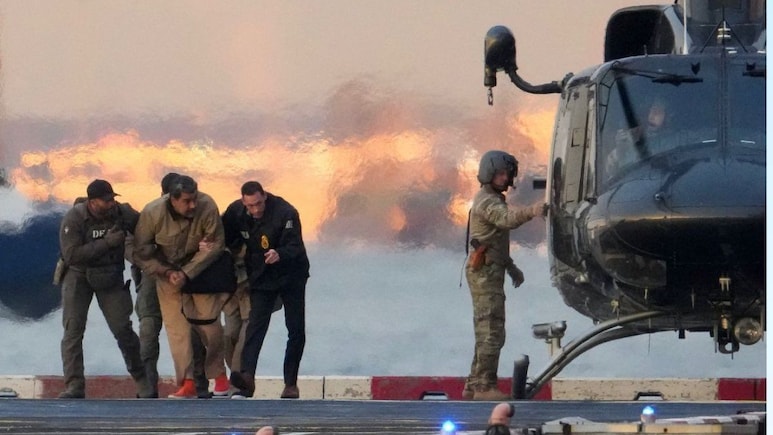
Proving 'might is right' right, yet again, the United States has unseated another head of state. President Donald Trump's announcement that United States forces conducted a "large-scale strike" in Venezuela and brought Venezuelan President Nicolás Maduro and his wife to the United States to face criminal charges is brazen even by US standards. Trump publicly stated that the United States would "run Venezuela" until a "safe, proper and judicious transition" could occur, framing the operation as a justified enforcement of US criminal law and national security interests.
What is even more unsettling is the barrage of visuals showing Maduro, inelegantly dressed, in handcuffs on American soil. Violation of international law aside, such a display of a president of a sovereign state, not declared criminal in any international court of law, is startling but nothing new in the US playbook. Remember Libya's Muammar Gaddafi and Iraq's Saddam Hussein? Only, the theatre is the neighbourhood and not the faraway 'Middle East'.
The 'Middle East' Manual, In Latin America
This poses an interesting conundrum for critics and supporters of the US alike. Does the Middle East manual of ushering in 'peace and democracy' apply here? Or are there different sets of rules at work? After all, the Nobel Peace Prize awardee for 2025, Maria Corina Machado, almost rolled out a red carpet to US intervention to rid her country of the despotic regime of Maduro. Machado, the Venezuelan opposition leader, even praised Trump directly in her Nobel acceptance speech.
The use of military force inside the territory of a sovereign state without its consent or an authorised basis under international law, but almost at the behest of the opposition leader, complicates the Venezuela situation. Under the United Nations Charter (1945), the use of force by one state against another is prohibited unless it meets one of two narrow exceptions: (1) a lawful act of self-defence under Article 51; or (2) Security Council authorisation under Chapter VII. Article 2(4) of the Charter obligates all members to "refrain in their international relations from the threat or use of force...against the territorial integrity or political independence of any state." The US has not publicly claimed that Venezuela posed an imminent military threat to the United States such that its actions could qualify as self-defence under Article 51.
Another layer of illegality concerns the special status of heads of state. Customary international law grants sitting heads of state immunity from the jurisdiction of foreign national courts for official acts and protection from forcible seizure by foreign powers. While the US has indicted Maduro under domestic laws, the extraterritorial enforcement of a criminal indictment through military force against a sitting president undermines norms protecting sovereign political leaders and diplomatic protocols.
Realpolitik vs Norms
The capture of Venezuelan President Nicolás Maduro reveals a profound clash between realpolitik and established legal norms. Even if the United States has jurisdiction over alleged crimes committed by Maduro, the method of military intervention without consent or international authorisation appears inconsistent with core principles of international law, including the prohibition on the use of force and sovereign immunity.
However, does the Trump administration care about any principles, including those enshrined in its own books? Trump's disdain for multilateral organisations and groupings, such as the UN and NATO, is well documented. The 'America First' policy does not believe in any norms that appear to be 'taking advantage' of the US. Countries allied with Maduro, including US archenemies Russia and China, have denounced the military action as a breach of international law and a violation of Venezuelan sovereignty. US allies are still calibrating their responses.
India, for whatever it is worth, has expressed deep concern for the people of Venezuela. The response is restricted to the well-being and safety, conveniently avoiding the question of sovereignty.
As of now, Maduro, along the expected lines, has entered a not guilty plea in the New York court. The US stock market has responded buoyantly to Maduro's capture, and the global oil companies are holding their breath. Trump's base has got another reason to cheer for their leader after the dampness of the Epstein files.
The question, however, that everyone seems to be murmuring but nobody is uttering, is that the military and economic might of the US threatens the 'rules-based order' that the international community is fond of slapping only at the Global South. For the US, it's only the unchecked Monroe Doctrine, now rechristened as the Donroe Doctrine, ascribing untramelled power even over spaces beyond its hemisphere. How countries like China and Russia adapt it in their conflicts with Ukraine and Taiwan, respectively, remains to be seen.
(Nishtha Gautam is a Delhi-based author and academic. She's currently researching Nationalism at Jindal School of International Affairs)
Disclaimer: These are the personal opinions of the author

