






Meta Platforms Inc. is spending $900 million on an Indian fintech whose founder will run WhatsApp globally. Is this just an expensive talent hire? Perhaps. But I think the motivation runs deeper. Mark Zuckerberg may be trying to revive the super-app idea.
The global tech firm announced this week that it will own 20% of Bengaluru-based Cred, which rewards people who pay their credit-card bills on time. Cred's founder and Chief Executive Officer Kunal Shah will move to Meta as the head of its flagship messaging service. With an estimated 500 million-plus users, India is WhatsApp's largest market. But how to make them do more on the app than just communicate?
This is where a super-app enters the picture, as a one-stop shop for users to arrange travel, order food, get entertained, pay online, save money, take a loan, or buy micro-insurance. China's WeChat is one such colossus; Alipay is another. Indonesia also has two: GoTo and Singapore-based Grab. But surprisingly, the world's most populous nation hasn't yet yielded a homegrown digital utility for daily needs. Large Indian conglomerates like the Adani Group, Jio, and the Tata Group have all tried and failed to capture the crown.
Zuckerberg has also displayed similar ambitions before. A decade ago, he approached the Indian data market with the promise of Free Basics, a walled garden in which the Silicon Valley behemoth and its partners would have been the banyan tree providing shade from high data costs. When that plan didn't fly with authorities, and data prices crashed when tycoon Mukesh Ambani entered the Indian wireless market in 2016, the Silicon Valley behemoth switched its attention to promoting WhatsApp as a facilitator of online payments.
Being able to mirror Tencent Holdings Ltd.'s success with WeChat Pay could have spawned India's first super-app, but Facebook Inc. (as Meta was then called) didn't get the chance. Instead, Alphabet Inc.'s Google Pay and Walmart Inc.'s PhonePe stole the lead and built solid moats over the so-called Unified Payments Interface, a platform shared across India's banks. Stuck in a regulatory logjam, Zuckerberg waited for a very long time to scale up the service. As I wrote six years ago, WhatsApp got a raw deal.
Then a lot of other things happened. Zuckerberg pivoted toward - and later abandoned - the metaverse. His concept of a blockchain-based world money was shot down by regulators. He threw Meta's immense weight into the AI race, investing heavily to capture the frontier of open-source intelligence. Amid all this tumult, however, WhatsApp remains a potentially underharvested field. Although restrictions on onboarding users for the payments function went away in December 2024, Meta doesn't even have a 1% share of the record 23 billion transactions that took place on UPI last month. Not only is Cred slightly ahead, but more importantly it has some of India's highest-spending online customers.
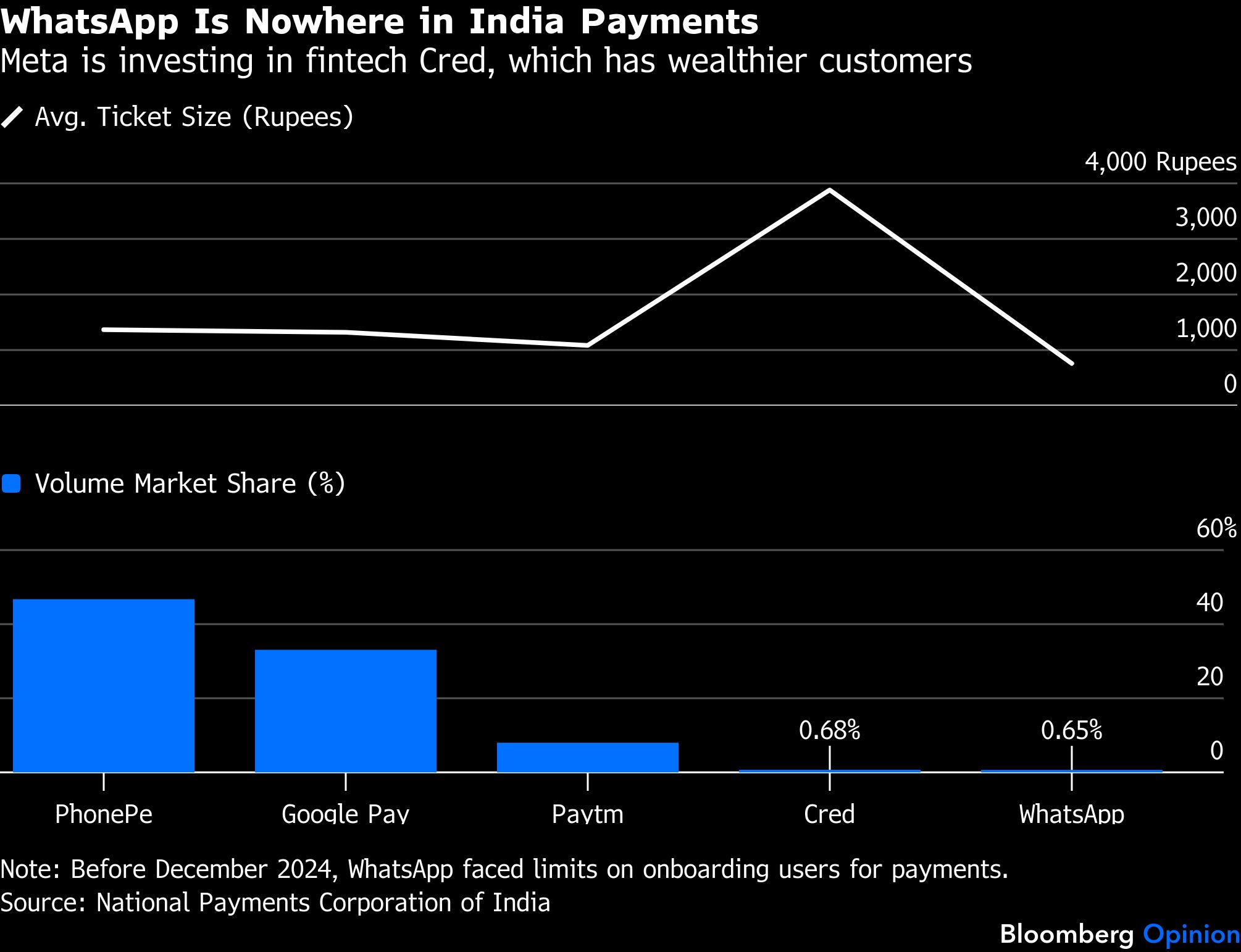
Therein lies the attraction to Zuckerberg of both Cred and its founder. Shah breaks the stereotypes of an Indian techie. For one thing, he isn't an engineer. A philosophy graduate from Mumbai, Shah built Cred around the idea that in a deeply unequal society like India's, people climbing the economic ladder have a strong yearning to signal their superiority to others. To create a sense of exclusivity, he allowed only people with high credit scores to join his platform. The strategy paid off. Today, Cred processes more than 40% of India's credit-card bills.
Although Cred has ruled out any sharing of members' data with Meta, some critics are asking if the deal is evidence of American tech companies' increasing control over the vast financial data generated by Indian consumers.
The nationality of the investor, however, is a sideshow. Online consumers in India are being routinely fleeced by "dark patterns" - design elements in apps and websites that trick users into overpaying, or paying for things they never wanted. Shah's challenge will be to create a fair one-stop commercial portal that doesn't abuse its knowledge of the customer to act against her. Realizing this vision requires a shift from pure utility to high engagement while staying within the limits of India's new personal data protection act.
Meta may have secured the right visionary. But with just 17 million monthly active users, Cred is a niche business. To give Zuckerberg his elusive super-app, Shah will have to do the exact opposite of what made him famous: shift from rewarding the 1% of society that he has served so far to empowering the hundreds of millions in the middle of the pyramid. That is the ultimate test for both him and his new boss.

