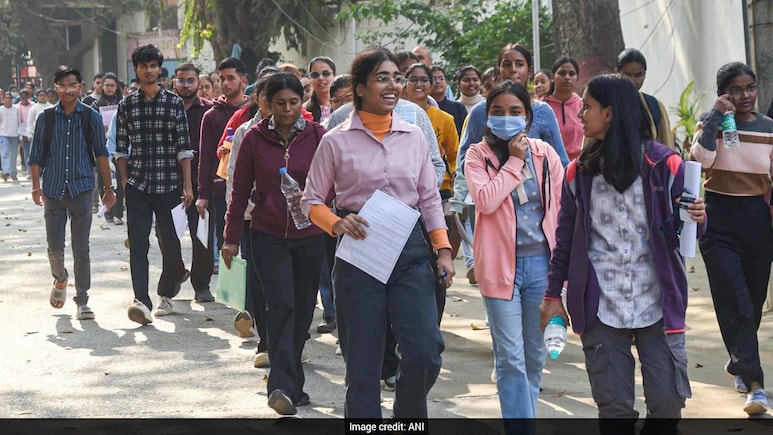
CLAT 2027 Registration: The registration portal for the Common Law Admission Test (CLAT) 2027 is currently open and will close in October 2026. The examination is scheduled to be held on December 6. CLAT is a national-level admission test for undergraduate (UG) and postgraduate (PG) law programmes offered by 26 National Law Universities in India. Several affiliate universities and organisations also use CLAT for admissions and recruitment, respectively.
Admissions to the five-year integrated LLB and one-year LLM programmes for the academic year 2027-28 will be based on CLAT 2027. The examination is organised by the Consortium of National Law Universities, which comprises representative universities.
CLAT 2027 UG Question Paper Format
The CLAT 2027 UG examination will be of two hours' duration. The question paper will comprise 120 multiple-choice questions, with each question carrying one mark. A negative marking of 0.25 marks will apply for every incorrect answer.
The questions will be divided across the following five sections:
- English Language
- Current Affairs, including General Knowledge
- Legal Reasoning
- Logical Reasoning
- Quantitative Techniques
CLAT 2027 UG Syllabus
The CLAT 2027 UG will assess the comprehension and reasoning skills of candidates. The examination is designed to test the aptitude and skills necessary for legal education rather than prior knowledge. However, prior knowledge may occasionally be useful for answering questions in the Current Affairs, including General Knowledge, section.
The five sections of the UG-CLAT 2027 are as follows:
English Language
The English Language section will include passages of about 450 words each. These passages will be derived from contemporary or historically significant fiction and non-fiction writing and will be of a standard that a Class 12 student should be able to read in approximately five to seven minutes.
Each passage will be followed by questions designed to assess candidates' comprehension and language skills, including their ability to:
- Read and comprehend the main point discussed in the passage, along with the arguments and viewpoints presented.
- Draw inferences and conclusions based on the passage.
- Summarise the passage.
- Compare and contrast different arguments or viewpoints presented in the passage.
- Understand the meaning of words and phrases in the context in which they are used.
Current Affairs, Including General Knowledge
This section will include passages of up to 450 words each, derived from news, journalistic sources, and other non-fiction writing.
The questions may examine legal information or knowledge discussed in or related to the passage. However, they will not require any additional knowledge of law beyond the information provided in the passage.
The questions will assess candidates' awareness of various aspects of current affairs and general knowledge, including:
- Contemporary events of significance from India and around the world
- Arts and culture
- International affairs
- Historical events of continuing significance
Legal Reasoning
The Legal Reasoning section will include passages of around 450 words each. The passages may relate to factual situations or scenarios involving legal matters, public policy questions, or moral and philosophical enquiries.
Candidates will not require prior knowledge of law to attempt the questions in this section. However, a general awareness of contemporary legal and moral issues may help candidates apply general principles or propositions to the given factual situations.
Questions following each passage will require candidates to:
- Identify and infer the rules and principles set out in the passage.
- Apply those rules and principles to different factual situations.
- Understand how changes to the rules or principles may alter their application to different factual situations.
Logical Reasoning
The Logical Reasoning section will include a series of short passages of about 450 words each. Each passage will be followed by one or more questions designed to assess candidates' reasoning and analytical abilities.
Candidates may be required to:
- Recognise an argument, its premises and conclusions.
- Read and identify the arguments presented in the passage.
- Critically analyse patterns of reasoning and assess how conclusions may depend on particular premises or evidence.
- Assess how conclusions may be strengthened or weakened by changes in premises or supporting facts.
- Infer what follows from a passage and apply these inferences to new situations.
- Draw relationships and analogies, identify contradictions and equivalence, and assess the effectiveness of arguments.
Quantitative Techniques
The Quantitative Techniques section will include short sets of facts or propositions, or other textual representations of numerical information, followed by a series of questions.
Candidates will be required to derive information from the passages or questions and apply mathematical operations to that information.
The questions will require candidates to:
- Derive, infer and manipulate numerical information presented in the passages.
- Apply Class 10-level mathematical operations to the information, including concepts such as ratios and proportions, basic algebra, mensuration and statistical estimation.
