





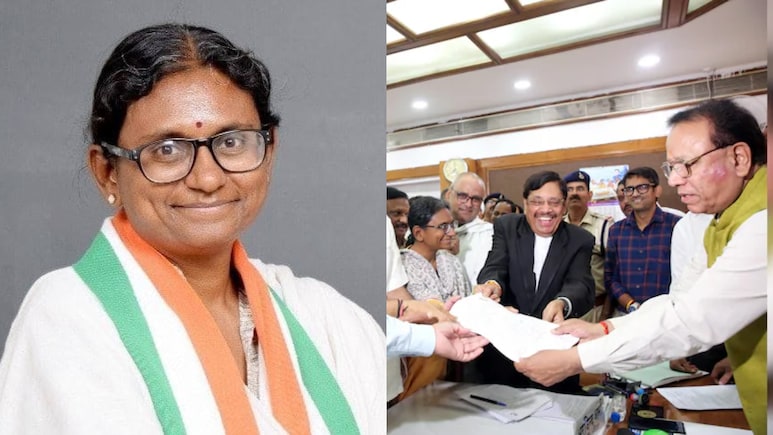
The controversy over Meenakshi Natarajan's rejected Rajya Sabha nomination from Madhya Pradesh has been read largely as a Congress embarrassment. On the surface, it is that. A candidate's papers have been rejected. The BJP is poised to gain from it. The Congress is crying foul. Legal arguments, affidavit technicalities, and Election Commission procedures have now taken centre stage.
But the larger political story lies elsewhere.
The question is not merely whether Natarajan should have disclosed the Telangana court matter in her affidavit. If a court had issued summons in a private complaint and she had knowledge of it, she was ill-advised not to mention it. In election affidavits, over-disclosure is safer than clever disclosure. A political party entering a high-risk Rajya Sabha contest should not leave even a pinhole for the opponent to exploit.
Yet the more interesting question is this: was Rahul Gandhi taking a risk in fielding her?
The answer is yes. And, more importantly, he seems to have known it.
The Leader of Opposition was not walking into Madhya Pradesh under the illusion that the Rajya Sabha seat was secure. Trouble could have come at three stages. First, at the nomination stage, where the BJP could raise technical objections. Second, through the possible defection or abstention of a small number of Congress MLAs. Third, through cross-voting on polling day. In other words, the danger was not accidental. It was part of the political terrain.
The BJP had already disturbed Congress calculations by fielding a third candidate. In the Madhya Pradesh Assembly, the BJP had a comfortable majority, while the Congress had just about enough strength to fight for one of the three seats if its flock held firm. The margin was not generous. The Congress leadership was reportedly considering moving MLAs to Congress-ruled states to prevent poaching or cross-voting. That itself revealed the nervous arithmetic.
A cautious Congress would have responded to such a situation by choosing a candidate who could manage the state unit, calm the old guard, speak to fence-sitters, and perhaps even neutralise sections of the local BJP establishment. In Madhya Pradesh, that name would have been Kamal Nath.
Rahul Gandhi chose otherwise.
Kamal Nath or confrontation
One option before Rahul Gandhi was to field an aging warhorse such as Kamal Nath. He may not represent renewal, but he represents power. He knows Madhya Pradesh. He knows its factions, its contractors, its district leaders, its caste equations, and its arrangements. He has the capacity to negotiate, persuade, cajole, and contain. He may have given the Congress a better chance of saving the Rajya Sabha seat.
But choosing Kamal Nath would also have meant choosing the old grammar of Congress survival. It would have meant that, when numbers are tight and the BJP applies pressure, the Congress falls back on the very leaders who have repeatedly dominated its state units, blocked transition, and treated renewal as a decorative slogan.
Rahul Gandhi was not willing to make that bargain.
This is not to romanticise his decision. Nor is it to offer him an excuse. Politics is not a theatre of good intentions. The Rajya Sabha is a numbers chamber, not a seminar room. If the Congress loses a seat, it loses a vote, a voice, committee space, parliamentary presence, and political momentum.
But one must understand Rahul's mindset. He seems to have decided that saving one seat through compromise was less important than showing that the Congress would not bend its choices to either BJP pressure or old-guard blackmail. The outcome, even if adverse, would carry a message: no compromise with the BJP, even if it means going one down in the Rajya Sabha; no automatic surrender to the old guard, even if the candidate of renewal is vulnerable.
Why Meenakshi became the signal
Meenakshi Natarajan is not an accidental Congress nominee. She is a Rahul Gandhi politician in the fullest sense of the term.
She belongs to the cohort that came into prominence when Rahul first tried to rework the Youth Congress and NSUI structures. She was NSUI president, later Madhya Pradesh Youth Congress president, and was brought into the AICC when Rahul began assembling a younger political team. In 2009, he picked her for the Mandsaur Lok Sabha seat, where she defeated BJP veteran Laxminarayan Pandey. She later lost in the Modi wave, but she remained within Rahul's circle of trust.
That circle has often been labelled inside the Congress as the "Jai Jagat" group: left-of-centre, social-justice oriented, morally earnest, organisationally uneven, often accused of having an NGO-style approach to politics. Its critics see in it a lack of electoral cunning. Its defenders see in it the ideological spine Rahul believes the Congress must recover.
Natarajan's nomination has to be seen through this lens. It was not merely a ticket. It was an internal note to the party.
Rahul was telling the old Congress that proximity to state power is not the only qualification for reward. He was telling the younger Congress that loyalty, ideological clarity, and long association still count. He was telling the BJP that the Congress would contest even in unfavourable terrain. He was also telling himself, perhaps, that renewal cannot be postponed every time the arithmetic becomes uncomfortable.
BJP's opening, Congress's Failure
The BJP, of course, did what the BJP does well. It identified vulnerability and acted on it.
The objection to Natarajan's nomination centred on her alleged non-disclosure of a court matter in Telangana. The Congress argued that this was a legal notice or complaint where, according to its side, disclosure was not mandatory in the way the BJP claimed. The BJP insisted otherwise. The Returning Officer accepted the objection. The nomination was rejected.
The Congress has called it political manipulation. Natarajan herself has described it as political, not legal. Senior Congress leaders rushed to complain to the Election Commission. There were accusations of democracy being undermined, and familiar charges that the BJP uses institutions and technicalities to deny opponents a fair contest.
There is merit in examining whether the rejection was disproportionate. But there is also no escaping the Congress's own failure. A party that knows it is contesting against a ruthless and alert opponent cannot afford casualness. It cannot say the BJP will exploit loopholes and then leave a loophole. Procedural competence is now part of political resistance.
Rahul Gandhi may have chosen risk. But the organisation around him had to reduce avoidable risk. It did not.
This is the larger Congress problem. Rahul often frames politics in moral and ideological terms. The BJP fights it in institutional, procedural, and tactical terms. The Congress cannot answer one kind of politics with only the other. It needs both. It needs the moral argument and the form correctly filled. It needs the slogan and the polling agent. It needs the idea and the arithmetic.
A seat lost, a line drawn
The easy conclusion is that Rahul Gandhi miscalculated. Perhaps he did. If the Congress ends up one seat short in the Rajya Sabha because of this episode, the cost is real.
But the more meaningful conclusion is that Rahul made a choice with eyes open. He could have played safe. Instead, he treated the situation as a political signal.
That signal is not without contradiction. It may not comfort Congress workers who want winnability over symbolism. It may irritate veterans who believe Rahul still underestimates the mechanics of power. It may invite ridicule from the BJP, which will say that moral posturing without numbers is useless.
But Rahul's point appears different. He seems to be saying that the Congress cannot keep postponing internal change in the name of immediate survival. Every time the party faces the BJP, it cannot outsource the fight to those who specialise in accommodation. Every difficult election cannot become an argument for returning to the same old managers.
There is a hard lesson here for both Rahul and his critics.
For Rahul, the lesson is that risk must be backed by rigour. If he wants to field a Meenakshi Natarajan over a Kamal Nath, the nomination must be flawless, the MLAs must be secured, the legal team must be alert, and the party must be ready for every BJP move before it happens.
For the old guard, the lesson is that their indispensability is no longer assumed. Rahul may lose by refusing to compromise, but he seems increasingly willing to accept that loss rather than remain hostage to the politics of yesterday.
In Madhya Pradesh, the Congress may have lost more than a nomination paper. It may have lost a Rajya Sabha seat.
But Rahul Gandhi has drawn a line that explains his current politics better than many speeches: better to lose a seat fighting the BJP on his own terms than win one by restoring the old Congress bargain.
Whether that is courage or folly will depend on what he builds next.
(Rasheed Kidwai is an author, columnist and conversation curator)
Disclaimer: These are the personal opinions of the author

