






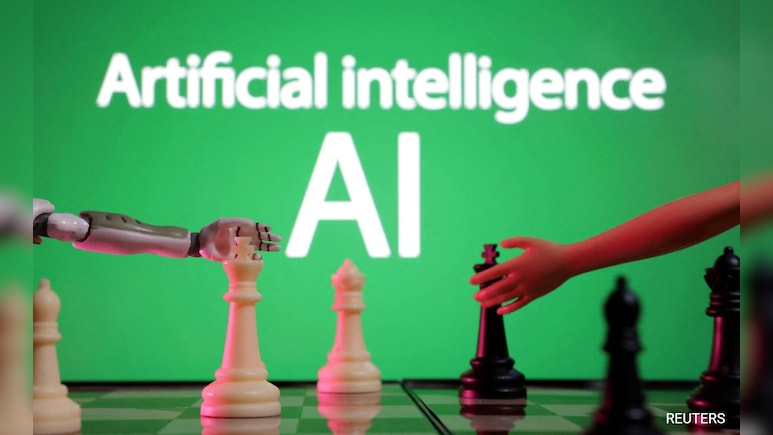
On September 7, Jensen Huang, CEO of NVIDIA, announced that artificial general intelligence, or 'AGI', had arrived. The occasion was OpenAI's GPT-6 Astra, trained on a "modest" cluster of more than one lakh NVIDIA Grace Blackwell GPUs. Then came the real news: 4 lakh more NVIDIA GPUs, each with the computing power of hundreds of high-end computers, making compute the new infra of the AI age.
This was not his first resurrection. In March, on Lex Fridman's podcast, Huang was asked if an AI that could launch, scale, and run a billion-dollar company autonomously would count as AGI. "I think it's now. I think we have achieved AGI," Huang said, with his signature calm.
-

-
 'AI Scares Me': Kriti Sanon On Personality Rights And Need For Laws
 -
 'This Time I Wanted Gold': Savita Punia Reflects On Historic Asiad Success
 -
 Favourite Bollywood Actor To 5-Year Plan, Kriti Sanon Interviews AI Actor Tilly Norwood
 -
 Neeru Dhanda Carried Homemade Churma To Asiad, Returned With Two Gold Medals
 -
 Inside The Mind Of Archer Kumkum Mohod, Who Dared To Challenge South Korea
 -
 "High Inflation Is Like Tax On Everyone": RBI Governor At NDTV World Summit
 -
 Ashwini Vaishnaw Explains Semiconductor Complexity: 'Everything On This Tiny Nail'
 -
 Indian-Branded Mobile Phones By October 23, 2028, Says Ashwini Vaishnaw
 -
 AI Law In India Soon? What Ashwini Vaishnaw Said At NDTV World Summit
 -
 World's 1st AI Actor Tilly Norwood Was Asked If She Knew Hindi. A Conversation Followed
One catch. The question never said the company had to survive in the real world. So, within six months, AGI arrived twice. Once, as a short-lived founder. Once as Astra.
OpenAI has been just as generous. After Astra launched, president Greg Brockman said it is "not unreasonable to feel that we are now in the AGI era". Then, with the humility of a man about to IPO: "For me personally, I do think we are there."
Sam Altman got there first. Late last year, he said AGI "kinda went whooshing by", then added, "Okay, fine, we built AGIs".
All scientific breakthroughs in history shared one flaw: outsiders could verify them. The Wright brothers stayed aloft for twelve seconds at Kitty Hawk. Neil Armstrong stepped on the moon and left no disclaimer saying "Moon" was a fluid term open to investor interpretation.
AGI has a rare gift. It can arrive before anyone agrees what that arrival looks like. It is Silicon Valley's version of a Gurugram builder announcing 'possession open' on a tower with no occupancy certificate, no plumbing, no lifts, and a promise of electricity next quarter. The definition expands on Monday to fit whatever shipped on Sunday, then gets presented on social media as proof it was met.
None of this means Astra isn't awesome engineering, or that OpenAI, Anthropic, Google DeepMind, and NVIDIA haven't achieved monumental things. Somewhere along the way, AGI stopped being a question of what machines can do and became a question of what Silicon Valley is financially allowed to call it. That distinction matters because it is worth about two trillion dollars.
AGI now has as many definitions as a political manifesto. Human-level cognition. Software that automates economically valuable work. An agent that books an IRCTC ticket without crashing. Topping a high-school maths benchmark.
Demis Hassabis, co-founder of Google DeepMind, keeps AGI's definition strict: a machine with the full range of human cognitive ability. He has also accepted that the definition is being "watered down", and that there is "a lot of hype for various reasons" - raising money among them.
Francois Chollet, creator of the ARC benchmark, is more blunt: define AGI as automating routine tasks, and you have not defined intelligence ... you have defined an assembly line.
Computer scientist Yann LeCun describes scaling today's large language models into AGI as nonsense.
So what makes the term so profitable? Build a better chatbot, you have a software product. Build a better coding assistant, you have an enterprise tool. Build a machine that claims to replace the majority of human talent: you have an invoice for the future of global GDP.
In March, OpenAI closed $122 billion in committed capital at an $852 billion valuation. In May, Anthropic raised $65 billion at $965 billion. At those numbers, investors aren't buying a business. They are buying an option on future economic output.
AGI is the password that keeps that option open, driving Anthropic, OpenAI, and compute landlords like CoreWeave toward trillion-dollar IPOs. News reports say Anthropic is projecting about $200 billion in annual revenue by 2028. 'AGI is here' is the key that keeps such companies from being valued like normal software firms, bound by arithmetic. A software company reports revenue today. AGI only promises the world tomorrow, and tomorrow doesn't file regulatory disclosures.
NVIDIA is not just selling shovels for the AI gold rush. It is financing the miners: a $30 billion investment in OpenAI's February round, a residual-value guarantee capped at $105 billion on the Ohio data-centre campus OpenAI is leasing, a stake in CoreWeave, and a promise to buy up to $6.3 billion of CoreWeave's unused cloud capacity if no one else wants it.
Money leaves NVIDIA, travels to multi-billion-dollar startups, turns briefly into "R&D expense", then parachutes back onto the titan's income statement as high-margin cloud revenue. To keep that carousel spinning, demand for compute has to stay infinite. An autocomplete for customer support needs a server room. An artificial god managing humanity's economic output needs the sun. Hence, Jensen Huang's 400,000 more GPUs.
AGI has apparently arrived, even as the physical world reopens decommissioned nuclear reactors, drains water tables for cooling towers, and requests enough power to make a national electricity grid faint, just to keep the racks from melting.
None of this means the technology is not real. The internet was real in 1999, so was the dot-com crash. In 1954, Lewis Strauss, chairman of the US Atomic Energy Commission, promised nuclear power would make electricity "too cheap to meter." The physics was sound. The economics was a fairy tale.
Silicon Valley's greatest invention is the ability to turn a real, incremental advance into an elastic financial story: a scientific milestone, an enterprise product, a labour-market scare, an investment thesis, and a PR campaign, all at once.
In our rush to declare we have birthed a mind in our own image, we reveal everything about ourselves. The real question is not whether machines will learn to think like us. It is whether we, dazzled by the scale of the machine, will still remember how to tell the difference.
(Chief Content Officer at NDTV Network)
Disclaimer: These are the personal opinions of the author

