






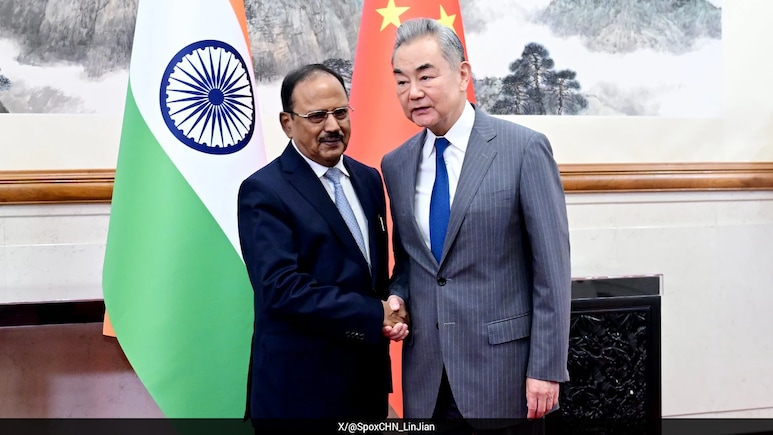
The Chinese strategic community closely followed India's National Security Advisor Ajit Doval's meeting with his Chinese counterpart Wang Yi in Beijing for the 25th meeting of the Special Representative for the China-India border issue.
Since 2003, the special representative meeting has been a top priority for both China and India in addressing the boundary question and maintaining border peace and stability. However, after the Galwan Valley conflict in 2020, this mechanism was interrupted for nearly five years and only resumed in December 2024, after Prime Minister Narendra Modi and President Xi Jinping met each other on the sidelines of the 16th BRICS Summit in Kazan on October 23, 2024. On December 18, 2024, the 23rd Meeting of Special Representatives was held in Beijing, marking the first such talks in five years. On August 19, 2025, the 24th meeting was held in New Delhi, where important consensus was reached between the two sides on issues such as setting up an expert group under the Working Mechanism for Consultation and Coordination on India-China Border Affairs (WMCC) to explore early harvest in boundary delimitation in the India-China border areas, setting up a working group, under the WMCC to advance effective border management and maintain peace and tranquillity in India-China border areas, creation of general-level mechanisms in the eastern and middle sectors, in addition to the existing general-level talks in the western section of the boundary among others. The 25th meeting built on the progress made in the earlier rounds and carried forward the conversation on border issues, as well as bilateral relations and international and regional affairs.
However, what made this meeting a major talking point among Chinese observers was its timing. On one hand, weeks before the meeting, China-India had a brief spat over the names of places in the north-eastern state of Arunachal Pradesh, which China claims as "South Tibet". On August 7, India identified 27 places and features located in Arunachal Pradesh by standard names on the official maps of the Survey of India. The move came against the backdrop of Beijing's repeated attempts to rename places in Arunachal Pradesh, the latest exercise being carried out in April 2026. The Chinese side has been fuming at India's "audacity", while the Chinese foreign ministry declared the move "illegal and invalid" on August 10.
Similarly, the Chinese side noted with great unease as Indian Defense Minister Rajnath Singh and Japanese Defense Minister Shinjiro Koizumi signed a memorandum of understanding on maritime security cooperation on August 20, where both sides strongly opposed "any unilateral actions that hinder the freedom and safety of navigation and flight" as well as any "attempts (by countries) to change the status quo in the region by force or coercion". The development attracted significant media attention in China, given the current downturn in China-Japan ties. India was also criticised for its two-faced China policy.
However, on the other hand, Chinese observers are well aware that the Doval-Wang Yi meeting is to be closely followed by the BRICS summit in New Delhi on September 12-13, where India will serve as the rotating chair and pass the baton to China for the year 2027. From that perspective, it is argued that the outcome of the Doval-Wang Yi meeting in Beijing will have a direct bearing on the pace of operations within BRICS for the next two years. Any sign of fracture in China-India ties can very well undermine the message of the "Global South unity/solidarity", particularly at a time when the US administration is considering levying up to 100% tariffs on countries doing business with Russia and Iran, which includes both China and India.
Given the paradoxical situation, the Chinese internet maintained a cautiously optimistic attitude towards the meeting, with several articles highlighting the achievements made so far. These included the resumption of the Kailash-Manasarovar pilgrimage, the re-opening of the three traditional border trade ports, the revival of cultural and cross-border exchanges, and India's various cooperative measures towards China in the run-up to the meeting, such as the resumption of direct flights and mutual resident correspondence, the easing of investment restrictions on Chinese companies, among others.
China, in its official statement, also walked a tightrope by putting forward its major demands, such as "placing the border issues in an appropriate position in bilateral relations", and claims like "China-India are partners rather than competitors", alongside a charm offensive. It highlighted the need for China and India to be 'good neighbours and friends', like 'dragon and elephant dancing together'.
Internally, however, Wang Yi's mention of the "Three No's" in his statement - no stagnation, no regression, no deviation - became quite a buzzword in Chinese discussions. It was interpreted as China drawing its red lines regarding the direction of its relations with India. "China is highlighting its bottomlines that the positive momentum of relations must not stop, the trust that has been hard-won must not be lost, and the overall direction must not deviate due to local issues" explained an article in Chinese online media Sohu.com. Chinese discussions also highlighted Doval agreeing to "developing a stable, predictable, and forward-looking India-China relations" and "both countries being partners rather than competitors", although these terms do not feature in the Indian read-out.
It is important to know that overall, in the Chinese assessment, the real significance of NSA Doval's visit to Beijing was not so much about "border negotiations" but the reopening and entrenchment of high-level communication channels between China and India. As is now known, the meeting of special representatives in Beijing was a prelude to President Xi's expected visit to India for the BRICS Summit, after seven long years. The Chinese side argues that as long as this pipeline of high-level contact between China and India remains open and functioning, the likelihood of border friction escalation can be reduced, while the space for the US to strengthen its military presence in South Asia and exert pressure on China through its Quad/Indo-Pacific strategy, can be undermined, which in turn will impact the overall trend of global order restructuring. For those in India hoping for some sort of settlement of the border issue through the special representative meeting, the broader public sentiment in China should raise concern.
(The author is a Fellow at the Strategic Studies Programme at Observer Research Foundation, New Delhi.)
Disclaimer: These are the personal opinions of the author

