






Pictures of a heavily missile-laden Chinese Shenyang J-16 multirole fighter jet, in what is being called the ‘Beast Mode', have been seen and have sent analysts scurrying to interpret the PLA's long-range air superiority and combat patrol capabilities. The photograph, which was released by a Chinese aviation oversight body, has circulated widely. It shows the fighter carrying eight PL-15 beyond-visual-range (BVR) missiles and two PL-10 short-range dogfighting missiles. Is this intimidating propaganda or a real development? Only time will tell.
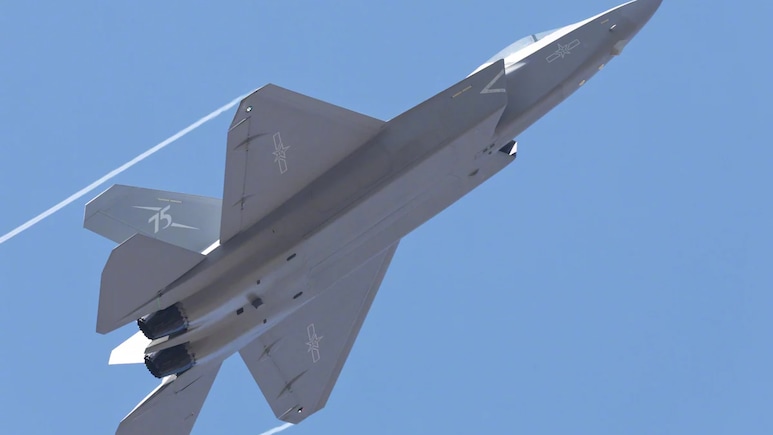
Meanwhile, China aerospace watcher Andreas Rupprecht “Deino” has assessed that the PLA Air Force (PLAAF) already has 500 Chengdu J-20 stealth fifth-generation fighters. Earlier reports had indicated that China plans to have 800 by 2030 and 1,500 by 2035, by which time the Indian Advanced Medium Combat Aircraft (AMCA) will be inducted.
Simultaneously, production of China's second fifth-generation fighter, the Shenyang J-35, is being doubled, and Pakistan is all set to be the first foreign customer.
As China pulls away and ahead, it leads in 66 of the 74 critical and emerging technologies tracked by the Australian Strategic Policy Institute. This dominance spans nearly 90 percent of the strategic fields vital for global defence, space, robotics, energy, the environment, biotechnology, and artificial intelligence. By comparison, the United States leads in only eight. It is time to understand these platforms and China's Anti-Access/Area Denial (A2/AD) strategy.
Shenyang J-16
The Shenyang J-16 ‘Hidden Dragon' is a Chinese all-weather 4.5-generation, tandem-seat, twin-engine, multirole strike fighter developed from the Shenyang J-11, the licensed-production variant of the Russian Sukhoi Su-27. The J-16 is equipped with an active electronically scanned array (AESA) radar and is powered by two Chinese Shenyang WS-10B engines with 135 kN of thrust with afterburner. The J-16 uses radar-absorbent paint to reduce its radar signature and enhance its suppression of enemy air defences (SEAD) capability in conjunction with electronic support measures pods. Some technologies have been imbibed from the fifth-generation J-20. Over 450 have been built. The payload capacity of the 12 external hardpoints is approximately 8,000 kg. It can carry a mix of up to 10 to 12 air-to-air missiles, typically consisting of long-range PL-15 and PL-17 beyond-visual-range (BVR) missiles and short-range PL-10 missiles for close combat (dogfighting).
Chengdu J-20
The Chengdu J-20 ‘Mighty Dragon' is a twin-engine all-weather fifth-generation stealth fighter that made its maiden flight on 11 January 2011. Designed as an air superiority fighter with precision strike capability, the aircraft entered service in March 2017, making China the second country in the world to field an operational stealth aircraft. It features extended weapon-carrying capability, unmanned aircraft teaming, and WS-15 thrust-vectoring engines. The J-20 can obtain situational awareness through advanced sensor and data fusion. Analysts have raised doubts about the quality of its stealth as it uses canards on a low-observable design. China advertises an annual production rate of 100-120 aircraft; however, analysts believe that a production rate of 60-70 aircraft is more likely. The aircraft's maximum weapon-load capacity is 11,000 kg. Internal weapon bays can carry up to six air-to-air missiles (AAMs). External hardpoints carry larger weapons.
Shenyang J-35
The J-35 is China's newest twin-engine, fifth-generation stealth multirole fighter designed primarily for air superiority and surface-strike missions. It exists in both a carrier-based variant and a land-based variant (J-35A). In September 2025, it joined the PLA Air Force and PLA Navy. It makes China the second country to use two types of stealth fighters, the other being the United States, operating the F-22 and F-35. Six internal (2,000 kg) and six external hardpoints (6,000 kg) provide a total weapon payload of up to 8,000 kg. Around 60 have been built to date. In May 2026, China rolled out the export variant of the Shenyang J-35A, designated J-35AE. Pakistan is planning the acquisition of up to 40 of these fighters, which would make it the first export customer of the J-35 (both land-based and naval variants).
Chinese HVAA Killer Missiles
China's PL-15 and PL-17 are advanced beyond-visual-range (BVR) missiles designed to target High-Value Airborne Assets (HVAA), such as AWACS (Airborne Warning and Control System) aircraft and mid-air refuelling tankers, from extreme distances. PL-15 has a claimed range of around 200-300 km and can be carried on J-20, J-10C, and JF-17C aircraft. The export version, known as the PL-15E, features a restricted maximum range of approximately 145 km. The massive, 6-metre-long PL-17, with a range in excess of 350 km, can be carried on the J-20 and J-16.
The induction of the PL-15 and PL-17, notably integrated into the Pakistan Air Force's JF-17 Block 3/JF-17C jets and the Chinese PLAAF's J-20 fleet, fundamentally changes the geometry of air warfare. These “AWACS killer” missiles force defending air forces to position their vulnerable, high-value command aircraft much further from the front lines, degrading local battlefield awareness and tactical coordination.
China-Pakistan Military Aviation Nexus
The China-Pakistan military aviation nexus represents a deep strategic alliance. Pakistan now sources roughly 80 percent of its major military hardware from China, with state-run companies from both nations collaborating closely on research, development, and operational deployments. The JF-17 ‘Thunder' is the flagship project. The multirole fighter has progressed through several variants (Blocks I, II, and III), integrating advanced Chinese avionics and the active electronically scanned array (AESA) radar.
Pakistan has confirmed a collaborative agreement to acquire the fifth-generation Shenyang J-35 stealth fighter to counter regional rivals (India). China supplies Pakistan with strike-capable and reconnaissance drones, including the CH-4 and Wing Loong series, which are integrated into Pakistan's frontier defences. Over the last decade, Pakistan's reliance on Chinese aerospace technology has become foundational, replacing older Western and indigenous platforms. The air forces frequently conduct “Shaheen” (Eagle) joint air combat drills to practise interoperability, tactics, and electronic warfare.
Pakistan utilizes the Chinese-supplied HQ-9/P surface-to-air missile (SAM) system, forming a deeply integrated air and missile defence architecture. Indian defence planners view this nexus as a severe operational challenge, pointing to the risk of coordinated two-front tactical pressure and real-time data and intelligence sharing. The integration of modern Chinese electronic warfare (EW) capabilities, satellite communications, and precision missiles into the Pakistan Air Force (PAF) supports multi-domain warfare and radically alters the aerial dynamics in South Asia.
China's Air Strategy in SCS and Across the Himalayas
China's Anti-Access/Area Denial (A2/AD) is a military strategy designed to deter foreign intervention, specifically by the U.S. military, in regional conflicts involving Taiwan or the South China Sea. It utilizes a layered network of long-range missiles, submarines, and integrated air defences to keep adversaries far from Chinese shores. Anti-Access (A2) actions are aimed at preventing adversary forces (like U.S. aircraft carrier strike groups) from entering its operational areas. This is largely enforced by land-based anti-ship ballistic missiles (DF-21D and DF-26), anti-satellite weapons, and advanced submarines. Area Denial (AD) actions aim to limit the freedom of action of forces that are already within the operational area. This relies on a dense umbrella of surface-to-air missiles (S-400, HQ-9), fourth- and fifth-generation tactical aircraft, and electronic and cyber warfare.
Across the Himalayas, the focus will be on overcoming the geographical limits of the Tibetan Plateau by relying on an interlocking “kill web” of advanced stealth fighters (J-20s), extensive base hardening, drone swarms, and hidden ground-based air defences. This approach minimizes high-altitude physical disadvantages while projecting overwhelming regional deterrence. The PLAAF will use fifth-generation fighters like the J-20 to secure a “first-look, first-shot” advantage. Paired with long-range PL-15 and PL-17 beyond-visual-range missiles, these aircraft aim to neutralize non-stealth platforms before they can enter contested zones. Because thin, high-altitude air naturally reduces fighter payload capacity and range, China has constructed and doubled the capacity of forward air bases and heliports in the region. These sites include hardened bunkers to shelter aircraft and underground logistics hubs capable of pumping medical-grade oxygen to ground and aircrews. China has developed heavily defended, integrated air defence sites. Retractable, garage-style roof shelters conceal radar domes and surface-to-air missile batteries, allowing them to engage targets while hiding from satellite surveillance and drone targeting.
India's Key Strategic and Operational Strengths
India's primary strengths in Himalayan air action stem from a geographic advantage in elevation and superior operational preparedness. By utilizing specialized, high-altitude bases, diverse multirole fleets, and unique operational experience, the Indian Air Force (IAF) maintains a distinct tactical edge in the region. The IAF operates a dense network of airfields in the plains at the foothills across the Himalayas. It has upgraded Advanced Landing Grounds (ALGs) closer to the Line of Actual Control (LAC) than opposing forces. The airbases in Ladakh and the Northeast enable lightning-fast troop and equipment staging.
India holds a historical, combat-proven record of high-altitude air strikes, most notably demonstrated during the 1999 Kargil War. This hands-on, localized experience in dealing with extremely thin air, sharp terrain masking, and severe weather extremes is an advantage that adversaries lack. Flying low over the 4,500 m-high Tibetan Plateau allows IAF strike fighters to easily avoid enemy radar lines. Aircraft in the Indian arsenal, such as the Rafale, Sukhoi Su-30MKI, and Mirage-2000, are highly optimized for this kind of terrain-hugging, low-level penetration.
According to independent metrics like the WDMMA (World Directory of Modern Military Aircraft) Global Air Power Index, the IAF consistently outranks regional peers in operational capability, fleet balance, and pilot competence. India deploys lightweight, rapidly deployable 3D radars (such as the DRDO-developed Aslesha Mk I) designed specifically for mountainous environments. This ensures continuous, low-level tracking of enemy drones, fighters, and helicopters.
The Indian military routinely conducts rigorous Himalayan joint exercises. The construction of multi-tier mountain infrastructure, like tunnels and all-weather roads, ensures that crucial fuel, parts, and munitions are supplied year-round, overcoming historical logistical hurdles.
Countermeasures against Long-Range Missiles
Countermeasures against the PL-15 and PL-17 require a combination of Electronic Warfare (EW), kinetic evasion, and escort protection. Because these massive Beyond-Visual-Range (BVR) weapons use AESA seekers and data links to target vulnerable aircraft, specialized defence strategies are vital. The HVAAs must be heavily guarded by friendly stealth fighters (F-35, Su-57) operating far forward to intercept the launching aircraft before it reaches firing range. Utilizing integrated jammers and directional infrared countermeasures can disrupt the missile's AESA seeker and break the mid-course data link. Deploying advanced expendable active decoys can draw the missile's radar away from the actual high-value target. The Indian Air Force (IAF) equips its Rafale fighter jets with the Israeli-made X-Guard, an AI-powered, fibre-optic towed decoy (FOTD) system.
Way Ahead For India
Major world powers, including India, are trying to understand the implications of and options against Chinese long-range aerial missiles. Countervailing options include shifting from large, centralized bases to distributed operations across multiple remote airfields and civilian highways. Positioning more AD weapons in the Himalayas will result in air denial. Equipping existing platforms with extended-range weapons, such as maritime strike missiles exceeding 1,000 kilometres (BrahMos with a 1,500 km range), allows aircraft to strike from outside the threat envelope.
India has a four-to-one advantage in airfields. Even if China were to neutralize 5-6 Indian airfields for a few hours, India's neutralizing even two Chinese airfields will have a greater impact.
The world is developing very long-range BVRs to counter Chinese missiles. The Russian R-37M ‘Axehead', with a Mach 6 speed and an operational range of up to 300-400 km, and the KS-172/K-100 ultra-long-range missile (300-400 km) are designed specifically to target HVAA. The American AIM-174B boasts an estimated range of between 300 km and 400 km. The MBDA Meteor has one of the highest no-escape zones, with a range exceeding 200 km. Named ‘Gandiva', the Astra Mk-3 is India's most advanced, state-of-the-art BVRAAM being developed by the DRDO. It utilizes cutting-edge Solid Fuel Ducted Ramjet (SFDR) propulsion to achieve an unparalleled range of up to 340 km.
Deploying robust electronic warfare (EW) pods to jam missile terminal guidance systems, alongside accelerating directed-energy research for close-in physical destruction. Fielding loyal wingmen and autonomous combat drones to absorb initial strikes, saturate enemy radar, and conduct counter-battery operations on mobile missile launchers. Upgrading mobile Surface-to-Air Missile (SAM) networks (S-400/500) with integrated, networked sensor data across allied forces to detect and intercept low-flying, sea-skimming, or high-altitude targets.
Project Kusha is India's indigenous, long-range surface-to-air missile (SAM) defence system developed by the DRDO. Designed to create a multi-layered air defence shield comparable to Russia's S-400, it features three interceptor variants with ranges of 150 km, 250 km, and 400 km to intercept stealth aircraft, drones, and hypersonic missiles.
Lastly, having stealth aircraft combined with electronic warfare (EW) and tactical flight profiles can shrink the enemy's targeting window. Ultimately, it is important to stay ahead on the technology curve. India needs to hasten the development of its fifth-generation AMCA aircraft and its advanced aerial missiles.
(The author is a retired Air Marshal)
Disclaimer: These are the personal opinions of the author

