






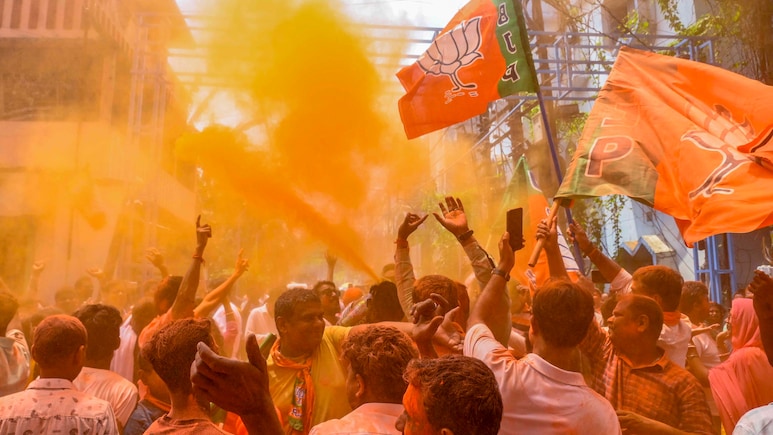
The electoral rise and victory of the Bharatiya Janata Party in West Bengal is not just another political event; it reflects a deeper ideological and civilisational shift. Bengal, long seen as a stronghold of Leftist and regional political traditions, is now witnessing a transformation that challenges decades of entrenched narratives about its political identity.
Political thinker Samuel P. Huntington, in his idea of the "Clash of Civilizations," suggested that future conflicts would be driven more by culture and identity than by purely economic or ideological factors. While his framework was global, similar dynamics can be observed in Bengal, where politics is increasingly shaped by questions of identity, culture, and national belonging.
For decades, Bengal's politics was deeply influenced by Left ideology as well as strong regional assertion. This regionalism often created a distinct political identity that, at times, appeared to stand apart from broader national narratives. Critics argue that such over-assertion of regional identity sometimes led to the weakening of a shared national outlook. The recent electoral shift indicates that many voters are now aligning more strongly with a wider national identity, suggesting that regionalism is gradually giving way to a more integrated sense of nationalism.
This election also reflects a larger contest between ideological frameworks. On one side are the Marxist and Left traditions that shaped Bengal for decades, along with strands of conflict-driven politics rooted in class struggle and ideological polarization. On the other side is a growing emphasis on cultural continuity, national identity, and civilisational consciousness. Many observers interpret this as not only the decline of communism, Maoism, and Naxalite influence, but also as a rejection of politics built primarily on division and confrontation.
For nearly thirty years, Bengal was governed by Left parties, making it one of the longest-running communist governments in a democratic system. Over time, however, issues such as economic stagnation, industrial decline, and political fatigue weakened their hold. The current shift marks a symbolic end of that era. While Left ideology will continue to exist intellectually, its central place in electoral politics has clearly diminished.
Another important element in this transformation is the perceived decline of what critics describe as "appeasement politics." The new political narrative emphasizes equal treatment, national cohesion, and a move away from policies or rhetoric that are seen as catering to specific groups for electoral gains. In this view, the shift represents not only a political change but also a change in the style and priorities of governance.
The developments in Bengal are often compared with those in neighboring Bangladesh, where concerns about political instability, identity tensions, and violence are frequently highlighted in public discourse. In contrast, Bengal's transition is widely seen as democratic and largely peaceful, underlining the resilience of India's electoral institutions even during periods of intense political competition.
A significant aspect of this transformation is the renewed emphasis on India's civilisational traditions. Bengal has historically been a center of spiritual and cultural renaissance. Figures like Chaitanya Mahaprabhu, who promoted devotion and unity, and Swami Vivekananda, who reinterpreted Indian spirituality for the modern world, symbolize the region's deep cultural heritage. Supporters of the current shift often see it as a renaissance - a re-emergence of these traditions in public life.
For a long time, Bengal was considered politically "unchangeable." The recent electoral developments challenge this perception. They show that voters are willing to rethink long-held loyalties, that aspirations are evolving, and that no ideology can maintain dominance indefinitely. This shift reflects a broader trend in Indian democracy, where political alignments remain fluid and responsive to changing social and cultural dynamics.
The changes in Bengal should not be seen as a final conclusion but as part of an ongoing evolution. Some interpret them as a civilisational resurgence and a strengthening of national identity, while others see them as a response to governance concerns and developmental aspirations. What is clear is that Bengal today stands at a crossroads - where regional identity, national consciousness, and political ideology intersect. The long-term significance of this shift will depend on how it translates into governance, social harmony, and inclusive development in the years ahead.
(Rajiv Tuli is an independent columnist and commentator)
Disclaimer: These are the personal opinions of the author

