







As India concluded its demonetisation exercise in the early parts of 2017, a silent change on the electoral landscape was triggered in two states - Bengal and Odisha. This change manifested itself in the by-election results. In Bengal, in the assembly by-elections held to Dakshin Kanthi in 2017, and in Maheshtala in 2018, the BJP came runner in both, where in the 2016 assembly elections the party had less than 10 per cent votes. Clearly the BJP had appealed to an aspirational Hindu voter consistently 2017 onwards, fueled by the narrative of demonetisation, being an act of leveling up society.
Flash back in history to the early 50s and 60s in Kerala, when the undivided CPI contested without allying with any parties: the party performed well in Hindu majority districts; it did poorly in districts of Kottayam, Ernakulam, and Kozhikode, where the religious minorities have a decisive influence, and the party got better results in places where the SC and the lower caste Ezhavas had a high presence. Again here it was an aspirational section of the Hindu society which had allied with the Left Front.
OPPOSING IDEOLOGIES WITH IDENTICAL SOCIAL BASE
The early trajectories of the stories of the growth of the BJP and the Left, not just reveal similarities in voter base appealed to, but also reinforce the complementary nature of their growth.

In Bengal, the growth of the BJP between 2016 and 2019 was precisely in the areas where the LF was strong earlier and not the urban areas which remained a stronghold of the Trinamool. The Trinamool on the other hand claimed and retained a vote, which was largely dependent on an urban populace, and an anti-Left vote, that was inherited from the Congress party.
In a nutshell the Congress remained more or less intact; however, the Left voters morphed themselves into BJP voters. A contrast is seen comparing the votes of the Left and the BJP in Bengal between 2016 and 2021 elections. The perfect swap graphic for West Bengal is as below.
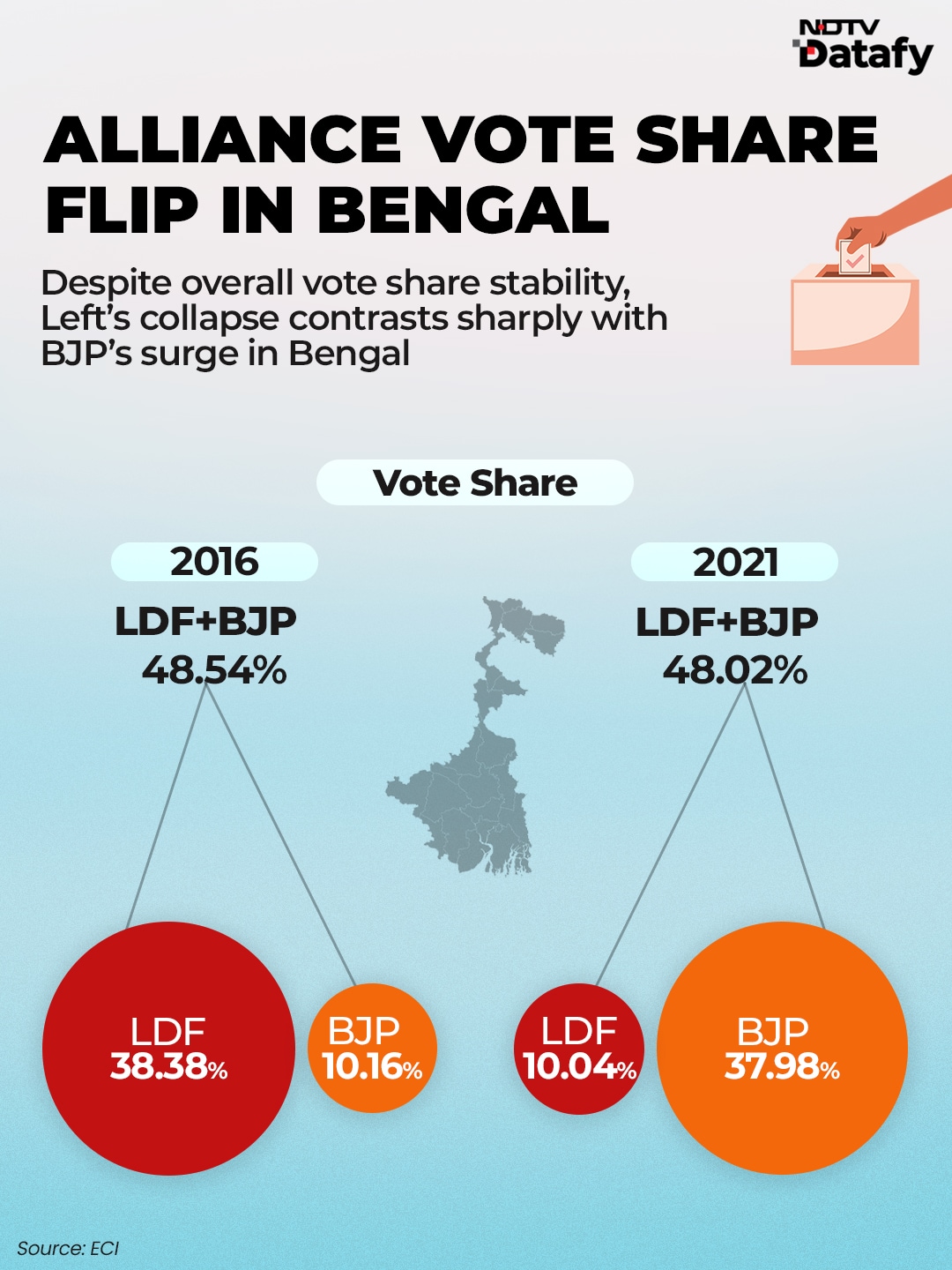
The Left started by grooming its constituency within the Borgadaras, the share croppers from 1978-80, which remained with the party right until 2017, from whence the BJP started picking up threads. The Jangal Mahal region (Paschim Medinipur, Bankura, Purulia) in West Bengal, the most underdeveloped, has been crucial to the BJP's rise, with a large focus on ST groups, and then the border regions, where the BJP draws a bulk of its support from the Matua's (SCs).
Similarly, in Kerala, one of the most celebrated victories of the BJP is in the Thiruvananthapuram Municipal Corporation in December 2025. The party unseated the 40-year monopoly of the Left, clearly indicating a direct switch between the same set of voters.
One of the lesser publicised facts of the 2024 elections in Kerala was a tangible growth of the BJP, post January 2024. The party forfeited its deposit only in 6 of the 16 Lok Sabha seats it contested . Across the state, the BJP grew by reducing the Left to rubble.
Here's a flashback: The 2021 success of the LDF in beating anti-incumbency with a sizable 6 per cent lead over the votes of the UDF. The success was based on a consolidation of minority votes in addition to Hindu votes. In the 2024 general election, the Left saw a serious erosion in its vote share, polling just 33.6 per cent votes, a drop of 45.43 per cent from the 2021 assembly election that resulted in a rout across the state.
The vote swap dataset is as follows:
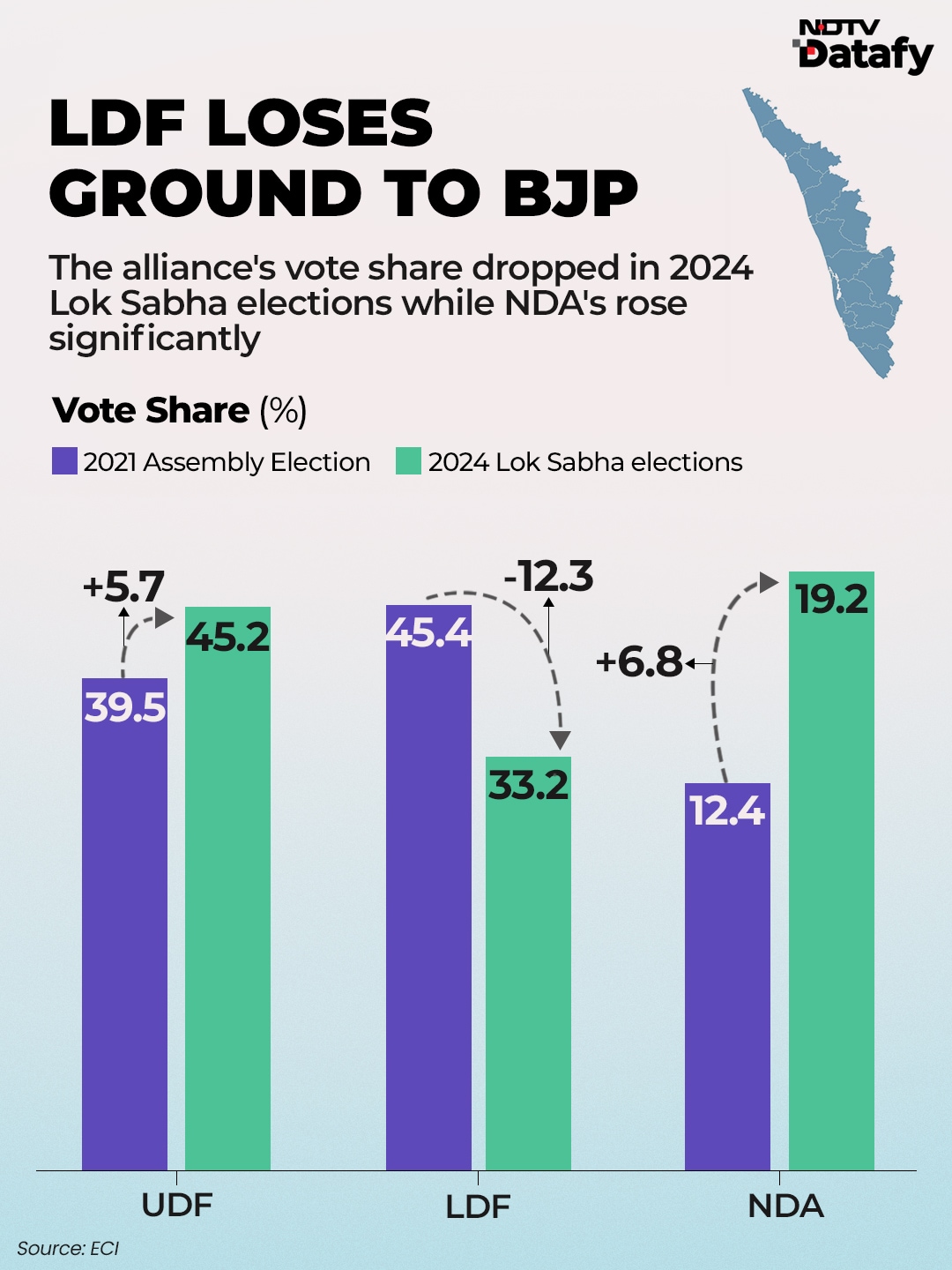
Given the sizable minority population in Kerala, all the loss of the Left does not translate to the gain of the BJP. The gain or loss is complementary. A survey conducted by VMR for MMTV across all 20 seats in Kerala in 2024. It showed the support for the BJP rose from 18 per cent to 27 per cent among the Hindus between the two Lok Sabha elections in 2019 and 2024.
For every three Hindu voters who voted for the LDF , two Hindu voters voted for the NDA in the 2024 Lok Sabha elections.
HOW SHIFTING LOYALTIES OF ASPIRATIONAL GROUPS WORK
The Left Front does include various societal groups, having built a rainbow of Hindu support from dominant backward classes in Kerala led by the LDF. Ezhavas and other SC are the social groups among whom the LF has a primary support base.
The vote share of the LDF amongst the Ezhava Hindus, as estimated in a poll conducted by VMR during the 2024 Lok Sabha elections. Within the Hindus the Left Front's vote share is highest among the OBC's (54.57 per cent) amongst OBC. Similarly, the LF has the highest vote share among the SC (with a support level pegged at 56 per cent).
According to an opinion poll conducted in West Bengal recently, amongst the ST the BJP has the largest support at 51 per cent, and even among the Matua, the dominant SC community, it has the largest vote share of 43 per cent followed by 39 per cent, supporting the Trinamool Congress.
Clearly, it is the rise of the aspirational Hindu class that has always been the bulwark of the BJP and the Left in the respective states in their growth phases.
SIMILAR ADVENTURES AND PURSUITS
The post-election surveys held by the Delhi-based Centre for the Study of the Developing Societies (CSDS) in the 2011 and 2016 Kerala assembly elections illustrate that the Left Front commanded only 25 per cent to 35 per cent votes of both religious minorities even after forming electoral alliances with parties based on minority groups. One of the most pragmatic solutions for the Left was to build relationships with breakaway factions of the Muslim League (Indian National League) and build bridges with splinter factions of the Kerala Congress, which represented support of various Christian denominations. The stupendous success of the Left beating anti-incumbency in 2021 in Kerala also includes a fair share of Christian voters brought to its fold by the Kerala Congress (Mani) faction.

One of the last minute surprises in the 2024 Union Cabinet formation was George Kurian, a Christian, as a part of the BJP representation from Kerala in the Union government. It was the BJP addressing a "fill in the blank" for its growth in Kerala. The BJP co-opted various Christian leaders into its fold especially on the plank of "love Jihad" to create its own coalition of Hindu and Christian voters much alike the Left by inducting prominent Christian leaders into its fold. In April 2021, George publicly demanded that India be declared a Hindu Rashtra, to protect Hindus and adherents of other Indic religions.
Clearly, the Left and the BJP though ideologically diverse end up cultivating the same set of voters, and their growth is complementary across the states. The goal of a Congress-mukt Bharat, for the BJP, passes through a Left-mukt navigation more than a Congress-mukt navigation, in the Left leaning states.
(The author is co-founder of VMR [Votersmood Research] and founder of M76 Analytics. You can follow him @JMAI799249 on X)
Disclaimer: These are the personal opinions of the author

