




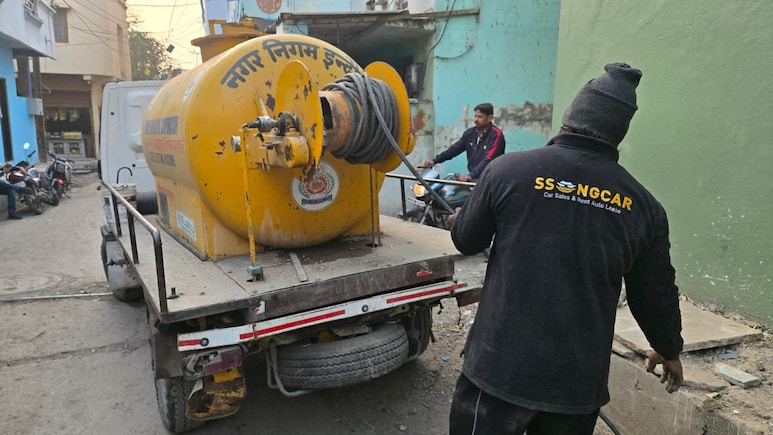
Indore, Gandhinagar and Bengaluru often feature at the top of India's urban success stories. Indore has been repeatedly crowned the 'cleanest' city under the Swachh Survekshan rankings. The twin cities of Gandhinagar and Ahmedabad are projected as planned, green and well-governed urban centres, with Gandhinagar set to host the Commonwealth Games in 2030. At the Swachh Survekshan 2024-25 awards in July 2025, Ahmedabad was declared India's cleanest 'big city' (million-plus population category), while Gandhinagar topped the 'Super Swachh League' (3-10 lakh population).
Bengaluru, despite its chronic challenges, continues to be branded India's technology hub and boasts one of the highest municipal revenues in the country.
Yet beneath these impressive labels lies a disturbing and deadly reality: contaminated drinking water caused by the mixing of water supply and sewage pipelines. Cracks develop, sewer lines overflow, and contamination becomes inevitable. These incidents now occur even outside the monsoon season. That severe water contamination continues to recur with increasing frequency in major Indian cities is nothing short of deplorable.
The recent loss of lives in Indore, the outbreak of typhoid in Gandhinagar, and widespread illness linked to water contamination in Bengaluru expose a deep systemic failure-one that forces us to question what 'clean' and 'well-managed' truly mean in India's urban governance vocabulary.
So-called 'Clean' Cities
On Tuesday (January 6), the Madhya Pradesh government confirmed at least eight deaths before the High Court. According to reports, 310 patients from Indore's Bhagirathpura area have been admitted to hospitals since December 24.
In Gandhinagar, a sudden surge in typhoid cases has been reported across several localities. Health authorities confirmed 85 active cases, with a total of 144 cases registered as of January 7. Anticipating an influx of young patients, Gandhinagar Civil Hospital opened a 30-bed paediatric ward to treat children suffering from high fever, vomiting and gastrointestinal symptoms. Contaminated water has been identified as the primary cause.
In Bengaluru, households in KSFC Layout, Lingarajapuram, have been forced to arrange private water supplies for over a week due to contaminated tap water. Residents reported gastrointestinal issues, vomiting and diarrhoea for months, but the scale of contamination became evident only recently.
At its core, access to safe drinking water is neither a luxury nor an aspirational goal; it is a constitutional and moral obligation of the state. Article 21 of the Indian Constitution, as interpreted by the Supreme Court, includes the right to clean water as intrinsic to the right to life. When people fall seriously ill or die because sewage enters drinking water pipelines, it is not an accident - it is a failure of governance, planning, maintenance and accountability.
The tragedy in Indore is particularly stark given the city's reputation. Its cleanliness rankings focus largely on solid waste management, visible sanitation and behavioural campaigns such as segregation and public toilets. Water infrastructure, by contrast, remains largely invisible - buried underground and ignored until it fails catastrophically.
Gandhinagar's typhoid outbreak reveals a similar contradiction. Officials have admitted that the problem did not stem from ageing pipelines but from newly laid ones placed dangerously close to existing sewer lines. When high-pressure water began flowing, weak pipes developed leaks, allowing contamination. This represents gross dereliction of public duty and safety, and those responsible must be held accountable.
Planned cities are often assumed to be safer, but planning without sustained maintenance is meaningless. Preventive and breakdown maintenance are well-established concepts in urban management. Yet preventive maintenance, in practice, remains confined to paper.
Bengaluru's experience highlights another dimension: fragmented governance. Multiple agencies manage water supply, sewage, stormwater drains and roadworks. When one agency damages pipelines during excavation, another is tasked with repairs, while a third monitors water quality - often resulting in no one being held responsible. During monsoons, overflowing drains and flooded streets further exacerbate contamination risks. For a city that projects itself as a global technology hub, residents routinely boil water or rely on expensive private tankers - an irony bordering on the absurd.
Why this is alarming
Around 70% of India's surface water is unfit for consumption. Major rivers are heavily polluted by sewage and industrial waste, while groundwater is contaminated by naturally occurring elements such as arsenic and fluoride. Millions are affected, imposing severe health and economic costs and placing immense pressure on limited freshwater resources.
As policymakers focus on universal access to potable water, these recurring tragedies serve as a reminder that coverage alone is not the problem. Even cities with long-established piped water networks cannot guarantee water free from dangerous contamination.
What makes these failures especially troubling is that they occur in cities with higher revenues, stronger administrative capacity and greater civic awareness than smaller towns. If Indore, Gandhinagar and Bengaluru cannot ensure safe drinking water, conditions in less visible cities and peri-urban areas are likely far worse. This exposes a structural bias in India's urban governance: prioritising rankings, optics and infrastructure announcements over mundane but critical systems such as pipeline integrity, routine water testing and preventive maintenance.
It also reflects the challenge of meeting basic needs as rapid urbanisation pushes more people into congested cities, placing immense strain on ageing water and drainage infrastructure.
Wide Impact
There is a stark social dimension to this crisis. Water contamination disproportionately affects children, the elderly and the poor. Middle-class households may install filters or purchase bottled water, but low-income families depend entirely on municipal supply. When contamination occurs, it quickly becomes a public health emergency with long-term consequences - missed school days, medical expenses, malnutrition and, in extreme cases, death. These costs never appear in cleanliness rankings or GDP figures, yet they steadily erode public trust and deepen inequality.
Accountability remains the weakest link. Investigations are announced, compensation promised, and officials suspended or transferred. Systemic reform, however, rarely follows. There is little transparency around water quality reports, pipeline audits or the frequency of contamination incidents. Citizens often learn of contamination only after hospitals report spikes in waterborne diseases. A truly 'clean' city would proactively publish real-time water quality data and issue immediate alerts, much like air quality warnings.
India's urban future depends on addressing this blindspot. Investment must shift from surface-level sanitation to underground infrastructure - modernising pipelines, separating sewage and water networks, installing pressure-management systems, and deploying sensors to detect contamination early. Regular third-party audits and community-level monitoring should be mandatory, not optional. Above all, water safety must be treated as a public health priority, not merely an engineering concern.
The deaths in Indore and the illnesses in Gandhinagar and Bengaluru are not isolated incidents; they are warning signs. Clean streets and awards cannot compensate for poisoned taps. Until Indian cities redefine cleanliness to include safe, reliable drinking water, urban success will remain a hollow promise - one that costs lives rather than improving them.
(The author is Contributing Editor, NDTV)
Disclaimer: These are the personal opinions of the author

